The Government of India is scaling up action on industrial decarbonisation and climate targets with a focus upon Carbon Capture and Utilisation (CCU).
About Carbon Capture and Utilisation (CCU)
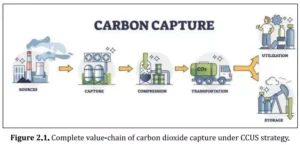
- Carbon Capture and Utilisation (CCU) refers to a set of technologies that capture carbon dioxide emissions from industrial sources or directly from the air and convert them into useful products.
- This process removes carbon from the atmosphere and puts it into the economy as inputs for fuels, chemicals, building materials, or polymers.
Why Does India Need CCU?
- High Emissions Profile: India is the world’s third-largest CO₂ emitter, with major emissions from power, cement, steel, and chemical sectors.
- Hard-to-Abate Industries: Sectors like cement and steel involve process emissions that cannot be eliminated solely through renewable energy.
- For Example: Cement manufacturing alone contributes around 7–8% of global CO₂ emissions.
- Limits of Renewables Alone: While renewable energy reduces future emissions, it cannot fully address existing industrial carbon intensity.
- Industrial Decarbonisation Tool: CCU provides a practical pathway to cut emissions from carbon-intensive industries.
- Economic Opportunity: Captured CO₂ can be converted into fuels, chemicals, and building materials, creating new value chains.
- Alignment with Climate Goals: Supports India’s net-zero target of 2070 and transition towards a circular, low-carbon economy.
India’s Initiatives in Carbon Capture, Utilisation and Storage (CCUS)
- Government R&D Support: The Department of Science and Technology (DST) is funding CCU research and has developed a dedicated R&D roadmap for carbon utilisation technologies.
- Policy Roadmap (2030): The Ministry of Petroleum and Natural Gas has released a Draft 2030 CCUS Roadmap, identifying priority sectors and pilot projects for large-scale deployment.
- Encouragement to the Private Sector:
- Ambuja Cements (Adani Group): In collaboration with IIT Bombay under an Indo-Swedish partnership, it is piloting technology to convert captured CO₂ into fuels and value-added materials.
- JK Cement Initiative: Developing a CCU testbed to capture CO₂ for producing lightweight concrete blocks and chemicals such as olefins.
- Bio-CCU Innovation (ORSL): Organic Recycling Systems Limited (ORSL) is leading India’s first pilot-scale Bio-CCU platform, converting CO₂ from biogas streams into bio-alcohols and specialty chemicals.
Global Initiatives in Carbon Capture and Utilisation (CCU)
- European Union (EU): The EU Bioeconomy Strategy and Circular Economy Action Plan explicitly supports CCU as a way to turn CO₂ into feedstocks for chemicals, fuels, and materials, linking it to circularity and sustainability targets
- Belgium: ArcelorMittal, in partnership with Mitsubishi Heavy Industries and climate-tech firm D-CRBN, is piloting technology at its Gent plant to convert captured CO₂ into carbon monoxide for use in steel and chemical production.
- United States: The U.S. uses a combination of tax credits and funding to scale CCUs, particularly for CO₂-derived fuels and chemicals.
- United Arab Emirates (UAE): The UAE’s Al Reyadah project and planned CO₂-to-chemicals hubs leverage CCU with green hydrogen.
Challenges
- Cost Competitiveness Challenge: Capturing, purifying, and converting CO₂ is energy-intensive and expensive, making CCU-derived products less competitive than cheaper fossil-based alternatives without policy incentives.
- Infrastructure Gaps: CCU requires co-located industrial clusters, reliable transport of CO₂, and integration with downstream manufacturing, all of which are unevenly developed across Indian industrial regions.
- Regulatory and Market Uncertainty: The absence of clear standards, certification, and market signals creates uncertainty for investors and limits demand for CO₂-derived products.
Difference Between Carbon Capture and Storage (CCS) and Carbon Capture and Utilisation (CCU)
| Basis |
Carbon Capture and Storage (CCS) |
Carbon Capture and Utilisation (CCU) |
| Meaning |
Captured CO₂ is permanently stored underground to prevent its release into the atmosphere. |
Captured CO₂ is converted into useful products instead of being stored. |
| Objective |
Long-term emission reduction through geological sequestration. |
Emission reduction plus value creation through reuse of CO₂. |
| End Use of CO₂ |
Injected into deep saline aquifers, depleted oil & gas fields. |
Converted into fuels, chemicals, building materials, polymers. |
| Economic Output |
Limited direct revenue (except enhanced oil recovery). |
Generates commercial products and new value chains. |
| Example – India |
Proposed CO₂ storage in depleted oil fields under the Draft 2030 CCUS Roadmap by the Ministry of Petroleum & Natural Gas. |
Ambuja Cements’ pilot project converting captured CO₂ into fuels and materials with IIT Bombay. |
| Global Example |
Sleipner CCS Project (Norway) stores CO₂ under the North Sea seabed. |
ArcelorMittal (Belgium) converting captured CO₂ into carbon monoxide for steel production. |
| Long-term Impact |
Focused purely on climate mitigation. |
Combines climate mitigation with circular economy goals. |
Way Forward
- Integrate with Green Hydrogen Mission: Link CCU with India’s National Green Hydrogen Mission to produce synthetic fuels (e-methanol, e-kerosene), similar to UAE’s CO₂-to-chemicals hubs
- Create Standards & Certification: Develop clear carbon accounting standards through the Bureau of Indian Standards (BIS) to certify CO₂-derived building materials and chemicals, improving investor confidence.
- Enhance R&D Funding : Expand Department of Science and Technology (DST) grants for low-energy capture technologies and carbon-to-value pathways.


 26 Feb 2026






.png)






 Current Affairs




 GS Foundation
 Optional Course
 Combo Courses
 Degree Program