The Union Budget 2026-27 proposes to build a ‘strong care ecosystem’ by training 1.5 lakh multiskilled caregivers in geriatric, core care and allied skills under National Skills Qualification Framework (NSQF).
- However, it overlooks over 5 million women workers—including ASHA and Anganwadi workers—who sustain India’s welfare system but remain classified as “volunteers” rather than formal employees.
About the National Skills Qualification Framework (NSQF)
- Definition: The National Skills Qualification Framework (NSQF) is a competency-based framework that organizes qualifications according to levels of knowledge, skills, and aptitude.
- Launch: It was notified in 2013 by the Government of India to integrate vocational education, skill training, and formal education into a unified national structure.
- Structure: The framework consists of 10 levels, ranging from basic skill certification to advanced professional competencies, enabling vertical and horizontal mobility across education and training pathways.
- Institutional Mechanism: It is implemented by the National Skill Development Agency under the Ministry of Skill Development and Entrepreneurship.
- Key Objectives: To ensure standardisation of skills, promote Recognition of Prior Learning (RPL), and enhance employability through nationally recognised qualifications.
|
About the Care Economy
- Definition: The Care Economy comprises economic activities and services that address the physical, emotional, and social needs of individuals—particularly children, the elderly, the sick, and persons with disabilities—and is increasingly recognised as a critical pillar of human development and social protection.
- Paid Care Work: Includes formal and remunerated services delivered by professionals such as doctors, nurses, caregivers, childcare providers, and domestic workers within the health, education, and social welfare sectors.
- Unpaid Care Work: Refers to non-remunerated caregiving and domestic tasks, largely performed by women within households, such as childcare, elder care, cooking, and household management, which remain largely invisible in GDP calculations and national accounting systems.
- The Indian Model of Care Provision: India has historically relied on a community-based “volunteer” model to deliver welfare services through workers such as Accredited Social Health Activists (ASHAs) and Anganwadi Workers (AWWs) under programmes like Integrated Child Development Services and National Health Mission.
- While this approach enabled large-scale grassroots service delivery at low fiscal cost, it has also institutionalised the undervaluation and informalisation of care labour by treating it as social duty rather than professional work.
| ASHA and Anganwadi Workers in India |
| Aspect |
ASHA Workers |
Anganwadi Workers |
| Programme |
- Accredited Social Health Activist programme
|
- Integrated Child Development Services
|
| Launch & Ministry |
- Launched in 2005 under the National Health Mission
|
- Launched in 1975 under the Ministry of Women and Child Development
|
| Primary Role |
- Community health activist linking public health system with rural communities
|
- Deliver nutrition, early childhood care, and preschool education
|
| Key Functions |
- Promote immunisation, maternal & child health, institutional deliveries, health awareness
|
- Provide supplementary nutrition, growth monitoring, preschool education, support immunisation
|
| Target Beneficiaries |
- Pregnant women, newborns, children, and rural households
|
- Children (0–6 years), pregnant women, lactating mothers
|
| Nature of Employment |
- Treated as voluntary workers receiving incentives/honorariums
|
- Treated as honorary workers receiving honorariums
|
| Significance |
- Ensure last-mile delivery of healthcare services
|
- Form the backbone of child nutrition and early childhood development programmes
|
About Female Labour Force Participation Rate (FLFPR)
- Refers: The Female Labour Force Participation Rate (LFPR) measures the proportion of women who are either employed or actively seeking employment within a specific population.
- Historically, India’s FLFPR saw a steady decline from 2004-05. However, recent years have marked a significant structural shift.
- Recent Data and Trends: According to the latest Monthly Bulletin of the Periodic Labour Force Survey (PLFS) and the Economic Survey 2025-26:
- National FLFPR: As of January 2026, the Female LFPR stands at 35.1% (for ages 15 and above).
- Rural vs. Urban: Rural Female LFPR: 39.7% (driven by agricultural engagement).
- Urban Female LFPR: 25.5% (reflecting a persistent urban gap).
- Historical Leap: While participation was just 23.3% in 2017-18, it climbed to 37.0% in 2022-23 and reached a yearly peak of 35.3% in December 2025.
- The “Feminization” of Agriculture: The rise in female participation is heavily linked to a shift in the rural economy:
- Agricultural Share: According to PLFS 2022-23 and reinforced by 2025 trends, the share of women in the agricultural sector has increased significantly, with over 64% of working women now engaged in this sector.
- Self-Employment: This growth is primarily driven by self-employment (as own-account workers or helpers in family enterprises), which accounts for nearly 63.2% of rural female employment.
|
Key Statistics on the Care Economy in India
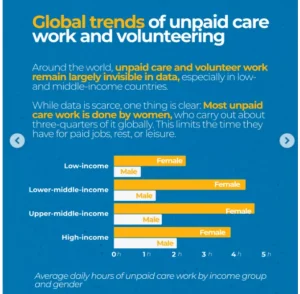
- Time Use Disparity: According to the 2024 Time Use Survey conducted by the National Sample Survey Office, Indian women aged 15-59 spend an average of 140 minutes per day on unpaid caregiving, whereas men in the same age group contribute only 74 minutes.
- Workforce Scale: India’s frontline health and nutrition programs are managed by approximately 10.4 lakh (1.04 million) ASHA workers and over 25 lakh (2.5 million) Anganwadi Workers and Helpers.
- Economic Contribution: Research suggests that if unpaid care work were assigned a monetary value based on minimum wages, it would contribute roughly 15% to 20% of India’s Gross Domestic Product (GDP).
Methods to estimate the monetary value of unpaid household activities:
- Opportunity Cost Method (GOC): This approach calculates the value of unpaid labour by considering the monetary benefits individuals forgo when engaging in unpaid household work instead of paid activities.
- Essentially, it estimates what individuals could have earned if they spent that time working in a paid capacity.
- Replacement Cost Method (RCM): This method calculates how much it would cost to hire someone to do unpaid household tasks.
- It estimates the value of unpaid work by determining the expenses society would incur if those tasks were performed by paid workers.
|
Need for a Robust Care Economy
- Demographic Transition: India is witnessing an increase in its elderly population. A formal care economy is essential to provide specialized Geriatric Care (care for the elderly) as traditional joint family structures evolve into nuclear units.
- 12% of India’s population comprises elderly individuals, a proportion projected to rise to 319 million by 2050.
- Unlocking Female Labour Force Participation (FLFP): By providing affordable, institutional childcare through Creches, the state can reduce the “double burden” of domestic work on women, allowing them to join the formal workforce—a vital component for national economic growth.
- Human Capital Investment: High-quality intervention in Early Childhood Care and Education (ECCE) ensures that the next generation is healthier and more productive, leading to long-term national development and a more capable workforce.
Legal and Policy Framework of India’s Care Economy
The governance of the care economy in India is rooted in the Constitution, supported by labor laws, and delivered through massive social welfare programs. These provisions ensure that caregiving is not just a private duty but a public priority.
- The Constitutional Foundation: The Constitution acts as the “parent law,” ensuring that women and care workers are treated with fairness and dignity.
- Right to Equality (Articles 14 & 15): These articles protect against unfair treatment. Article 14 ensures the law treats everyone equally at work, while Article 15 bans keeping someone out of a job just because of their gender.
- Fair Access to Jobs (Article 16): This guarantees that women have the same right as men to seek government employment, receive promotions, and claim work benefits.
- Directive Principles (Article 39): These are goals the government must follow:
- Equal Livelihood (39a): Men and women must have a fair way to earn a living.
- Equal Pay (39d): This is the “Equal Pay for Equal Work” rule, essential for closing the gender wage gap.
- Health and Safety (39e): The state must protect the health of workers and ensure nobody is forced into dangerous jobs due to poverty.
- Workplace Welfare (Article 42): This requires the state to provide humane working conditions and maternity relief for pregnant workers.
- Labor Laws for Worker Protection: These laws provide the legal teeth to protect people working in the formal care sector.
- Maternity Benefit Act (2017): This law provides 26 weeks of paid leave for women for their first two children. It also includes a “Work from Home” option if the job allows for it.
- Code on Social Security (2020): This is a new law designed to help the unorganized sector. It brings gig workers and home-based workers (like domestic help) under a safety net for insurance and maternity benefits for the first time.
- Institutional Frameworks for Frontline Care: The Indian model relies on a vast network of workers who deliver care directly to the doorstep.
- Integrated Child Development Services (ICDS): This manages the Anganwadi system. These workers are the main providers of child nutrition and early schooling in rural India.
- National Health Mission (NHM): This empowers ASHA workers. Although called “volunteers,” they are the primary providers of maternal and newborn health care in villages.
- Mission Shakti (Palna Scheme): This plan sets up creches (day-care centers) to help working mothers by providing a safe place for their children during work hours.
- Rights of the Elderly and Disabled: Special laws ensure that the most vulnerable members of society receive proper care.
- Senior Citizens Act (2007): This makes it a legal duty for children to provide for their parents. It also mandates that the government build old-age homes in every district.
- Rights of Persons with Disabilities Act (2016): This shifted the focus from “charity” to “rights.” It covers 21 types of disabilities and mandates equal opportunity and accessibility (like ramps in public buildings).
- Evolving Policy: Counting the “Invisible”: The government is now moving toward measuring the actual economic value of care.
- Time Use Survey (TUS): Conducted by the National Statistical Office (NSO), this tracks the hours women spend on unpaid chores.
- This data is used to prove that care work contributes nearly 15% to 20% of India’s GDP and should be part of the official national accounts.
|
Challenges & Concerns that need to be Tackled
- The ‘Volunteer’ Paradox and Labor Injustice: India’s welfare architecture relies on a massive workforce that is legally “invisible.”
- Status vs. Skill: Approximately 3.5 million ASHA and Anganwadi workers are designated as “volunteers” or “honorary workers.”
- This label dismisses their highly skilled medical and educational work as “social service,” preventing them from being recognized as formal workers.
- The Honorarium Gap: Instead of a legal Minimum Wage, these workers receive small “honorariums.”
- In 2024–25, protests revealed that many ASHAs earn as little as ₹2,000–₹3,500 in fixed incentives monthly, which is far below the cost of living.
- Security Deficit: Because they aren’t “employees,” they are excluded from Employees’ Provident Fund (EPF), paid maternity leave, and pension schemes, leaving them financially stranded in old age.
- Invisibility and the “Care Penalty”: Care work is frequently uncounted in economic planning because it does not generate a direct bill or receipt.
- GDP Exclusion: A homemaker working 10–12 hours daily contributes to national stability and human capital, yet this labor is absent from GDP calculations.
- Gendered Time Poverty: According to the 2019 Time Use Survey, Indian women spend 16.4% of their day on unpaid domestic work, while men spend just 1.7%.
- This disparity creates “time poverty,” where women have no time left for self-care, education, or career growth.
- Social Norms: Care is often viewed as a “natural female trait” rather than a technical profession.
- This leads to the “Care Penalty,” where even professional care roles are low-paid because they are seen as an extension of household chores.
- Infrastructure and Investment Gaps: The lack of physical care facilities forces the burden back onto the individual household.
- The Childcare Crisis: Inadequate crèches and overstretched Anganwadi centers force many women to exit the Female Labour Force Participation (FLFP) pool.
 The Aging Population: India’s demographic shift means the country requires an estimated $4.8–$8.4 billion investment by 2030 in senior living and geriatric infrastructure to meet rising demand.
- Mental Health Neglect: Chronic underinvestment in mental health infrastructure undermines general workforce productivity and social resilience.
- Policy Inconsistency and Measurement Deficits: There is a disconnect between new government goals and the treatment of existing workers.
- The Skilling Gap: While the Union Budget 2026-27 focuses on training a new cadre of caregivers, it fails to provide a “Bridge Course” or pathway for existing workers (like ASHAs) to get NSQF certifications and higher pay.
- Data Infrequency: While the Time Use Survey was a milestone, such data collection is infrequent.
- Without regular, gender-disaggregated data, care work remains a “blind spot” in economic planning.
- Fiscal Neglect: While the Gender Budget rose to 8.86% in FY 2025–26, critics argue this is largely due to better “re-classification” of old schemes rather than fresh, targeted spending on the Purple Economy.
- The Legal Vacuum: India currently lacks a dedicated national policy that treats care as a public good.
- Judicial Recognition vs. Legislative Silence: High Courts (such as Madras and Delhi) have begun recognizing a homemaker’s non-financial contribution as vital to family assets.
- In Kannaian Naidu vs Kamsala Ammal (2023), the court held that household labor entitles women to an equal share of property.
- Lack of Statutes: Despite these court rulings, there is no federal law that mandates social security or pensions for unpaid caregivers, leaving them without a safety net.
|
Comparison of Employment Benefits: Formal Sector vs. ‘Volunteer’ Care Workers
|
| Feature |
- Formal Sector Employee (e.g., Nurse/Teacher)
|
- ‘Volunteer’ Care Worker (ASHA/Anganwadi)
|
| Legal Status |
- Recognized as a ‘Worker’ under Labor Laws.
|
- Classified as ‘Honorary’ or ‘Volunteer’.
|
| Primary Pay |
- Fixed Monthly Salary (above Minimum Wage).
|
- Honorarium (often below Minimum Wage).
|
| Service Continuity |
- Permanent or Fixed-term Contracts.
|
- At-will or temporary nature (though work is permanent).
|
| Maternity Benefits |
- 26 weeks of paid leave (Maternity Benefit Act).
|
- No uniform policy; depends on state-specific mercy.
|
| Retirement |
- Provident Fund (PF) and Gratuity.
|
- No formal pension; only voluntary contributory schemes.
|
| Working Hours |
- Defined 8-hour shifts with Overtime Pay.
|
- Undefined hours; often on-call 24/7 for emergencies.
|
| Career Growth |
- Clear Promotions and pay increments.
|
- Stagnant roles with no formal promotion path.
|
Initiatives Taken by India
- National Skills Qualification Framework (NSQF): The government is currently aligning caregiver training with national standards to standardize and professionalize the sector.
- Mission Shakti (Palna Scheme): This initiative focuses on setting up Anganwadi-cum-Creches to provide safe, state-supported environments for children while mothers engage in formal employment.
- Pradhan Mantri Shram Yogi Maandhan (PM-SYM): A voluntary and contributory pension scheme intended to provide old-age protection for unorganized workers, including those in the care sector.
- Ayushman Bharat Extension: The government recently extended health insurance coverage under the Pradhan Mantri Jan Arogya Yojana (PM-JAY) to all ASHA workers, Anganwadi workers, and helpers.
Global Best Practices & Global Initiatives
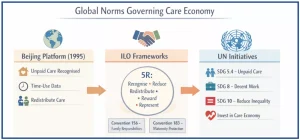
- The Global Foundation- Beijing Platform for Action (1995): This was the first major international agreement to label unpaid domestic work as a serious economic issue.
- Making Work Visible: It pushed countries to use Time-Use Surveys to track how much work women do for free at home.
- Sharing the Load: It introduced the idea that care shouldn’t just be a “woman’s job.” Instead, it should be shared between men and women, and supported by the government and the market.
- The International Labour Organization (ILO) Standards: The ILO treats caregiving as a professional and productive activity that deserves legal protection.
- The “5R” Roadmap: This is the gold standard for fixing the care economy:
- Recognize: Count unpaid work in national statistics.
- Reduce: Use technology and infrastructure to make chores easier.
- Redistribute: Shift the burden from women to the state and men.
- Reward: Ensure fair pay and benefits for professional caregivers.
- Represent: Allow care workers to join unions and have a voice.
- Convention No. 156 (Family Responsibilities): Protects workers from being fired or treated poorly just because they have to care for a child or elderly parent.
- Convention No. 183 (Maternity Protection): Guarantees that pregnant workers get time off, health care, and job security. It teaches that raising the next generation is a society-wide duty, not just a private problem.
- United Nations (UN) Initiatives: The UN views the care economy as a bridge to Gender Equality and Economic Growth.
- The Sustainable Development Goals (SDGs):
- SDG 5.4: Specifically calls for valuing unpaid work through better public services and social laws.
- SDG 8 & 10: Focus on creating “decent jobs” in the care sector and reducing the gap between the rich and poor caused by “care poverty.”
- Women’s Empowerment Panel: This group identified that unpaid labor is the #1 “brick wall” stopping women from joining the workforce. They suggest that spending money on care services is a smart growth strategy for any country.
- UN Women: Advocates for Care-Sensitive Budgeting, which means the government must specifically set aside money for things like nurseries and elderly centers.
- Successful Global Models: Different countries use different “recipes” to manage their care needs effectively.
- The Nordic Model (Norway & Denmark): These countries treat care as a Public Good, like clean water or roads.
- They use tax money to provide top-quality childcare and elderly care for everyone. This results in some of the highest female employment rates in the world.
- The French “Voucher” System (CESU): France uses a system called CESU that makes it easy for families to hire home help.
- The government tracks these “vouchers” to make sure the workers get their pension and health insurance, preventing the “informal” or hidden work trap.
Global Care Chain:
- The Global Care Chain refers to a system in which caregiving responsibilities are passed from one woman to another, often crossing borders and varying socio-economic strata.
- This phenomenon emerges as women from more privileged communities increasingly enter the workforce, creating a “care gap” that is frequently filled by migrant women and those from marginalized backgrounds.
- As a result, women at the bottom of the socio-economic ladder are the most vulnerable and remain at the bottom of the chain.
SDG 5 – Gender Equality:
- United Nations Sustainable Development Goal 5 seeks to achieve gender equality and women’s empowerment.
- Target 5.4 specifically calls for the recognition and valuation of unpaid care and domestic work through public services, social protection, and supportive policies, while promoting shared household responsibilities, particularly in low- and middle-income countries by 2030.
|
Way Forward
- Formal Recognition and Professional Dignity: The first step is to stop calling professional health and nutrition services “volunteering.”
- From “Honorariums” to Salaries: We must replace small “thank you” payments with a National Floor Minimum Wage. This ensures every worker has enough to live on.
- Legal Worker Status: Frontline staff should be made permanent employees.
- This is backed by the 2025 Supreme Court ruling (Dharam Singh vs State of U.P.), which stated that if the government needs a job done continuously, it cannot keep that worker “temporary” forever.
- Counting the Invisible: Governments must use Time Use Surveys and “Satellite Accounts” to put a price tag on unpaid chores. As the Beijing Platform for Action suggests: if you don’t measure it, you won’t budget for it.
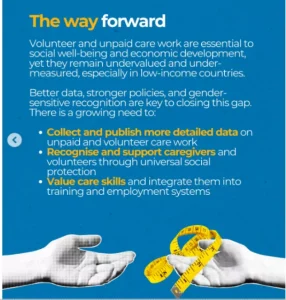 Skilling and Career Growth: Instead of just hiring new people, we should help the millions of women already doing the work to move up.
-
- The “Bridge” Approach: Current ASHAs and Anganwadi workers should get Bridge Courses and Recognition of Prior Learning (RPL) certifications.
- This allows their years of experience to count as a professional degree, letting them move into higher-paying specialized roles.
- Mobility: Creating a clear “career ladder” turns a dead-end “volunteer” role into a lifelong professional path.
- Care as “Hard” Infrastructure: We need to change how we think about the money spent on care. It isn’t “welfare”; it’s an investment in the economy.
- Core Infrastructure: We should fund childcare centers, eldercare, and disability support with the same urgency as we build roads or power plants.
- Care-Sensitive Budgeting: Public budgets should specifically show how much is being spent on care and how it helps women. This aligns with UN Women strategies to boost economic productivity.
- Redistribution- Sharing the Load: Care work is a shared societal duty, not a “women-only” burden.
- Sharing with Men: Policies like paid parental leave for both parents and flexible work hours help men take an equal role at home.
- Sharing with the State: Expanding the Mission Shakti (Palna) scheme for affordable creches allows women to stay in the workforce, helping India reach its Viksit Bharat 2047 goals. This is a core part of SDG 5.4.
- Resilience and Protection: The care system must be strong enough to handle modern-day shocks.
- Safety Nets: Every care worker—including domestic help—needs social security, health insurance, and pension plans to protect them as they age.
- Climate and Crisis Planning: When a pandemic or a climate disaster hits, the burden of care at home sky-rockets. We must build public care systems that can absorb these shocks so women aren’t forced to quit their jobs to take care of family during crises.
Conclusion
Recognising care work is essential not only for better welfare delivery but also for transforming unequal gender relations in society. Unless unpaid and underpaid care labour is acknowledged, reduced, redistributed, and rewarded, substantive gender equality in India will remain incomplete.


 9 Mar 2026








.png)






 Current Affairs




 GS Foundation
 Optional Course
 Combo Courses
 Degree Program