Recently, the Central Armed Police Forces (General Administration) Bill, 2026, was introduced in the Rajya Sabha.
- It seeks to standardise officer-related provisions across CAPFs, ensuring legislative clarity, operational autonomy, and alignment with judicial and federal requirements.
About the Central Armed Police Forces (CAPF) Bill, 2026
- Maintaining IPS Presence in Leadership: The Bill seeks to ensure continued presence of IPS officers in senior leadership roles, reflecting the government’s preference for administrative experience and inter-agency coordination.
- Providing a Unified Legal Framework: The government presents the Bill as an “umbrella legislation” aimed at providing clarity and uniformity in recruitment, service conditions, and cadre management of Group A officers across CAPFs.
- Legislative Override of Judicial Directions: By incorporating provisions that operate notwithstanding judicial rulings, the Bill effectively attempts to redefine the implementation of the Supreme Court’s directives, raising questions about institutional balance.
Evolution of the Conflict: Institutional Context and Judicial Turning Point
- Historical Context: The Central Armed Police Forces form the backbone of India’s security architecture.
- Historically, these forces have functioned under a dual-control model.
- While the internal cadre performs the ground operations, senior leadership positions—at the rank of Deputy Inspector General and above—have been predominantly drawn from the Indian Police Service through deputation.
- The government has traditionally justified this by citing the need for broad administrative experience and seamless coordination between the Central and State governments.
- Persistent Grievances and the Struggle for Service Status: Over decades, this institutionalized dominance of the Indian Police Service created a “structural ceiling” for internal cadre officers, leading to several critical issues:
- Career Stagnation: Officers often remain in the same rank for 15 to 18 years due to a lack of promotional vacancies at the top.
- The Pay Parity Gap: Despite the 2019 grant of Organised Group ‘A’ Service status, administrative hurdles in implementing Non-Functional Financial Upgradation (a scheme providing pay-scale parity with peers in other services) have caused deep-seated resentment.
- Morale Crisis: The perception of being “permanent subordinates” within their own specialized force has consistently hindered institutional cohesion and operational motivation.
- The Judicial Turning Point (2025): The Central Armed Police Forces (General Administration) Bill, 2026, is a direct legislative response to the government’s recent setbacks in the judiciary:
- The 2025 Supreme Court Order: In May 2025, the Supreme Court delivered a landmark verdict noting that the dominance of outside officers was causing “severe career stagnation.”
- The Court explicitly ordered the Union Government to progressively reduce Indian Police Service deputation in the ranks of Deputy Inspector General and Inspector General within a strict two-year window.
- Dismissal of the Review Petition: In October 2025, the Supreme Court dismissed the government’s review petition, which argued that an Indian Police Service presence was vital for federal harmony.
- The Court reiterated that low morale due to a lack of promotion opportunities constitutes a threat to national security.
- Emerging Policy Conflict: The introduction of this Bill signifies a major “Legislative-Judicial Tussle,” highlighting a clear divergence in priorities:
- Judicial Intent: Prioritizes Cadre Justice, institutional parity, and the fundamental right to career progression.
- Executive Policy: Prioritizes Administrative Continuity, centralized command, and the utilization of the Indian Police Service as a link between the Centre and the States.
|
Key Provisions of the Bill
- Statutory Backing to IPS Deputation in CAPFs: The Bill seeks to provide explicit legal sanction to the deputation of IPS officers in CAPFs, particularly in senior leadership positions.
- It proposes that a significant proportion of posts at IG and above levels will continue to be occupied by IPS officers.
- This provision effectively converts what was earlier an executive practice into a statutory mandate, thereby ensuring the continuity of IPS dominance in command roles.
- While the government justifies this on grounds of experience, leadership, and inter-agency coordination, it raises concerns about the institutional autonomy of CAPFs.
Enroll now for UPSC Online Course
Deputation Quotas for IPS Officers
The Bill prescribes fixed quotas for IPS officers in senior leadership positions:
- Inspector General (IG) – 50% posts reserved for IPS officers
- Additional Director General (ADG) – 67% posts reserved
- Special DG and Director General (DG) – 100% posts reserved
- This effectively institutionalises IPS dominance at the highest levels of command.
|
- Creation of an Umbrella Legislative Framework: At present, different CAPFs are governed by separate Acts with fragmented provisions, leading to inconsistencies in service conditions and administrative practices.
- The Bill proposes to establish a single umbrella framework that will harmonise rules related to:
- Recruitment and appointments
- Promotions and career progression
- Cadre management and deputation policies
- This is intended to ensure uniformity, clarity, and administrative efficiency, while preserving the functional distinctiveness of individual forces.
- Structured Cadre Management System: The Bill introduces provisions to streamline cadre management across CAPFs, including clear rules for promotions, seniority, and postings.
- However, by reserving higher leadership positions for IPS officers, the framework may result in a structural ceiling for CAPF cadre officers, thereby limiting their ability to rise to top ranks. This could affect:
- Professional motivation
- Institutional morale
- Long-term leadership development within CAPFs
- Emphasis on Operational Coordination and National Security: The government argues that CAPFs operate in close coordination with state police forces, especially in areas such as counter-insurgency, internal security, and law & order support.
- Since IPS officers serve as a link between the Centre and States, their continued presence in CAPFs is projected as necessary for:
- Seamless coordination across jurisdictions
- Standardised command structures
- Effective crisis response mechanisms
- Thus, the Bill prioritises operational coherence over cadre-based autonomy.
- Legislative Position vis-à-vis Judicial Directions: One of the most debated aspects of the Bill is that it appears to dilute the spirit of the Supreme Court’s 2025 judgment, which had called for reducing IPS deputation.
- By giving statutory backing to IPS presence, the Bill raises important constitutional questions related to:
- Separation of powers
- Respect for judicial pronouncements
- Scope of legislative override in service matters
- This reflects a broader institutional tension between the judiciary’s emphasis on fairness and cadre rights and the executive’s focus on administrative control and security considerations.
Rationale for the Central Armed Police Forces (General Administration) Bill, 2026
The introduction of the CAPF Bill, 2026 is driven by a combination of administrative, operational, and institutional considerations, aimed at addressing long-standing gaps in the governance of Central Armed Police Forces.
- Need for a Uniform and Comprehensive Legal Framework: At present, CAPFs are governed by multiple force-specific legislations, leading to fragmentation and inconsistency in service conditions, recruitment rules, and promotion policies.
 The Bill seeks to establish a single, harmonised legal framework that ensures:
- Uniformity in administrative procedures
- Clarity in cadre management rules
- Reduction in ambiguity and litigation
- Thus, it aims to enhance predictability and standardisation in personnel administration across forces.
- Ensuring Effective Leadership and Command Structure: The government emphasises that CAPFs operate in complex internal security environments, often requiring close coordination with State police forces.
- In this context, the continued role of Indian Police Service (IPS) officers is justified on the grounds that they bring:
- Experience in law & order management
- Inter-operability between Centre and States
- Administrative and strategic leadership skills
- The Bill, therefore, seeks to ensure a stable and experienced leadership pipeline to maintain operational effectiveness.
- Strengthening Centre–State Coordination: Internal security challenges such as insurgency, terrorism, and law & order breakdowns require seamless coordination between Central forces and State police.
- Since IPS officers function across both levels, their presence in CAPFs is viewed as a mechanism to:
- Bridge institutional gaps between Centre and States
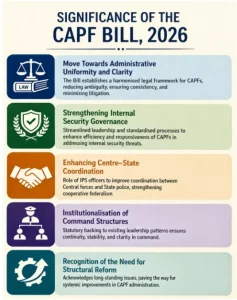 Ensure coherent policy implementation on the ground
- Facilitate unified command during crises
- Thus, the Bill prioritises cooperative federalism in security management.
- Addressing Administrative Inefficiencies and Cadre Management Issues: The absence of a unified framework has led to:
- Delays in promotions and appointments
- Ambiguity in seniority and posting rules
- Frequent service-related disputes
- By codifying these aspects, the Bill aims to:
- Introduce transparent and streamlined processes
- Improve career planning and personnel management
- Reduce administrative bottlenecks
- Balancing Judicial Directives with Administrative Practicality: While the Supreme Court (2025) emphasised reducing IPS deputation to promote cadre justice, the government perceives certain operational limitations in fully implementing these directions.
- The Bill represents an attempt to balance judicial intent with ground-level administrative realities, by:
- Retaining IPS presence in critical leadership roles
- Simultaneously introducing a structured cadre system for CAPF officers
- This reflects a pragmatic approach to reconciling institutional equity with security imperatives.
- Preserving Operational Distinctiveness with Administrative Integration: Different CAPFs have specialised roles and operational mandates, yet they function under the Ministry of Home Affairs (MHA).
- The Bill seeks to strike a balance by:
- Maintaining functional autonomy of individual forces
- While ensuring administrative integration under a common framework
- This is aimed at improving overall efficiency without diluting specialisation.
About Central Armed Police Forces (CAPFs)
- Definition and Administrative Control: The Central Armed Police Forces (CAPFs) are a group of paramilitary forces under the Ministry of Home Affairs (MHA), tasked with maintaining internal security, border management, and critical infrastructure protection in India.
- Although often referred to as “paramilitary forces”, CAPFs are distinct from the armed forces as they operate primarily in civilian security domains and function under civil authority.
- Constituent Forces of CAPFs: The CAPFs comprise the following major forces, each with a specialised mandate:
- Central Reserve Police Force (CRPF) → Handles internal security, counter-insurgency, and law & order support
- Border Security Force (BSF) → Guards India’s borders with Pakistan and Bangladesh
- Central Industrial Security Force (CISF) → Protects critical infrastructure, PSUs, airports, and metro networks
- Indo-Tibetan Border Police (ITBP) → Secures India-China border in high-altitude areas
- Sashastra Seema Bal (SSB) → Guards India-Nepal and India-Bhutan borders
- National Security Guard (NSG) → Specialises in counter-terrorism and hostage rescue operations
- Assam Rifles (AR) → Operates in the Northeast, focusing on counter-insurgency and border security
- Together, these forces form the backbone of India’s internal security architecture.
- Key Roles and Functions : CAPFs perform a wide range of critical security functions, including:
- Border Management → Preventing infiltration, smuggling, and cross-border crimes
- Internal Security → Tackling insurgency, terrorism, and Left-Wing Extremism
- Law & Order Support → Assisting states during riots, elections, and emergencies
- Protection of Vital Installations → Safeguarding airports, ports, and strategic assets
- Special Operations → Conducting counter-terror and high-risk missions (NSG)
- Thus, CAPFs act as a bridge between military and police functions, ensuring stability within the country.
- Organisational and Command Structure: CAPFs follow a hierarchical command structure, with leadership positions often occupied by:
- CAPF cadre officers (direct recruits)
- Indian Police Service (IPS) officers on deputation
- Historically, senior leadership roles (IG and above) have been dominated by IPS officers, leading to a dual-command and dual-cadre system.
- Distinctive Features of CAPFs:
- Centralised control under MHA ensures uniform policy direction
- Operational flexibility across diverse terrains (deserts, mountains, urban areas)
- Permanent deployment in high-risk zones, unlike state police forces
- Combination of policing and military-style training
- Emerging Challenges: Despite their critical role, CAPFs face several structural and operational challenges:
- Cadre management issues and career stagnation
- High operational stress and personnel fatigue
- Coordination challenges with State police forces
- Debate over IPS deputation vs cadre autonomy
|
Check Out UPSC CSE Books From PW Store
Challenges that need to be Considered
- Undermining Career Progression of CAPF Cadre Officers: By reserving senior leadership positions for IPS officers, the Bill may restrict upward mobility of CAPF officers, leading to career stagnation and frustration, which can adversely impact morale and motivation.
- Dilution of Supreme Court’s Directions: The Bill appears to go against the spirit of the 2025 Supreme Court judgment, which advocated reducing IPS deputation and strengthening cadre-based leadership.
- This raises concerns about respect for judicial pronouncements and institutional balance.
- Continued Institutional Imbalance: The formalisation of IPS dominance may perpetuate a dual-cadre system, where CAPF officers remain subordinate in leadership roles despite operational experience, leading to institutional inequity.
- Impact on Professionalisation of CAPFs: Modern security forces require domain-specific expertise and continuity in leadership. Excessive reliance on deputation may hinder the development of in-house leadership capacity and long-term institutional memory.
- Centralisation vs Autonomy Debate: The Bill reflects a tendency towards centralised administrative control, which may come at the cost of functional autonomy and flexibility of individual forces.
- Morale and Operational Effectiveness Concerns: Persistent issues of recognition, promotion, and leadership opportunities can negatively affect personnel morale, which is crucial for forces operating in high-risk and stressful environments.
Way Forward
- Balanced Cadre Policy: A phased and rational reduction of IPS deputation, especially up to the IG level, should be implemented while ensuring adequate representation of CAPF cadre officers in leadership roles.
- Implement Supreme Court Directives in Letter and Spirit: The government should align the Bill with judicial directions by ensuring:
- Time-bound promotions
- Fair cadre management systems
- Reduction in structural inequalities
- Strengthening In-house Leadership Development
- Investment should be made in:
- Training academies and leadership programs
- Specialised skill development
- Career progression pathways
- This will enable CAPFs to develop professional and self-reliant leadership structures.
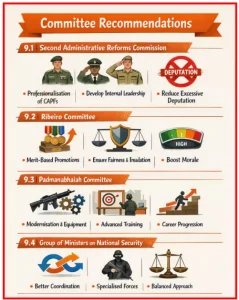
- Drawing from Committee Recommendations: Incorporating the following recommendations can ensure a balanced and reform-oriented approach.
- Ribeiro Committee → Recommended greater promotional avenues for CAPF officers
- Second Administrative Reforms Commission (ARC) → Emphasised professionalisation and modernisation of security forces
- Ensuring Morale and Welfare of Personnel: Addressing issues related to career stagnation, working conditions, and stress is essential for maintaining operational effectiveness and human resource stability.
- Promoting Cooperative Federal Security Framework: While ensuring coordination with States, the system should avoid over-centralisation and promote collaborative decision-making mechanisms.
Conclusion
The CAPF Bill, 2026 represents a significant attempt to reform the administrative framework of India’s internal security forces, aims to ensure uniformity and efficiency, but its success hinges on balancing fairness, autonomy, and judicial principles, while safeguarding morale and effectiveness of forces.


 27 Mar 2026






.png)






 Current Affairs




 GS Foundation
 Optional Course
 Combo Courses
 Degree Program