Circular Economy in Agriculture: Waste-to-Wealth and Government Initiatives

19 Feb 2026

Circular Economy in Agriculture: Waste-to-Wealth and Government Initiatives

The Government of India emphasised the importance of circular economy principles in agriculture to convert agricultural waste into valuable resources, addressing environmental challenges and enhancing economic efficiency.
Circular Economy in Agriculture

  • By 2050, India’s circular economy is expected to reach a market value of $2 trillion and create 10 million jobs.

Circular Economy in Agriculture: Waste to Wealth

About “Waste-to-Wealth” Approach

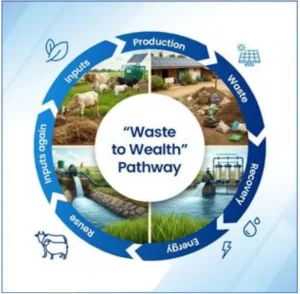
  • It is a strategy that converts waste materials into valuable products such as energy, compost, recycled goods, or industrial inputs, thereby reducing pollution while generating economic value and sustainable livelihoods.
  • Status of Waste:
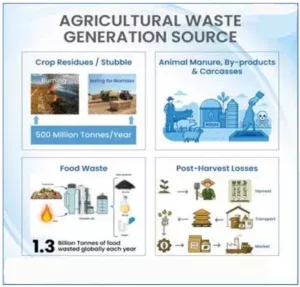
    • Scale of waste: India produces an estimated 350 million tonnes of agricultural waste annually.
    • Such residues have the potential to generate over 18,000 MW of power annually if utilised efficiently.

Circular Economy in Agriculture

About Circular Agriculture

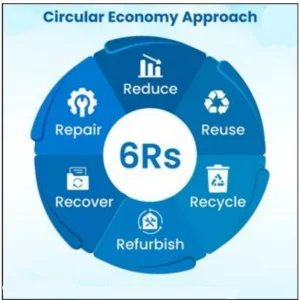
  • Circular Agriculture is a sustainable farming approach that minimizes waste by reusing, recycling, and regenerating resources such as converting crop residues, animal waste, and by-products into manure, bioenergy.
  • It supports SDG 2, which aims to “end hunger, achieve food security, improve nutrition, and promote sustainable agriculture”.
    • For Example: It supports the SDGs by reducing global food waste, which reached 1.05 billion tonnes in 2022, of which 60% generated at the household level.

Circular Agricultural Practices

  • Crop Residue Management: Using stubble for mulching, composting, or bioenergy instead of burning.
  • Integrated Farming Systems: Linking crops, livestock, fisheries, and agro-forestry to reuse by-products.
  • Organic Manure & Biofertilisers: Converting animal waste and biomass into compost or biogas slurry.
  • Water Recycling: Reusing treated wastewater for irrigation.
  • Agroforestry & Mixed Cropping: Enhancing soil fertility and biodiversity naturally.

Benefits of Circular Agriculture

  • Energy Generation: Waste can be used to produce power and bio-energy.
  • Soil Health: Organic fertilisers from waste improve soil nutrition and reduce dependence on chemical inputs.
  • Environmental Protection: Reduces air, soil, and water pollution from in-field burning of residues.

Challenges

Circular Economy in Agriculture

  • High Initial Costs: Setting up biogas plants, composting units, or bio-CNG facilities requires significant capital.
    • For Example: Small farmers struggle to adopt biomass-based energy systems.
  • Technological & Skill Gaps: Limited awareness and technical know-how hinder adoption of precision farming and residue management.
    • For Example: Improper use of mulching machines in stubble-prone states like Punjab.
  • Market & Value Chain Constraints: Weak market linkages for organic manure or bio-products reduce profitability.
    • For Example: Limited buyers for compost compared to chemical fertilizers
  • Fragmented Landholdings: Small and scattered farms make efficient waste collection and recycling difficult (common in eastern India).

Government Initiatives Driving Circularity in Agriculture

  • Galvanising Organic Bio-Agro Resources Dhan (GOBARdhan): The scheme brings together multiple ministries to convert cattle dung, crop residues, and food waste into compressed biogas (CBG) and organic manure.
    • For Example: By 14th January 2026, the scheme covered 51.4% of India’s districts and had 979 operational biogas plants, indicating substantial progress in sustainable waste management.
  • Crop Residue Management (CRM): The CRM initiative curbs stubble burning by promoting in-situ residue management (soil incorporation/mulching) and ex-situ use (composting, biogas, bioenergy).
    • From 2018–19 to 2025–26, ₹3,926.16 crore was released to Punjab, Haryana, Uttar Pradesh, NCT of Delhi, and ICAR, leading to over 42,000 Custom Hiring Centres and distribution of 3.24 lakh crop residue management machines.
  • Agriculture Infrastructure Fund (AIF): It supports organic farmers, Primary Agricultural Credit Societies (PACS), and agri-entrepreneurs in strengthening value chains by financing warehouses, cold storage, grading, and primary processing infrastructure.
  • Animal Husbandry Infrastructure Development Fund (AHIDF): Launched in 2020 under Atmanirbhar Bharat with a ₹15,000 crore corpus.
    • It promotes private and cooperative investment in dairy, meat processing, feed manufacturing, and waste-to-wealth to strengthen the livestock value chain.
  • Water Management for Sustainable Agriculture: The Ministry of Jal Shakti promotes the treatment and reuse of domestic and wastewater for non-drinking purposes, such as agriculture, landscaping, and horticulture, through schemes such as the National Mission for Clean Ganga and Jal Shakti Abhiyan.

Check Out UPSC CSE Books

Visit PW Store


online store 1

Way Forward

  • Strengthen Financial Support & Credit Access: Expand subsidies and low-interest loans under schemes like Agriculture Infrastructure Fund (AIF) for composting units, bio-CNG plants, and storage facilities.
  • Promote Decentralised Waste-to-Energy Models: Scale up village-level biogas plants under GOBARdhan Scheme, converting dung and crop waste into bioenergy and organic manure.
  • Enhance Technology & Mechanisation Support: Increase Custom Hiring Centres under the Crop Residue Management Scheme to provide mulchers and Happy Seeders to small farmers.
  • Develop Robust Market Linkages: Promote branding and assured procurement of organic produce through Farmer-Producer Organizations (FPOs) to improve profitability.

Need help preparing for UPSC or State PSCs?

Connect with our experts to get free counselling & start preparing

Aiming for UPSC?

Download Our App

      
Quick Revise Now !
AVAILABLE FOR DOWNLOAD SOON
UDAAN PRELIMS WALLAH
Comprehensive coverage with a concise format
Integration of PYQ within the booklet
Designed as per recent trends of Prelims questions
हिंदी में भी उपलब्ध
Quick Revise Now !
UDAAN PRELIMS WALLAH
Comprehensive coverage with a concise format
Integration of PYQ within the booklet
Designed as per recent trends of Prelims questions
हिंदी में भी उपलब्ध

<div class="new-fform">


    </div>

    Subscribe our Newsletter
    Sign up now for our exclusive newsletter and be the first to know about our latest Initiatives, Quality Content, and much more.
    *Promise! We won't spam you.
    Yes! I want to Subscribe.