Recently, the Madras High Court, while interpreting Article 161, held that the Governor is bound by the aid and advice of the Council of Ministers in matters of remission and premature release of convicts.
- The ruling, delivered amid conflicting judicial precedents and debates over the Governor’s expanding role, reaffirms the primacy of the elected executive in India’s parliamentary democracy.
UPSC Online Courses
Key Highlights of the Madras High Court Judgment
- Article 161 is Not a Personal Prerogative: The Court categorically held that the Governor does not possess independent discretionary powers while exercising powers under Article 161 (power to grant pardons, reprieves, respites, or remissions).
- The exercise of such powers is not personal, but institutionally guided.
- Binding Nature of Aid and Advice : It was emphatically reiterated that the Governor is constitutionally bound to act on the aid and advice of the Council of Ministers, in line with the parliamentary system.
- Any exercise of power detached from ministerial advice would undermine the core principle of responsible government.
- Departure from Ministerial Advice would be Constitutionally Inconsistent: The Court clarified that any deviation from the advice tendered by the Cabinet is constitutionally impermissible, as it would amount to a subversion of democratic accountability and violate the basic structure principle of parliamentary democracy.
- Reaffirmation of Binding Constitutional Precedent: The judgment explicitly declared certain earlier rulings—suggesting discretionary powers of the Governor in such matters—as per incuriam (i.e., rendered in ignorance of binding constitutional precedents), thereby reinforcing judicial consistency and constitutional supremacy.
- Governor as a Nominal Head, Not a Parallel Executive: The Court reaffirmed that the Governor functions as a “constitutional or nominal head”, and cannot act as an alternative or parallel executive authority.
- Real executive power vests in the elected government, ensuring adherence to the democratic will of the people.
About Article 161
- Article 161 of the Indian Constitution empowers the Governor to exercise clemency powers in respect of offences to which the executive power of the State extends. These include:
- Granting pardons, reprieves, respites, or remissions of punishment
- Suspending, remitting, or commuting sentences
- This provision acts as a constitutional safeguard within the criminal justice system, enabling the State to rectify judicial errors, address disproportionate punishment, and incorporate humanitarian considerations.
- Nature of the Power: Although the power is formally vested in the Governor, its constitutional character is clearly defined:
- Executive in Nature, not Personal: It is exercised as part of the State executive function, not as an individual prerogative of the Governor
- Subject to Constitutional Limitations: The exercise of this power is not absolute and is open to judicial review on limited grounds such as arbitrariness, mala fide intent, or extraneous considerations
- Humanitarian and Corrective Purpose: Designed to temper the rigidity of law with compassion, not to enable independent or discretionary authority
- Thus, Article 161 reflects a balanced constitutional mechanism, combining justice with mercy, while remaining firmly within the framework of responsible governance.
Constitutional Status of the Cabinet
- The Cabinet forms the core decision-making body within the State executive under India’s parliamentary system.
- Although the Constitution under Article 164 refers broadly to the Council of Ministers, the Cabinet constitutes its inner and most powerful core, exercising real executive authority.
- It is headed by the Chief Minister at the State level
- Functions as the principal policy-making organ of the government
- Exercises powers formally vested in the Governor, thereby translating constitutional authority into practical governance
- Thus, the Cabinet represents the operational centre of executive power.
Composition and Structure
- The Cabinet is a select group of senior ministers within the larger Council of Ministers:
- Cabinet Ministers → Hold key portfolios and take major policy decisions
- Minister of State (Independent Charge) (occasionally included in deliberations)
- Supported by junior ministers and administrative machinery
- This structure ensures:
- Efficiency in decision-making
- Confidentiality and coordination in governance
- Focused leadership in critical sectors
Functions and Powers of the Cabinet
- Policy Formulation: The Cabinet is responsible for:
- Framing public policies and developmental strategies
- Determining the legislative and administrative agenda
- Responding to emerging socio-economic and political challenges
- Executive Authority: Although executive power is constitutionally vested in the Governor, the Cabinet:
- Exercises actual executive functions
- Supervises administration and implementation of laws
- Issues decisions that are formally authenticated in the Governor’s name
- Legislative Role: The Cabinet plays a decisive role in the legislative process:
- Drafts and introduces bills in the State Legislature
- Advises on summoning, prorogation, and dissolution of the House
- Ensures passage of government legislation
- Financial Control: The Cabinet has primary control over State finances:
- Prepares and presents the State Budget
- Determines taxation policies and public expenditure priorities
- Ensures fiscal management and resource allocation
- Clemency and Constitutional Functions: In matters such as Article 161 (clemency powers):
- The Cabinet examines mercy petitions
- Provides binding advice to the Governor
- Ensures that such decisions reflect legal reasoning and humanitarian considerations
- This reinforces that even constitutional powers of the Governor are substantively exercised by the Cabinet.
|
UPSC Online Classes
About Governor and the Elected Executive
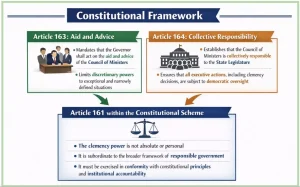
- Nominal Head vs Real Executive: The constitutional scheme establishes a clear distinction:
- The Governor is the nominal or constitutional head of the State
- The Council of Ministers, led by the Chief Minister, is the real executive authority
- While powers under Article 161 are formally exercised in the name of the Governor, their substantive exercise lies with the Council of Ministers, consistent with the principles of parliamentary democracy.
- Primacy of the Cabinet in Clemency Decisions: In the context of Article 161:
- The Cabinet evaluates mercy petitions, considering legal, administrative, and humanitarian factors
- It formulates advice regarding the grant, refusal, or modification of clemency
- The Governor is constitutionally bound to act on this advice
- This ensures that clemency powers are exercised through a democratically accountable process, rather than individual discretion.
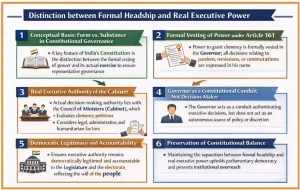 Doctrine of Aid and Advice: Under Article 163, the Governor is required to act on the aid and advice of the Council of Ministers. This principle applies fully to Article 161, implying that:
-
- The Governor does not exercise clemency as an independent personal prerogative
- Discretionary authority is extremely limited and exceptional
- The Council of Ministers’ advice is binding, preserving democratic legitimacy
- The doctrine ensures that executive power, including mercy jurisdiction, remains aligned with the will of the elected government.
- Democratic Accountability and Constitutional Morality: The Council of Ministers derives its authority from the elected Legislative Assembly, making it collectively responsible to the people. This ensures:
- Transparency and accountability in the exercise of clemency powers
- Consistency with public interest and constitutional values
- Prevention of arbitrary or politically motivated decisions
- In contrast, the Governor, being an unelected authority, cannot be vested with independent decision-making power without undermining:
- Representative democracy
- The principle of responsible government
- The constitutional balance between institutions
Judicial Precedents
- Shamsher Singh vs State of Punjab (1974): This landmark judgment established that the Governor is a constitutional or nominal head, and that all executive powers are to be exercised on the aid and advice of the Council of Ministers.
- The Court clarified that personal discretion of the Governor is extremely limited and confined to rare and exceptional situations
- It firmly laid down that real executive authority vests in the elected government, not in the Governor
- Maru Ram vs Union of India (1980): This case specifically examined the nature of clemency powers under constitutional provisions.
- The Court held that such powers are not personal prerogatives of the Governor
- They must be exercised on the aid and advice of the Council of Ministers
- This judgment ensured that mercy jurisdiction remains democratically accountable and institutionally guided.
- A.G. Perarivalan vs State of Tamil Nadu (2022): This recent and significant ruling further strengthened the constitutional position.
- The Court reaffirmed the primacy of the State Cabinet in remission decisions
- It highlighted that undue delay or inaction by the Governor is constitutionally untenable
- It emphasised that the Governor cannot override or indefinitely withhold Cabinet recommendations
- The judgment reinforced the need for timely and constitutionally compliant exercise of executive powers.
- M.P. Special Police Establishment vs State of Madhya Pradesh (2004): In this case, the Court clarified the distinction between statutory powers and constitutional powers.
- The ruling pertained to statutory sanction for prosecution
- It was held to be not applicable to clemency powers under Article 161, which operate within a distinct constitutional framework
- This distinction ensured that precedents relating to statutory discretion are not incorrectly extended to constitutional functions.
- Cumulative Judicial Position: The consistent judicial position emerging from these rulings is unambiguous:
- The Governor cannot act as an independent executive authority
- Executive powers, including those under Article 161, must be exercised on the aid and advice of the Council of Ministers
- Discretionary powers are minimal, exceptional, and narrowly confined
- The doctrine of aid and advice is binding and central to constitutional governance
Significance of the Judgment
- Reinforcement of Parliamentary Democracy: The judgment decisively reaffirms the foundational principle of parliamentary democracy that real executive authority resides with the elected Council of Ministers, while the Governor functions as a constitutional or nominal head.
- By clarifying that powers under Article 161 must be exercised on Council of Ministers advice, it preserves the constitutional design wherein governance is carried out in accordance with the will of the people, as expressed through their elected representatives.
- Strengthening Democratic Accountability: The ruling ensures that decisions with significant implications for individual liberty and criminal justice, such as clemency, are taken by a body that is collectively responsible to the legislature and ultimately accountable to the electorate.
- This strengthens the chain of democratic responsibility, ensuring that executive actions remain transparent, answerable, and subject to public scrutiny, rather than being insulated within an unelected constitutional office.
- Limitation on Arbitrary Exercise of Power: By circumscribing the scope of gubernatorial discretion, the judgment prevents the possibility of arbitrary, unilateral, or politically motivated decisions in the exercise of constitutional powers.
- It reinforces the principle that constitutional authorities must operate within defined limits, thereby upholding the rule of law, fairness, and constitutional morality.
- Upholding the Federal Balance: The judgment plays a critical role in protecting the autonomy of State governments, particularly in areas falling within their executive domain, such as criminal justice and remission policies.
- By affirming the primacy of the State Cabinet, it strengthens the federal structure and ensures that States retain meaningful control over their constitutional functions, free from undue interference by unelected authorities.
- Ensuring Constitutional Consistency and Legal Certainty: By aligning its interpretation with established Supreme Court jurisprudence, the judgment contributes to doctrinal clarity and uniformity in constitutional interpretation.
- This reduces the likelihood of conflicting judicial approaches, enhances predictability in the application of law, and strengthens the overall coherence of constitutional governance.
Click to Explore UPSC Offline Coaching
Concerns that need to be Tackled
- Continuing Ambiguity in Discretionary Powers: Despite judicial clarification, the Constitution does not provide an exhaustive and clearly demarcated list of situations where the Governor may exercise discretion. This lack of precision often leads to:
- Divergent interpretations by constitutional authorities
- Judicial inconsistencies and recurring litigation
- Scope for subjective exercise of power under the guise of discretion
- Rising Governor–State Government Frictions: In recent years, there has been an observable increase in institutional tensions between Governors and elected State governments, manifested through:
- Delays in granting assent to Bills passed by State legislatures
- Prolonged inaction on Cabinet recommendations, including in clemency matters
- Public disagreements that undermine institutional dignity and constitutional harmony
- Such developments raise concerns about the smooth functioning of the State executive.
- Concerns Regarding Political Neutrality of the Governor’s Office: Given that Governors are appointed by the Union executive, concerns are frequently raised regarding:
- The perception of political alignment or bias
- The possibility of actions being influenced by central political considerations rather than constitutional principles
- This perception risks eroding public trust in the neutrality and impartiality of the office.
- Implications for Cooperative Federalism: Actions by Governors that are perceived to be inconsistent with the advice of elected State governments can:
- Undermine the spirit of cooperative federalism
- Lead to distrust between the Union and the States
- Escalate into constitutional conflicts and governance inefficiencies
- This weakens the collaborative framework essential for effective multi-level governance in India.
Way Forward
- Clearer Delineation of Discretionary Powers: There is a pressing need to clearly define and codify the scope of the Governor’s discretionary powers, either through:
- Constitutional clarification, or
- Authoritative judicial guidelines
- This would reduce ambiguity, minimise scope for misuse, and ensure uniform constitutional practice across States.
- Strengthening Constitutional Conventions and Norms: Beyond formal provisions, emphasis must be placed on strengthening unwritten constitutional conventions, including:
- Political neutrality and impartiality of the Governor
- Respect for the democratic mandate of elected governments
- Adherence to the principle of non-interference in routine executive matters
- Such conventions are essential for the smooth and dignified functioning of constitutional offices.
- Institutional Reforms in the Office of Governor: Revisiting the recommendations of bodies such as the Sarkaria Commission and the Punchhi Commission can provide a roadmap for reform.
- Key suggestions include:
- Consultative and transparent appointment processes
- Ensuring security of tenure
- Enhancing institutional accountability and credibility
- These reforms would strengthen the legitimacy and effectiveness of the office.
- Ensuring Time-bound Constitutional Functioning: It is essential to establish mechanisms—either judicially evolved or legislatively prescribed—to ensure:
- Time-bound decisions on Bills and on the advice tendered by the Council of Ministers
- Prevention of delays that disrupt governance and policy implementation
- Greater efficiency, responsiveness, and constitutional discipline
- Fixing Timelines for Decision-Making: There is a need to prescribe clear timelines for the Governor to act on Council of Ministers recommendations to avoid delays or “silent vetoes.”
- As seen in the Perarivalan case, prolonged inaction is unconstitutional and disrupts justice delivery.
- Codified procedures can ensure timely decisions and uphold constitutional discipline.
Conclusion
The judgment strongly reaffirms constitutional principles of executive power, democratic accountability, and federal balance, while highlighting persistent ambiguities and institutional frictions. Ensuring the Governor’s office functions in harmony with the elected executive requires clear legal norms, robust institutional practices, and respect for democratic values, thereby upholding the spirit and integrity of the Constitution.


 3 Apr 2026





.png)






 Current Affairs




 GS Foundation
 Optional Course
 Combo Courses
 Degree Program