Recently, India’s Defense Minister released a landmark document titled ‘Defence Forces Vision 2047: A Roadmap for a Future-Ready Indian Military.’
About Defence Forces Vision 2047
- Institutional Origin and Authorship: Created by the Headquarters Integrated Defence Staff (HQ IDS), this plan acts as a comprehensive, long-term guide to systematically transform India’s military architecture.
- Strategic Alignment with National Growth: The primary goal is to ensure that as India transitions into a developed nation (Viksit Bharat) by 2047, its military remains robust, modern, and fully capable of protecting the country’s expanding global influence and interests.
 Integration Beyond Service Silos: The vision serves as a long-term navigational guide that intentionally moves beyond the traditional, service-specific silos of the Army, Navy, and Air Force to foster a unified force.
- Philosophical Shift in Warfare: It represents a fundamental shift in military philosophy, prioritizing organizational synergy and technological integration as the core drivers of future combat effectiveness.
- Self-Reliance and Proactive Readiness: The overarching objective is to build a military that is self-reliant in both thought and capability, successfully moving from a traditionally reactive stance to a proactive, all-domain readiness model.
- Seamless Multi-Domain Adaptability: The vision highlights three main goals:
- The forces should be technologically advanced,
- Well-integrated across the Army, Navy and Air Force, and
- Capable of operating in multiple domains such as cyber, underwater and space.
Key Highlights of the Vision 2047
- Multi-Domain and Intelligence-Centric Warfare: The roadmap moves the military beyond conventional battlefield boundaries to prepare for Multi-Domain Operations.
- This marks a critical evolution from network-centric systems to Intelligence-Centric Warfare, where the integration of Artificial Intelligence (AI) and advanced data analytics allows the forces to detect, track, and neutralize threats at machine speed, providing a decisive edge in high-intensity conflicts.
- Establishment of Specialized Technical Forces: To manage the shift toward high-tech warfare, the vision proposes the creation of four specialized tri-service entities. These include:
- A Defence Geospatial Agency for high-resolution satellite intelligence,
- A Data Force to manage massive battlefield information,
- A Drone Force to centralize unmanned aerial and underwater capabilities, and
- A Cognitive Warfare Action Force dedicated to countering misinformation and psychological operations.
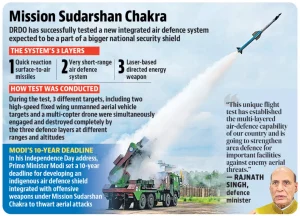
- Strategic Shield through Mission Sudarshan Chakra: A cornerstone of the vision is the development of a comprehensive, multi-layered Ballistic Missile Defence (BMD) and air defense architecture.
- Known as Mission Sudarshan Chakra, this initiative is designed to create an impenetrable shield over critical national infrastructure, strategic economic hubs, and major civilian population centers against advanced aerial threats.
- Jointness and Structural Reform: The vision stresses the urgent need for tri-service integration to enhance operational synergy.
- This involves the establishment of Integrated Theatre Commands, where the three wings of the military plan and execute operations as a single unit.
- To support this, a Common Defence Forces Act is proposed to unify the legal framework, discipline, and service conditions across all three services.
- Aatmanirbharta and Industrial Sovereignty: A major pillar of the roadmap is achieving Total Self-Reliance in defense production.
- This involves a complete overhaul of the Defence Acquisition Procedure (DAP) to foster a domestic ecosystem where high-end technology, such as indigenous fighter jets and submarines is designed and manufactured within India, tailored specifically for the country’s unique climatic and geographical challenges.
- Indigenous Strategic Culture and Human Capital: The document calls for a “decolonization” of the Indian military mind, urging the development of a native strategic culture rooted in India’s own history and geography.
- Simultaneously, it emphasizes strengthening the Agnipath scheme and raising the educational and technical thresholds for soldiers to ensure the force is capable of handling increasingly sophisticated, technology-driven weaponry.
The Phased Roadmap- A Journey to 2047
The vision document recognizes that such a massive transformation cannot happen overnight. It proposes a structured timeline to ensure India remains protected while it modernizes:
- Phase I: Era of Transition (2026–2030): The immediate focus is on organizational restructuring and building the foundation for “jointness.”
- This phase prioritizes the rollout of integrated commands and the fast-tracking of indigenous platforms to fill immediate hardware gaps while enhancing Maritime and Air Domain Awareness.
- Phase II: Era of Consolidation (2030–2040): This decade is defined as the “Tech Leap,” where the military achieves digital dominance.
- Key milestones include the full operationalization of Project Sudarshan Chakra and the widespread deployment of unmanned drone swarms and AI-driven surveillance systems to secure the borders with minimal human risk.
- Phase III: Era of Excellence (2040–2047): By the centenary, India aims to achieve Total Intellectual and Industrial Sovereignty.
- The goal is for the Indian Armed Forces to become a world leader in Intelligence-Centric Warfare, serving as a primary global exporter of advanced defense technology and a dominant power in space and cyber security.
| Differences Between Traditional Doctrine & Modern Integrated Vision |
| Feature |
Traditional Doctrine |
Modern Integrated Vision |
| Command Structure |
- Service-Specific: Army, Navy, and Air Force operated under independent commands.
|
- Integrated Theatre Commands: All branches operate as a Unified Force under a single commander.
|
| Primary Domains |
- Focus on Kinetic Warfare (Land, Sea, Air).
|
- Multi-Domain Operations: Includes Cyber, Space, and Electromagnetic spectrums.
|
| Decision Making |
- Human-led analysis of field reports (slower).
|
- Intelligence-Centric: Uses Artificial Intelligence to process data and identify threats instantly.
|
| Procurement |
- Heavy reliance on Foreign Imports and “off-the-shelf” technology.
|
- Aatmanirbharta: Emphasis on Indigenous Design and localized supply chains.
|
| Technology Focus |
- Manned platforms (Tanks, Manned Aircraft).
|
- Unmanned Systems: Heavy use of Drones (UAVs) and autonomous robotics.
|
| Conflict Type |
- Front-line physical battles.
|
- Hybrid Warfare: Combatting Disinformation and psychological tactics alongside physical defense.
|
Why is this Vision Needed?
The Defence Forces Vision 2047 is more than a modernization roadmap; it is a strategic necessity born from a shifting global order. As India ascends as a global power, this vision serves as the blueprint for securing its interests through five core drivers:
- Navigating a Volatile Geostrategy: India faces a unique “Two-Front” challenge, requiring the simultaneous deterrence of two nuclear-armed neighbors along the LAC and LoC.
- Modern conflict has moved into the “Grey Zone”—hostile actions like cyberattacks and misinformation that remain just below the threshold of open war.
- Specialized units, such as the Cognitive Warfare Action Force, are essential to defend the national narrative and digital infrastructure against these hybrid threats.
- Adapting to the “Third Revolution” in Military Affairs: We are witnessing a technological explosion where traditional Network-Centric warfare is evolving into Intelligence-Centric Warfare.
- The AI Edge: Future battles will be won by whoever processes data fastest. AI-driven decision-making is no longer a luxury but a requirement.
- Closing the Gap: Adversaries are rapidly deploying drone swarms, stealth technology, and space-based weapons. Vision 2047 ensures India achieves technological parity, preventing traditional hardware from becoming obsolete.
- Strategic Autonomy through Aatmanirbharta: Ending foreign dependency is critical for national sovereignty. Historically, reliance on foreign imports created “chokepoint” vulnerabilities regarding spare parts and software updates during crises.
- Tailored Solutions: Domestic innovation ensures equipment—like the Tejas jet or light tanks—is purpose-built for India’s unique high-altitude and tropical environments.
- Industrial Depth: By integrating private companies, startups, and MSMEs, India is transforming from the world’s largest importer into a global defense manufacturing hub.
- Securing the “Engines of Growth”: As India moves toward a $30 trillion economy, its security umbrella must expand.
- Maritime Pivot: With 90% of trade by volume moving by sea, a future-ready Navy is vital to protect Sea Lanes of Communication (SLOCs) and undersea data cables in the Indo-Pacific.
- Mission Sudarshan Chakra: This provides a comprehensive missile defense shield over critical industrial corridors and economic hubs, ensuring that the nation’s “engines of growth” remain protected.
- Civilizational Continuity and Human Transformation: Vision 2047 seeks to “decolonize” Indian military thought, blending modern tech with an Indigenous Strategic Culture rooted in Indian wisdom (such as Chanakya’s principles).
- Modernizing the Force: This cultural shift is supported by human resource transformation. Through initiatives like the Agnipath scheme, the military is recruiting tech-savvy, motivated youth capable of mastering 21st-century warfare.
- Research & Diplomacy: By fostering collaboration between the DRDO, academia, and the private sector, India aims to lead in quantum tech and hypersonics while becoming a reliable defense partner for the Global South.
Significance of the Vision
The Defence Forces Vision 2047 is more than a modernization plan; it is a meta-strategy that intertwines national security with economic sovereignty. Its significance lies in shifting India from a legacy-dependent military to a globally dominant, self-reliant powerhouse.
- Foundation for Viksit Bharat: A developed nation requires a secure environment.
- This vision ensures that India’s military strength keeps pace with its economic rise, providing the “hard power” necessary to protect a $30 trillion economy and its global interests by 2047.
- Achieving Strategic Autonomy: By aiming for 100% self-reliance in critical technologies, India eliminates the risk of “diplomatic arm-twisting” or supply chain disruptions by foreign powers during crises.
- It transforms India from the world’s leading importer into a top global exporter of defense hardware.
- Paradigm Shift in Warfighting: The vision marks India’s transition to “Future Warfare.”
- By institutionalizing Cyber, Space, and AI-driven commands, India is moving away from reactive border defense to a proactive, multi-domain deterrence posture capable of handling “Grey Zone” and “Non-Kinetic” threats (like digital sabotage).
- Economic and Industrial Multiplier: The push for Atmanirbharta acts as a catalyst for the domestic economy.
- By integrating MSMEs and startups into the defense supply chain and strengthening Defence Industrial Corridors, the vision creates high-tech jobs and fosters a robust national innovation ecosystem.
- Shift to a “Whole-of-Nation” Approach: The document signifies a major move toward civil-military fusion.
- It integrates military strength with diplomatic, technological, and economic instruments of national power, ensuring that all sectors of the country contribute to and benefit from national security.
- Ensuring Resilience in Prolonged Conflicts: Learning from modern global conflicts (like Ukraine), the vision emphasizes “Surge Capacities.”
- It prioritizes the ability of the Indian industry to rapidly scale up production of ammunition, drones, and spares during high-intensity, long-duration wars.
- Global Leadership and Diplomacy: By developing a world-class military and indigenous strategic culture, India positions itself as a security provider for the Global South.
- It enhances India’s role as a “first responder” in the Indian Ocean Region, strengthening its regional leadership and diplomatic clout.
Challenges that need to be tackled
- Service Coordination Issues: The three services (Army, Navy, Air Force) have traditionally worked separately. Bringing them under Integrated Theatre Commands requires them to share power and resources, which often leads to internal friction or “turf wars.”
- Technology Gaps: India still struggles to make some “core” technologies, like jet engines or advanced microchips. Even if we build the plane, we often have to import the “brain” or the engine, which challenges the goal of total sovereignty.
- High Costs and Budget Limits: Buying new tech while paying salaries and pensions for a large army is very expensive.
- There is a risk that budget shortages might slow down the plan, forcing the military to use old equipment for longer than they should.
- Cyber Risks: As we move toward AI and digital warfare, we become more vulnerable to hacking.
- Protecting our military data from sophisticated foreign cyber-attacks is a never-ending and difficult task.
- Bureaucratic Delays: India’s procurement process (the way we buy weapons) is often slow and complicated.
- Long delays in making decisions can result in technology becoming outdated before it even reaches the soldiers.
- Training the Next Generation: Using high-tech drones and AI requires a very tech-savvy force.
- There is a concern about whether the current training systems and the short-term Agnipath scheme can produce enough experts for such complex warfare.
- Scaling Up Private Industry: While we want private companies to build weapons, many are still small.
- Moving from making small parts to building entire submarines or tanks requires massive investment that many companies are still hesitant to make.
Global Best Practices
- Jointness and Unified Command (USA Model): The United States moved to a unified structure through the Goldwater-Nichols Act.
- This law forced the different military branches to work together by making “joint experience” a requirement for promotion.
- India can follow this by ensuring that Integrated Theatre Commands have real authority over all resources, rather than just being a loose cooperation.
- Civil-Military Fusion (China Model): China has a “Whole-of-Nation” strategy where civilian technology (like AI and 5G) is shared directly with the military.
- India can adopt a similar Civil-Military Fusion by making it easier for private tech startups and universities to work on defense projects alongside the DRDO.
- The “Start-up” Military Ecosystem (Israel Model): Israel is famous for turning military challenges into commercial successes.
- They encourage young soldiers to solve technical problems, which leads to a vibrant innovation culture. India can use the Agnipath scheme to identify tech-savvy youth and fund their ideas through “Defence Incubators.”
- Rapid Procurement (Modern War Lessons): During the Ukraine conflict, it became clear that “slow and perfect” is worse than “fast and good enough.”
- Nations are now moving toward Rapid Prototyping, where they build and test drones in weeks rather than years. India needs to simplify its buying rules to allow for such quick updates.
- Focus on Asymmetric Warfare: Smaller nations (like Singapore or Israel) use “Smart Power”—relying on superior electronics, drones, and cyber tools to beat much larger armies.
- India’s focus on the Drone Force and Data Force aligns with this global shift toward “Quality over Quantity.”
- Long-Term Budgeting (Multi-Year Funding): Countries like France use “Military Programming Laws” that guarantee a fixed budget for 5 to 7 years.
- This prevents projects from stopping due to yearly budget changes. India could benefit from a Non-Lapsable Modernisation Fund to ensure that big projects like Mission Sudarshan Chakra never run out of money.
- Defence Export Leadership (South Korea Model): South Korea transformed from an importer to a top-10 global exporter by offering high-quality weapons at lower prices.
- India’s goal to be a global exporter by 2047 can follow this path by focusing on “trusted and affordable” tech for the Global South.
Steps Taken by India So Far
- Creation of the Chief of Defence Staff (CDS): To drive jointness, India appointed its first CDS and established the Department of Military Affairs (DMA).
- This was a historic move to provide single-point military advice to the government and bridge the gap between the three services.
- Launch of the Agnipath Scheme: This major human resource reform was introduced to lower the average age of the fighting force.
- It aims to recruit tech-savvy “Agniveers” who can handle the digital and automated systems of modern warfare.
- Positive Indigenisation Lists: The Ministry of Defence has released several lists of thousands of items—ranging from simple parts to complex missile systems—that cannot be imported.
- This “import ban” forces the military and industry to develop Aatmanirbhar (self-reliant) solutions.
- Setting up Defence Industrial Corridors: Two dedicated corridors in Uttar Pradesh and Tamil Nadu have been established.
- These hubs bring together the military, private manufacturers, and startups to build a robust domestic supply chain.
- The iDEX (Innovations for Defence Excellence) Initiative: This platform connects the military with startups and MSMEs.
- It provides funding and mentorship to small companies to solve specific military problems, such as high-altitude drones or secure communication tools.
- Corporatization of Ordnance Factories: To improve efficiency and quality, 41 old government factories were reorganized into seven new Defence Public Sector Undertakings (DPSUs).
- This move allows these entities to function more like professional companies.
- Successful Tests under Project Sudarshan Chakra: India has already begun testing its Integrated Air Defence Weapon System (IADWS).
- Recent successful flight tests of interceptor missiles off the Odisha coast mark the first practical steps toward a multi-layered ballistic missile shield.
- Increased Defence Exports: Through proactive Defence Diplomacy, India’s exports reached a record high of over 21,000 Crore in the 2023-24 financial year.
- This proves that India is moving toward its goal of becoming a global defense manufacturing hub.
- SRIJAN Portal: An online portal was launched to help private industries identify which defense items are currently imported so they can attempt to manufacture them locally (indigenisation).
The Human Pillar- Modernizing the Soldier (Agnipath)
A key part of the vision is ensuring the “soldier behind the machine” is as modern as the technology itself. The Agnipath scheme is the primary tool for this human transformation:
- A “Tech-Native” Force: By recruiting younger personnel (Agniveers), the military ensures that its frontline is composed of people who grew up with digital technology.
- These soldiers are naturally more comfortable with the high-tech tools (like drones and tablets) envisioned for 2047.
- Fusing Military and Society: Those who leave after four years return to the civilian workforce with specialized skills.
- This creates a skilled talent pool for India’s growing private defense industries, helping the nation meet its production goals.
- Financial Discipline: By moving toward this model, the military can better manage its budget.
- Savings on long-term pensions can be diverted into a Modernization Fund to buy the advanced satellites and AI systems required for future warfare.
|
Way Forward
- Strengthening Civil-Military Fusion: To win the tech race, the military must break down the walls between defense labs and civilian tech hubs.
- India should encourage more “dual-use” research where private startups building AI for healthcare or logistics can easily adapt their tools for the Data Force or Drone Force.
- Institutionalizing Jointness: Moving to Integrated Theatre Commands shouldn’t just be about moving offices. It requires a change in mindset.
- India should introduce a mandatory Joint Services Cadre where officers spend a significant part of their career working in other branches of the military to build trust and synergy.
- Stable and Multi-Year Funding: Since building a submarine or a fighter jet takes decades, the government should create a Non-Lapsable Modernization Fund.
- This would ensure that if money isn’t spent in one year, it stays in the defense budget for the next, preventing big projects like Mission Sudarshan Chakra from stalling.
- Building “Surge Capacity” in Industry: Modern wars show that countries run out of ammo and drones very quickly.
- India needs to help private companies and MSMEs build factories that can “surge” or rapidly increase production during a crisis, ensuring we are never caught without supplies.
- Removing Bureaucratic Red Tape: The way we buy weapons (Procurement) needs to be faster.
- By simplifying the Defence Acquisition Procedure (DAP) and removing unnecessary paperwork, India can ensure that by the time a soldier gets a new drone, the technology hasn’t already become outdated.
- Expanding Global Partnerships: India should focus on co-production—where we don’t just buy foreign tech but build it here with foreign partners.
- This will help us reach the goal of being a top global exporter for the Global South, offering reliable and affordable “Made in India” defense systems.
- Investing in Near-Space and Cyber Frontiers: The military must prioritize the “new high ground.”
- This means investing heavily in near-space assets (like high-altitude balloons or satellites) and creating a resilient cyber-wall to protect our national power grid and communication networks from foreign hackers.
Conclusion
The Defence Forces Vision 2047 is a promise that India will not be left behind in a fast-changing world. By focusing on local innovation, teamwork between services, and smart technology, India is building a military that doesn’t just react to threats but prevents them. Ultimately, this roadmap ensures that the security of the nation keeps pace with its economic growth toward a developed future.


 16 Mar 2026








.png)






 Current Affairs




 GS Foundation
 Optional Course
 Combo Courses
 Degree Program