Post–Operation Sindoor and rising two-front security risks, the Union Budget 2026–27 sharply boosts defence capital spending to accelerate modernisation and indigenisation.
Key Highlights of the Defence Budget Allocation
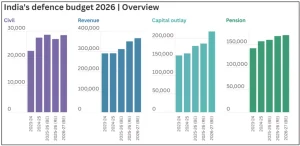
- Record Overall Outlay: The FY2026–27 defence budget stands at ₹7.85 lakh crore, the highest ever, marking a 15% year-on-year increase and accounting for 14.7% of total Union expenditure and 2% of the estimated GDP for the next financial year 2026-27.
- Sharp Rise in Capital Expenditure: Capital outlay has increased to ₹2.19 lakh crore, nearly 22% higher than last year, raising its share to about 28% of the total defence budget, signalling a clear pivot to modernisation.
- Support for Indigenous Procurement: Nearly 75% of the capital acquisition budget (₹1.39 lakh crore) is reserved for domestic industry, reinforcing the Aatmanirbhar Bharat push in defence manufacturing.
- Rationalisation of Revenue Components: The share of pensions (21.8%) and salaries (22.4%) has declined compared to FY20 levels, easing long-standing pressure on revenue expenditure.

Targeted Segments of Spending
- Military Modernisation: Funds are directed towards next-generation fighter aircraft, submarines, warships, UAVs, drones, precision-guided munitions, and smart weapons, addressing capability gaps exposed in recent operations.
- War Preparedness and Stockpiling: Higher capital spending supports replenishment of war wastage reserves, especially ammunition and loitering munitions depleted during Operation Sindoor.
- Indigenous Defence Industry: Defence Public Sector Undertakings (DPSUs), MSMEs, and private players benefit through Buy Indian – Indigenously Designed, Developed and Manufactured (Buy Indian–IDDM) and other indigenous procurement routes, boosting domestic supply chains.
- Buy Indian–IDDM is a procurement category under the Defence Acquisition Procedure (DAP) that gives top priority to defence equipment that is designed, developed, and manufactured in India, with high indigenous content.
- Emergency and Fast-Track Procurement: The budget reflects the institutionalisation of emergency procurement mechanisms, enabling rapid induction of critical technologies such as anti-drone systems and long-range strike assets.
Need for Higher Defence Expenditure
- Changing Geopolitical Environment: India faces a persistent two-front challenge from China and Pakistan, alongside regional instability, demanding sustained investment in deterrence and readiness.
- Lessons from Operation Sindoor: The operation highlighted shortfalls in ammunition depth, air defence, and rapid induction capabilities, necessitating higher and more flexible capital allocations.
- Breaking the Committed Liabilities Trap: Historically, large portions of capex were locked into past contracts, limiting new acquisitions. The current hike creates fiscal headroom for fresh big-ticket contracts like AMCA and Project 75I submarines.
- Shift from Manpower to Technology: Modern warfare increasingly relies on technology, precision, and networked platforms, making capital expenditure essential relative to salaries and pensions.
- Boosting Self-Reliance and Economic Spillovers: Higher defence spending supports indigenisation, job creation, technology transfer, and exports, aligning security objectives with economic development.
Conclusion
The increase in defence capital spending in the Union Budget 2026–27 reflects a strategic recalibration rather than routine expansion. Shaped by recent operational experience, evolving threats, and the maturity of India’s defence industrial base, the budget prioritises modernisation, preparedness, and self-reliance.