P. Wilson, Rajya Sabha MP of the Dravida Munnetra Kazhagam, introduced a Private Member’s Bill to amend the Constitution for diversity in judicial appointments.
- The Bill also advocates for regional benches of the Supreme Court.
Key Provisions of the Bill
- Ensuring Social Diversity in the Judiciary
- Mandates due representation to:
- Scheduled Castes (SC), Scheduled Tribes (ST)
- Other Backward Classes (OBC)
Need For Regional Benches
- Limited Access to Justice: The Supreme Court currently sits only in Delhi, making it difficult for citizens from distant states to approach the apex court.
- Heavy Pendency of Cases: Over 90,000 cases pending as of January 2026.
- Concentration of cases in Delhi leads to delays and backlog
- Reducing Regional Disparities: Regional benches in major cities (e.g., Kolkata, Mumbai, Chennai) can ensure equitable judicial access across different regions
- Strengthening Federal Principles: Establishing regional benches respects the federal structure by bringing the apex court closer to the states and their citizens.
Solution:
- As recommended by Parliamentary committees and Law Commission in the past, regional benches of the Supreme Court can be set up under existing provisions of the Constitution itself.
- The Court may even consider setting up a bench in one region initially and extend to other regions in a time bound manner
|
-
-
- Religious minorities
- Women
- Representation to be proportionate to their population.
- Applicable to appointments in Supreme Court of India, High Courts.
- Timeline for Appointments
- The Central Government must notify collegium recommendations within 90 days.
- Provision for Regional Benches:
- Establish regional benches in New Delhi, Kolkata, Mumbai, and Chennai.
- These benches will exercise full jurisdiction of the Supreme Court.
- Cases involving constitutional importance are to be heard by the Constitution Bench at Delhi.
Need for Diversity in the Indian Judiciary
- Enhancing Democratic Legitimacy: A judiciary that reflects India’s social diversity enhances public trust and legitimacy, whereas under-representation of major social groups fosters perceptions of bias and alienation.
- For Example: Since 2018, a large majority of judges appointed to High Courts are from upper castes (approx. 75–78%), while Scheduled Castes (SC), Scheduled Tribes (ST), OBCs and minorities together constitute less than 25% of appointments.
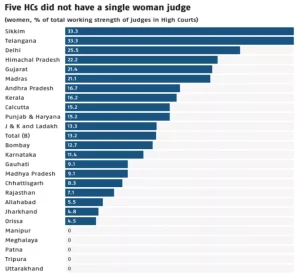
- Gender Representation: Women continue to be under-represented in the higher judiciary.
- For Example: Since 1950, only 11 women 3.8% of 287 Supreme Court judges, including Justices Fathima Beevi, Sujata V. Manohar, and Ruma Pal—have been appointed.
- Structural Barriers to Diversity: The collegium system, criticised for opacity and reliance on homogenous networks, coupled with the absence of reservations in higher judicial appointments, has slowed progress in ensuring diversity.
- For Example: Data between 2018 and 2024 shows that only about 20% of appointees to the higher judiciary belonged to SC, ST, and OBC communities combined.
- Link to Broader Social Objectives: Enhancing diversity aligns with the constitutional mandate of equality and social justice under Articles 14–15 and upholds India’s pluralistic ethos by ensuring institutions reflect societal diversity.
Constitutional Provisions on the Appointment of Judges and Seat of the Supreme Court
- Article 124: Appointment of Supreme Court Judges
- Judges of the Supreme Court of India are appointed by the President.
- An appointment is made after consultation with the Chief Justice of India (CJI).
- Article 217 – Appointment of High Court Judges
- Judges of a High Court are appointed by the President.
- Consultation required with the CJI, the Chief Justice of the concerned High Court, and the Governor of the State.
- Article 130 – Seat of the Supreme Court
- The seat of the Supreme Court shall be in Delhi.
- It may sit at another place(s) as decided by the CJI with the approval of the Central Government.
|
Challenges
- Narrow Talent Pool Argument: Often cited that fewer candidates from marginalized communities reach senior positions at the Bar or Bench.
- Structural inequalities in legal education and career progression affect representation.
- Federal & Political Concerns: Mandating proportional representation may raise concerns about:
- Judicial independence
- Executive interference
- Federal balance in appointments
- Institutional Resistance: Judiciary traditionally resists external reform attempts (e.g., NJAC struck down in 2015)
 Any structural reform may face constitutional challenges
- Risk of Merit vs Representation Debate: Critics argue diversity mandates may dilute “merit”.
- Lack of objective metrics to balance merit with social justice
Way Forward
- Private Members Bill as Constitutional Directive: The responsibility to ensure social diversity in judicial appointments lies primarily with the collegium, and the Private Member’s Bill seeks to reinforce this objective through a constitutional mandate.
- Reviving National Judicial Appointment Commission (NJAC): The long-term reform could be to revive the NJAC by broad basing its composition.
- It can include representatives from the legislature, bar council and academia like in South Africa and the U.K.
- Strengthen mentorship and pipeline programs: Encourage candidates from marginalized communities through training, scholarships, and preparatory support for judicial services.
- Periodic review and accountability: Monitor representation across caste, gender, and regional lines, with annual reporting to Parliament or a statutory body.
About Collegium System
- Supreme Court Collegium: Composed of the Chief Justice of India and the four senior-most judges of the Supreme Court.
- The Supreme Court Collegium is responsible for recommending appointments, transfers, and elevations of judges to the 25 High Courts and the Supreme Court.
- After these recommendations are processed by the central government, the President issues final orders for their implementation.
- High Court Collegium: Composed of the Chief Justice of the High Court and its two senior-most judges.
- It recommends appointments and elevations specific to the High Courts
Evolution of the Collegium System
- First Judges Case (1981): Held that the Chief Justice of India’s recommendation could be refused by the executive for “cogent reasons.”
- Established executive primacy over the judiciary in judicial appointments. Second Judges Case (1993): Introduced the Collegium system by interpreting “consultation” as “concurrence.”
- Determined that the CJI’s opinion must reflect institutional consensus, formed in consultation with the two senior-most SC judges.
- Third Judges Case (1998): Expanded the Collegium to a five-member body comprising the CJI and the four senior-most judges of the Supreme Court.
- Fourth Judges Case (2015): Struck down the NJAC Act, 2014, and the associated constitutional amendment, upholding the Collegium system to protect judicial independence.
National Judicial Appointments Commission (NJAC)
- The NJAC was established under the 99th Constitutional Amendment Act, 2014 to regulate judicial appointments and empower the commission.
- Composition: It comprised the Chief Justice of India (as Chairperson), two senior-most Supreme Court judges, the Union Minister of Law and Justice, and two eminent persons.
- Struck Down: In 2015, a Constitution Bench of the Supreme Court declared the NJAC unconstitutional, ruling that it violated the basic structure of the Constitution by jeopardizing judicial independence
|


 19 Feb 2026






.png)






 Current Affairs




 GS Foundation
 Optional Course
 Combo Courses
 Degree Program