The United Nations (UN) has welcomed the recent peace accord, “The Washington Accords” between the Democratic Republic of the Congo (DRC) and Rwanda.
Key Terms of the Peace Accord (The Washington Accords)
- Immediate Ceasefire: A primary commitment by all parties to immediately cease hostilities across the eastern DRC.
- M23 Withdrawal and Substitution: Mandating the withdrawal of the M23 rebel group from all seized territories, with their positions to be immediately replaced by a regional security force (EACRF/SAMIDRC).
- Reciprocal Security Guarantees: The accord requires clear actions from both nations to address mutual security threats:
- Rwanda’s Obligation: To withdraw its troops (allegedly operating alongside M23) from eastern DRC.
- DRC’s Obligation: To formally end all support and disarm the Democratic Forces for the Liberation of Rwanda (FDLR) militia.
- Regional Economic Cooperation: Establishing a path for diplomatic resolution of underlying political issues, including setting up a framework for regional economic integration focused particularly on the development and secure trade of critical minerals (Coltan, Cobalt, Gold), with international investor support.
About Geopolitical and Regional Frameworks
- East African Community (EAC): The EAC has been the primary mediator of the peace process, leading to the deployment of the EAC Regional Force (EACRF) in eastern DRC to monitor the ceasefire and facilitate the M23 withdrawal. DRC joined the EAC in 2022.
- The EAC is a regional intergovernmental organization aimed at widening and deepening economic, political, social, and cultural integration among its Partner States to improve the quality of life for the people of East Africa.
- The Luanda Process: This is a separate, Angola-led diplomatic track running parallel to the EAC efforts, aimed at resolving the core political tensions between Kinshasa and Kigali.
- UN Stabilization Mission in the DRC (MONUSCO): The UN has maintained a large peacekeeping force in the DRC since 1999.
- MONUSCO’s role includes protecting civilians and supporting government efforts to stabilize the region, though its effectiveness has faced criticism.
- Mineral Wealth: Eastern DRC is immensely rich in minerals, particularly Coltan, Cobalt, and Gold. The control over these resources by various armed groups, including M23, is a major factor fueling the conflict and regional interference.
|
Background of the Conflict
- Origins in the 1994 Rwandan Genocide: During which approximately 800,000 Tutsis and moderate Hutus were killed by extremist Hutu forces.
- Hutu militias, including the FDLR, fled to Congo (then Zaire), resulting in regional instability that has persisted for decades.
- Refugee Crisis and Militant Presence: The Hutu refugees, many armed, settled in eastern Congo, where they posed a direct threat to Rwanda’s security.
- Rwanda accused the Congolese government of harboring these militias, leading to ongoing tensions between the two countries.
- First Congo War (1996-1997): Rwanda intervened militarily in Congo in 1996, supporting Laurent-Désiré Kabila in overthrowing Mobutu Sese Seko.
- This intervention resulted in the First Congo War, which officially ended in 1997 but set the stage for further conflicts in the region.
- Second Congo War (1998-2003): The fall of Mobutu led to the Second Congo War, involving multiple African nations, including Rwanda and Uganda.
- Rwanda supported rebel groups in eastern Congo, claiming they were fighting against Hutu militants, while Congo’s government was supported by Angola, Zimbabwe, and other countries.
- This war resulted in millions of deaths and is referred to as “Africa’s World War” due to its widespread impact.
- M23 Rebellion: In 2012, the M23 rebel group was formed in eastern Congo, largely consisting of former soldiers from the National Congress for the Defense of the People (CNDP), a group once supported by Rwanda.
- The M23 seized key cities (e.g. Goma) and mineral-rich areas in eastern Congo, leading to intense violence and displacement.
M23 Armed Group
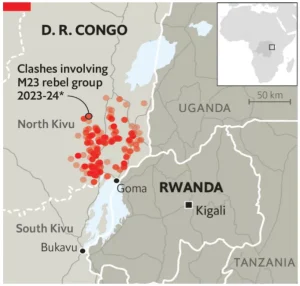
- M23 (March 23 Movement) is one of over 100 armed groups fighting Congolese forces in eastern DRC.
- Ethnic Composition: Leadership is dominated by ethnic Tutsis, a minority group in eastern DRC.
- Main Objective: Claims to protect the interests of Congolese Tutsis and other minorities, especially against Hutu rebel groups that fled to DRC after the 1994 Rwandan genocide.
- Location: Active in North Kivu province, along the borders of Rwanda and Uganda, with over 8,000 fighters as per UN estimates .
- Origin of Name: Named after the March 23, 2009, accord between the National Congress for the Defence of the People (CNDP), a Tutsi-led rebel group, and the Congolese government to end a Tutsi-led revolt.
- Allegations of Support: Rwanda is accused by the UN and DRC of supporting M23 with training, weapons, and even soldiers.
|
About Rwanda
- Landlocked country located south of the equator in east-central Africa.
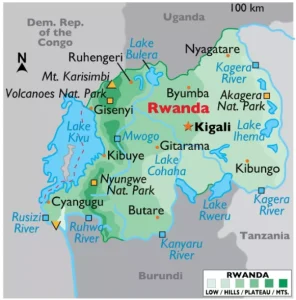 Part of the Great Rift Valley region of Africa, often referred to as the “land of a thousand hills” due to its hilly and mountainous terrain. Part of the Great Rift Valley region of Africa, often referred to as the “land of a thousand hills” due to its hilly and mountainous terrain.- It shares borders with Burundi (south), Tanzania (east), Uganda (north) and Democratic Republic of the Congo (DRC) (west).
- One of Africa’s most densely populated nations (~1,000 people per square mile), the Majority population comprises Hutu and Tutsi ethnic groups Predominantly Christian.
- Major Mountain Ranges: Albertine Rift and Virunga Mountains.
- Major rivers: Nile and Congo
- Other significant rivers: Kagera, Nyabarongo, Ruzizi, Luhwa, Akanyaru
- Drainage Patterns:
- ~80% of rivers drain into the Nile Basin via Lake Victoria
- ~20% drain into the Congo Basin via Rusizi River
- Lakes: Lake Kivu (bordering DRC) and Other Significant Lakes: Burera, Cohana, Ruhondo, Muhazi, Rweru, Ihema
About Democratic Republic of the Congo
- Located in Central Africa, it is the second-largest country in Africa after Algeria.
- It has a small maritime boundary with the Atlantic Ocean to the west.
- Shares land boundaries with
- North: Central African Republic and South Sudan.
- East: Uganda, Rwanda, Burundi, and Tanzania.
- West: Republic of the Congo and Angola.
- South: Zambia.
- The climate is tropical as the Equator passes through DRC.
- Home to the world’s largest tropical peatlands, along with Brazil and Indonesia
- The Congo River is the main river in the country , crosses the Equator twice and is one of the world’s deepest and second-longest rivers in Africa.
- The country is rich in minerals such as cobalt, copper, coltan, gold, coal, iron ore, and lithium.
|


 9 Dec 2025




.png)






 Current Affairs




 GS Foundation
 Optional Course
 Combo Courses
 Degree Program