Rapid adoption of Artificial Intelligence (AI) across sectors has significant environmental costs.
About Artificial Intelligence (AI)
- Refers: Artificial Intelligence is a branch of Computer Science that aims to create systems capable of Reasoning (using rules to reach conclusions), Learning (acquiring information and rules for using it), and Self-Correction.
- Objective:
- Drive economic growth, productivity enhancement, and national security
- AI leadership is a determinant of geopolitical power, economic competitiveness, and strategic autonomy.
- Key Domains of Application: Governance, healthcare, agriculture, defence, manufacturing, education, finance, climate action, and digital public infrastructure.
AI Market Dimension
- Global AI Market: The global AI economy is estimated at ~USD 400–450 billion (2026) and is projected to cross USD 2 – 2.5 trillion by early 2030s.
- Growth Rate: AI continues to register high double-digit growth (≈26–30% CAGR).
- Infrastructure Spend: Hyperscaler AI capital expenditure (data centres, advanced chips, cloud infrastructure) is expected to exceed USD 2 trillion cumulatively by 2026.
- Indian AI Market: India’s AI market is projected to reach ~USD 15–20 billion by 2027.
- Growth Rate: India ranks among the fastest-growing AI markets globally, with an estimated 25 – 35% CAGR.
- Talent Advantage: India accounts for ~16% of the global AI talent pool, ranking second worldwide.
- AI workforce demand is expected to approach 1 million professionals by end-2026.
AI’s Role in the Environment
- Pollution & Environmental Governance: AI platforms improve monitoring, compliance, and public access to environmental data.
- Example: Maharashtra Pollution Control Board’s GreenMind AI assists regulators and citizens with environmental compliance.
- Sustainable Agriculture: AI enables precision farming, early crop disease detection, and optimised resource use, reducing chemical inputs and water consumption.
- Example: IIIT Allahabad’s AI system detects crop diseases in real time enhances early intervention and reduces unnecessary chemical inputs.
- Smart Urban & Resource Management: AI optimises traffic flows and air quality monitoring, reducing urban environmental stress.
- Example: Project Green Light is a Google initiative that uses Artificial Intelligence (AI) to improve traffic flow at urban intersections, thereby reducing vehicle idling, fuel consumption, and carbon emissions.
- Waste Management: AI-powered image recognition technology in recycling facilities improves the sorting of materials, enhances the ability to turn waste into new products or even energy.
- Biodiversity Conservation: AI algorithms enable real-time monitoring of key issues affecting biodiversity, such as deforestation and shrinking wildlife populations.
- AI models can detect illegal activities, such as poaching and deforestation, and help predict ecosystem changes due to climate change.
- India’s first AI-enabled wildlife monitoring system installed by the Kerala Forest Department.
- Energy Efficiency & Climate Action: AI improves smart grids, building energy optimisation, and EV charging, reducing energy consumption and emissions.
- Climate Modelling & Disaster Management: AI enhances weather prediction, early warning systems, and climate risk forecasting, supporting disaster preparedness.
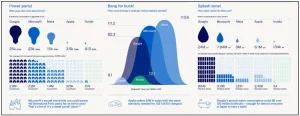
Environmental Costs of AI
- Energy Consumption:
- High Energy Demand: According to an OECD working paper, the development of AI algorithms is energy-intensive and results in significant environmental costs.
- For example, training large AI models like GPT-3 has been reported to consume 256,000 kWh of electricity, which is enough to power a home for over 20 years.
- Carbon Footprint:
- The global Information and Communication Technology (ICT) industry is estimated to be responsible for 1.8%-3.9% of global greenhouse gas (GHG) emissions.
- Resource Depletion:
- AI Servers and Cooling: According to a UNEP report, AI data centers may use between 4.2 to 6.6 billion cubic meters of water by 2027 for cooling systems.
- Raw Material: AI hardware requires rare earth metals, lithium, cobalt, copper, and gold.
- Mining these materials causes habitat destruction, water pollution, and high energy use.
- E-Waste Generation: The rapid pace of AI innovation results in hardware obsolescence and the generation of e-waste.
- According to research, e-waste could reach a total of 1.2-5.0 million metric tons by 2030, which is around 1,000 times more e-waste than was produced in 2023.
- Impact on Climate Change:
- Indirect Carbon Emissions: While AI can be used to optimize energy efficiency (e.g., in smart grids or automated buildings), its overall carbon footprint is concerning.
- Training and operating large AI models, such as Large Language Models (LLMs), can contribute significantly to carbon emissions if powered by fossil fuels.
- For example, training a single LLM has been shown to generate almost 300,000 kilograms of CO2 emissions, equivalent to the emissions produced by five cars over their lifetimes.
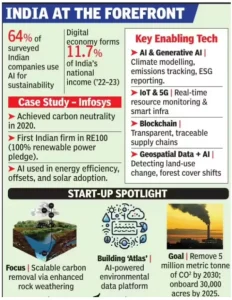
Global Initiatives to Mitigate AI’s Environmental Footprint
- UNESCO Recommendation (2021): The “Recommendation on the Ethics of Artificial Intelligence” has been adopted by nearly 190 countries.
- It emphasizes the need to recognize and mitigate Artificial Intelligence environmental risks.
- Paris Action Summit Legacy (2025): Building on previous summits, the Paris Summit officially incorporated AI Sustainability as a third pillar alongside Safety and Security.
- G7 AI Hub for Sustainable Development (2025): This initiative, endorsed by the G7 nations and UNDP, integrates renewable energy infrastructure with AI data centres in the Global South.
- US: Artificial Intelligence Environmental Impacts Act (2024):
- Mandates reporting and transparency on AI’s carbon footprint.
- Encourages sustainability standards for AI development and deployment.
- European Union (EU): Resolution on Harmonized AI Rules:
- Integrates environmental impact assessments into AI regulation.
- Promotes green AI practices across member states.
- Focus on standardised metrics for energy, water, and emissions.
India’s Initiatives for Sustainable AI
- Planet Sutra Framework (IndiaAI Impact Summit, 2026): India, as the host of the IndiaAI Impact Summit, introduced the Planet Sutra, positioning itself as a Global South leader.
- It emphasizes Mandatory Transparency, Sovereign Green Compute, and integrating environmental accountability into the national AI roadmap.
- Green Compute Pillar (IndiaAI Mission): Of the ₹10,372 crore allocated, a major portion funds Green Data Centres that are mandated to use Renewable Energy Certificates (RECs) and maintain a Power Usage Effectiveness (PUE) below 1.2, ensuring efficient energy consumption across AI infrastructure.
- BharatGen Model (2025): India’s foundational AI model employs Frugal Training, achieving high performance for Indic languages while using 40% less compute power than global peers.
- This demonstrates that AI efficiency and environmental sustainability can coexist.
Challenges in Mitigating AI’s Environmental Impact
- Complex Measurement Standards: There is no universally accepted framework for AI carbon accounting, leading to inconsistent estimates and weak comparability between organisations.
| Agentic AI is a new generation of artificial intelligence that acts with autonomy and purpose — it doesn’t just respond to commands but can set goals, plan, and execute tasks with minimal human intervention. |
- Agentic AI Surge: The rise of Agentic AI, which performs continuous background tasks, has increased inference energy consumption by 300% in just two years, placing immense pressure on data centres and energy infrastructure.
- Scope 3 Emissions Blind Spots: While organizations generally report Scope 1 and Scope 2 emissions (direct energy use), Scope 3 emissions—including the carbon footprint of GPU manufacturing, rare earth mining, and supply chains—remain largely unmeasured, creating gaps in true environmental accountability.
- Rebound Effect (Jevons Paradox): Gains in AI efficiency often lead to higher overall consumption, as lower operational costs drive greater usage, ultimately increasing net energy demand.
- Data Authenticity and Discursive Bias: Reports on AI’s carbon footprint are often incomplete or misleading. Current discourse overemphasizes AI as a climate solution while neglecting the environmental costs of training large-scale models.
- Regulatory and Policy Gaps: The MeitY AI Governance Guidelines (2025) emphasize Safety, Resilience, and Sustainability but lack enforceable environmental mandates such as lifecycle energy reporting, efficiency targets, or Environmental Impact Assessments for large-scale AI, leaving a critical policy gap requiring legislation or mission-level action.
- Social and Equity Implications: The environmental burden disproportionately impacts the Global South and vulnerable communities, as seen in water-stressed regions around major data centres, affecting local populations and ecosystems.
Way Forward
- Green Data Centre Leadership: India’s mandate for Power Usage Effectiveness (PUE) below 1.2 and 100% Renewable Energy Certificates (RECs) for IndiaAI Mission data centres sets a global benchmark for developing nations, demonstrating that high-performance AI infrastructure can coexist with aggressive decarbonisation goals.
- Frugal and Small Language Models (SLMs): India is prioritizing SLMs such as Yukti and Varta, which can run on mobile devices or edge servers, drastically reducing data centre traffic and energy consumption.
- Yukti and Varta are two of India’s new “Small Language Models (SLMs)” developed under the IndiaAI Mission.
- Circular Hardware Economy: Strengthening E-Waste (Management) Rules and mandating Hardware Passporting ensures every GPU and AI hardware has a clear recycling and refurbishment path, enabling recovery of rare earth minerals like Cobalt and Lithium.
- Sustainable AI Practices: Adoption of pre-trained models, renewable-powered data centres, and energy-efficient training methods ensures that AI development minimizes carbon footprint.
- AI for Green-fication: Deploying AI to support initiatives like the National Green Hydrogen Mission, Smart Grids, and climate monitoring helps offset the environmental impact of AI itself, making AI both a solution and a responsible user of resources.
- Standardization and Measurement: Implementing sustainability metrics for greenhouse gas emissions, energy, water, and natural resource consumption can guide policy, regulation, and corporate accountability.
- Others:
- Mandatory Environmental Impact Assessment (EIA) for Large AI Models: Extend the EIA Notification, 2006 to include high-compute AI projects, mandating lifecycle assessment from chip manufacturing and model training to deployment and e-waste disposal.
- Green Compute Taxonomy: Develop a national green compute taxonomy to classify AI systems based on energy efficiency, carbon intensity and water usage, with fiscal incentives for low-carbon models.
- District-Level Data Centre Zoning: Implement district-level zoning to restrict data centres in water-stressed regions and promote AI infrastructure in renewable-rich, low-risk coastal zones.
Conclusion
India’s approach to sustainable AI aligns with constitutional mandates under Articles 48A and 51A(g), reinforcing the state’s duty to balance technological growth with ecological protection.


 15 Jan 2026





.png)






 Current Affairs




 GS Foundation
 Optional Course
 Combo Courses
 Degree Program