The sudden resignation of Atanu Chakraborty, part-time chairman of HDFC Bank, citing “differences with values and ethics”, triggered concerns over corporate governance and ethical alignment.
About the Issue
- Ethical Dissonance in Institutional Frameworks: The case underscores a deep ethical incongruence between an individual’s moral conscience and prevailing organizational practices, wherein decision-makers may experience internal conflict while conforming to institutional expectations.
- Such dissonance is particularly pronounced in large and complex corporate entities where diffused responsibility often dilutes individual accountability and ethical ownership.
- Corporate Governance Deficits: The issue brings to light critical gaps in corporate governance structures, including limitations in transparency, the effective independence of boards, and robustness of internal accountability mechanisms.
- It also raises fundamental concerns regarding the tension between fiduciary responsibility (duty towards shareholders) and broader moral responsibility (duty towards stakeholders and ethical norms).
| Case-Specific Governance Concerns
The episode highlights several governance challenges:
- Board Independence: Concerns regarding effective oversight.
- Opacity in Decision-Making: Leads to information asymmetry and speculation.
- Weak Ethical Dissent Mechanisms: Lack of platforms for internal disagreement.
- Fiduciary vs Ethical Responsibility: Conflict between profit motives and ethical obligations.
- This underscores the need for ethics-driven governance beyond compliance.
|
- Erosion of Trust in Financial Systems: The situation highlights a growing trust deficit in financial institutions, particularly in systemically important banks, where stability is deeply rooted in public confidence and ethical credibility.
- Even perceptions of ethical compromise or governance lapses can have disproportionate consequences, potentially triggering investor anxiety, reputational damage, and systemic risk in the financial ecosystem.
Ethical Dilemma in the Case
The situation presents a classic ethical dilemma involving competing moral and professional obligations:
- Integrity vs Institutional Responsibility: Whether to uphold personal moral values or continue serving institutional stability and stakeholder interests.
- Conscience vs Continuity: Choosing between inner ethical conviction and the need for leadership continuity.
- Transparency vs Stability: Balancing ethical disclosure with risks to market confidence.
- Loyalty vs Moral Courage: Weighing organizational loyalty against ethical conviction.
- This reflects the tension between individual conscience and role-based obligations.
About Ethical Dissonance
- Conceptual Definition: Ethical dissonance refers to a moral conflict where an individual’s actions or decisions are inconsistent with their internal values, principles, or ethical beliefs.
- Theoretical Foundation: It is a specific manifestation of Cognitive Dissonance in the ethical domain, leading to inner tension, guilt, and moral discomfort.
- Contextual Occurrence: It is commonly observed in public administration, corporate governance, and professional life, especially under conditions of pressure, coercion, or competing obligations.
Core Features of Ethical Dissonance
- Value–Action Conflict: A mismatch between what one believes is right and what one actually does.
- Psychological Unease: Generates stress, guilt, and ethical anxiety, affecting decision-making.
- Rationalization Tendency: Individuals attempt to justify unethical behavior to reduce discomfort.
- Context-Driven Nature: Often triggered by external pressures like authority, institutional culture, or role expectations.
- Dynamic Resolution Process: May lead to behavioral change, belief adjustment, or ethical compromise over time.
Stakeholder Analysis and Ethical Impact
The ethical implications extend across multiple stakeholders:
- Board of Directors: Responsible for ethical governance, accountability, and oversight.
- RBI (Regulator): Ensures financial stability, trust, and systemic integrity.
- Shareholders/Investors: Sensitive to governance risks and ethical signals.
- Depositors/Public: Depend on trust, credibility, and institutional reliability.
- Employees: Affected in terms of organizational culture and morale.
- Outgoing Leader: Faces conflict between personal integrity and professional responsibility.
- This highlights the system-wide consequences of ethical decisions.
|
About Ethics
- Definition: Ethics refers to a system of moral principles that guide human conduct, enabling individuals and institutions to distinguish between right and wrong, and to act in a manner consistent with justice, fairness, and moral responsibility.
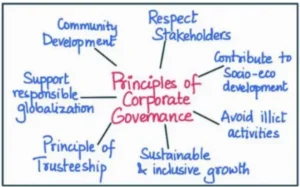 Normative Nature of Ethics: Ethics is inherently normative in character, as it prescribes standards of what ought to be done, shaping behavior in alignment with ideals of good conduct rather than mere compliance with rules.
- Contextual yet Value-Based Character: While ethical decision-making is often context-sensitive and influenced by situational factors, it remains anchored in universal moral values such as integrity, honesty, accountability, and fairness, ensuring consistency across diverse contexts.
- Core Ethical Values: The ethical framework encompasses foundational virtues like integrity (moral consistency), honesty (truthfulness), accountability (answerability for actions), and fairness (impartiality in decision-making), which collectively sustain trust and legitimacy in personal and institutional life.
- Dimensions of Ethics:
- Individual Ethics: This dimension relates to personal conscience and moral reasoning, guiding an individual’s behavior based on internalized values, beliefs, and sense of right and wrong.
- Professional and Social Ethics: Ethics extends to professional roles, where conduct is governed by codes, duties, and responsibilities, as well as to social ethics, which emphasize collective welfare, justice, and the larger common good in societal interactions.
About Personal Ethics
- Definition: Personal ethics refer to the internalized system of moral values and principles that guide an individual’s behavior, shaped by upbringing, cultural influences, life experiences, and one’s own conscience, forming the core of moral identity.
- Conscience-Driven Nature: These ethics are primarily guided by an individual’s inner voice or conscience, enabling self-regulation even in the absence of external supervision or enforcement.
- Relative Stability and Universality: Personal ethics tend to be relatively stable over time and often aligned with universal moral values, providing consistency in behavior across different situations and contexts.
 Core Moral Values: They encompass fundamental virtues such as honesty, compassion, integrity, empathy, and moral courage, which define the ethical character of an individual.
- Example: The resignation of a corporate leader (e.g., Chakraborty in the HDFC context) reflects moral courage and integrity, where personal ethical convictions are prioritized over positional authority, power, or material considerations.
About Professional Ethics
- Definition: Professional ethics refer to the codified set of norms, standards, and principles that govern conduct within a specific profession or organizational setting, ensuring discipline, accountability, and trust in professional roles.
- Role-Based and Institutional Character: These ethics are defined by the roles and responsibilities associated with a profession, and are shaped by organizational culture, legal frameworks, and industry-specific expectations.
- Structured and Enforceable Nature: Professional ethics are formally articulated through codes of conduct, regulatory frameworks, and oversight mechanisms, making them enforceable through institutional sanctions and disciplinary actions.
- Core Professional Values: They include confidentiality (protection of sensitive information), accountability (answerability for decisions), fiduciary duty (acting in the best interest of stakeholders), transparency, and professionalism.
- Example: In the banking sector, professional ethics emphasize prudence in financial decision-making, transparency in disclosures, and protection of depositors’ interests, which are critical for maintaining systemic stability and public trust.
Key Thinkers & Their Ethical Theories:
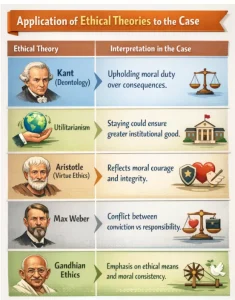
- Immanuel Kant – Deontological Ethics: Emphasizes duty, moral rules, and adherence to universal principles, where an action is considered ethical if it aligns with moral law, irrespective of outcomes.
- The resignation example reflects commitment to moral duty over situational convenience.
- Jeremy Bentham & John Stuart Mill – Utilitarianism: Advocates the principle of “greatest good for the greatest number”, where ethical decisions are evaluated based on their consequences and overall utility.
- Corporate decisions often prioritize profit maximization or stakeholder benefit, sometimes creating tension with individual ethics.
- Aristotle – Virtue Ethics: Focuses on moral character and cultivation of virtues, arguing that ethical behavior stems from habitual practice of virtues like integrity, courage, and prudence.
- Max Weber – Ethics of Conviction vs Responsibility: Distinguishes between acting based on absolute moral beliefs (conviction) and considering consequences of actions (responsibility), emphasizing the need for balance in leadership roles.
- Mahatma Gandhi – Ethical Philosophy: Advocated truth (Satya) and non-violence (Ahimsa), stressing that ethical means are as important as ethical ends, thereby reinforcing moral integrity in action.
|
Similarities Between Personal & Professional Ethics
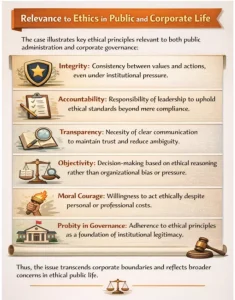
- Shared Moral Foundation with Institutional Recognition: Both are rooted in core values like integrity, fairness, accountability, and transparency, which are increasingly being formalized in governance frameworks.
- For instance, the RBI’s FREE-AI Framework (2025) explicitly emphasizes trust, fairness, and accountability as foundational ethical principles for financial systems, reflecting convergence between personal moral values and institutional ethics.
- Trust-Building Function in Society and Institutions: Both forms of ethics contribute to building trust and credibility, which is critical in sectors like banking. Recent data shows 72% of Indians believe financial institutions collect excessive data and 86% demand greater control, highlighting how ethical conduct both personal and institutional, is central to maintaining trust.
- Guidance for Ethical Decision-Making Across Contexts: Both guide individuals in making morally sound decisions, whether in private life or professional roles.
- Regulatory developments (e.g., RBI’s strengthened ombudsman and accountability frameworks in 2025–26) show how ethical principles are operationalized institutionally.
Key Differences Between Personal & Professional Ethics
- Source: Personal ethics originate from individual conscience, whereas professional ethics are institutionally codified and enforced.
- This is evident from RBI’s consolidation of 244 Master Directions (2025) to standardize ethical and regulatory compliance in banking.
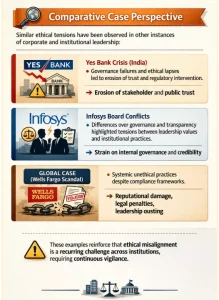 Nature: Personal ethics rely on self-regulation, while professional ethics involve formal enforcement mechanisms like audits, compliance checks, and regulatory oversight.
 -
- However, reports show gaps—e.g., only ~15–35% of financial institutions monitor AI bias or fairness, indicating weak enforcement in practice.
- Flexibility: Personal ethics are relatively stable, whereas professional ethics are context-dependent and role-based, often adapting to organizational goals like efficiency or profitability.
- Accountability: Personal ethics depend on internal moral responsibility, while professional ethics are backed by external accountability systems such as regulators, boards, and compliance bodies.
Ethical Dissonance Between Personal & Professional Ethics
- Conflict Between Personal Values and Institutional Expectations: Ethical dissonance arises when an individual’s Personal Moral Convictions come into conflict with Professional Role Obligations, a situation frequently observed across sectors such as Public Administration, Judiciary, Healthcare, Corporate Governance, and Information Technology (IT).
- This reflects a deeper tension between Conscience (Internal Ethics) and Compliance (External Duties).
- Impact on Trust, Legitimacy, and Institutional Credibility: Such ethical conflicts can lead to Erosion of Public Trust, Decline in Institutional Legitimacy, and Reputational Risks, not only in banking but also in governance and digital ecosystems.
- For instance, concerns over Data Privacy Violations and Algorithmic Bias in Artificial Intelligence (AI) systems have triggered Public Backlash, Regulatory Scrutiny, and Loss of Stakeholder Confidence, highlighting the systemic implications of ethical lapses.
- Structural and Systemic Drivers of Ethical Dissonance: Ethical dissonance is often rooted in Weak Accountability Mechanisms, Inadequate Oversight, Opaque Decision-Making Processes, and Performance-Oriented Incentive Structures that prioritize efficiency over ethics.
- Global policy frameworks such as United Nations Educational, Scientific and Cultural Organization (UNESCO) AI Ethics Recommendations emphasize the need for Robust Ethical Governance Mechanisms in emerging domains like AI.
- Illustrative Sectoral Manifestations:
- Public Administration: Pressure on civil servants to Manipulate Data or Bypass Due Process.
- Healthcare Sector: Conflict between Profit-Driven Hospital Policies and Patient Welfare Ethics.
- Corporate and IT Sector: Ethical concerns over Misuse of Personal Data and Unregulated AI Deployment.
- Judiciary and Legal Profession: Lawyers facing dilemmas between Professional Duty and Personal Moral Reservations.
- Resolution Imperative and Way Forward: Addressing ethical dissonance requires strengthening Ethical Governance Frameworks, Environmental Social Governance (ESG) Norms, Whistleblower Protection Mechanisms, and Transparency Standards.
- Promoting Ethical Leadership, Institutional Accountability, and Value-Based Decision-Making is essential to align Professional Ethics with Universal Moral Values, thereby minimizing dissonance and enhancing long-term institutional integrity.
| Ethical Decision-Making Framework
Ethical dilemmas of this nature can be addressed through a structured decision-making approach:
- Identification of Stakeholders and their competing interests
- Recognition of Ethical Conflict between personal values and professional duties
- Evaluation of Alternatives (continuation, dissent, exit, disclosure)
- Application of Ethical Principles (integrity, accountability, fairness)
- Decision and Justification, ensuring alignment with both ethical reasoning and institutional responsibility
- Such frameworks enable more systematic and transparent ethical choices in complex situations.
|
Way Forward
- Individual Level: Promote ethical awareness and moral reasoning through continuous training in ethics, values, and decision-making frameworks.
- Encourage moral courage, enabling individuals to act in accordance with conscience despite institutional pressures.
- Develop ethical sensitivity to recognize subtle forms of ethical compromise beyond clear legal violations.
- Foster a culture of self-reflection and accountability, where individuals evaluate the ethical implications of their decisions.
- Outcome: Aligns personal integrity with professional responsibilities.
- Institutional Level:
- Institutionalizing Ethical Dissent: Establish formal mechanisms such as Ethics Committees, independent board-level forums, and structured dissent recording systems.
- Encourage constructive disagreement within leadership to prevent suppression of ethical concerns.
- Strengthening Accountability Mechanisms: Conduct regular ethics audits and governance reviews to identify latent ethical risks.
- Integrate ethical performance indicators into organizational evaluation systems.
- Whistleblower Protection: Strengthen whistleblower protection frameworks to ensure confidentiality, non-retaliation, and institutional support.
- Create safe channels for reporting ethical misconduct or discomfort.
- Board Effectiveness and Independence: Enhance board independence, ensuring diversity of perspectives and reduction of conflicts of interest.
- Train board members in ethical leadership and governance responsibilities.
- Outcome: Transforms governance from compliance-based to ethics-driven systems.
- Regulatory Level: Enhance RBI’s supervisory role to include ethical risk assessment, not just financial compliance.
- Develop principled disclosure norms that balance transparency with market stability, reducing harmful ambiguity.
- Mandate periodic governance and ethics disclosures in annual reports.
- Strengthen fit-and-proper criteria for leadership positions, incorporating ethical track record.
- Outcome: Ensures systemic accountability and reinforces public trust.
- Organizational Culture: Foster a culture of values-based leadership, where ethics is integrated into strategic decision-making.
- Shift from rule-based compliance to principle-based governance, emphasizing intent and integrity.
- Promote open communication and transparency, reducing fear of dissent.
- Align incentive structures with ethical outcomes, discouraging purely profit-driven behavior.
- Outcome: Creates an environment where ethical behavior is normalized and rewarded.
- Structural Reforms: Address information asymmetry by improving disclosure standards and communication clarity.
- Reduce concentration of power through checks and balances in decision-making structures.
- Strengthen ESG (Environmental, Social, Governance) frameworks, embedding ethics into corporate evaluation.
- Incorporate technology ethics (AI governance, data privacy) into regulatory and corporate systems.
- Outcome: Minimizes structural drivers of ethical dissonance.
- Integrating Ethics into Public and Corporate Governance: Mainstream ethics through codes of ethics (values-based) rather than only codes of conduct (rule-based).
- Introduce mandatory ethics training across public and corporate sectors.
- Promote ethical leadership models, drawing from Gandhian ethics, virtue ethics, and constitutional values.
- Encourage public accountability mechanisms such as social audits, citizen charters, and stakeholder engagement.
- Outcome: Ensures holistic integration of ethics into governance systems.
Conclusion
Resolving ethical dissonance requires moving beyond formal compliance towards ethical coherence, where personal conscience, institutional frameworks, and regulatory systems operate in alignment. Sustainable governance in high-trust institutions depends not merely on rules and regulations, but on the consistent integration of integrity, accountability, and moral responsibility at all levels.


 23 Mar 2026

.png)




 Current Affairs




 GS Foundation
 Optional Course
 Combo Courses
 Degree Program