Subject: GS 3: Economy
Context: India’s EV ecosystem is expanding rapidly, driven by rising adoption, domestic manufacturing, supportive policies, and investments aimed at clean and energy-secure mobility.
UPSC Coaching Classes
About EV Ecosystem
- An Electric Vehicle (EV) ecosystem comprises the interconnected network of EV manufacturers, battery producers, charging infrastructure, component suppliers, software providers, research institutions, financing agencies, and government policies that collectively enable electric mobility.
- It supports sustainable transport, energy security, industrial growth, and reduced greenhouse gas emissions.
- Key Components
-
- Vehicle Manufacturing: It includes the production of electric two-wheelers, three-wheelers, passenger vehicles, buses, trucks, and associated Original Equipment Manufacturers (OEMs).
- Battery and Component Manufacturing: It covers Advanced Chemistry Cell (ACC) batteries, battery packs, motors, drivetrains, power electronics, wiring systems, and charging equipment, which form the technological backbone of EVs.
Status of EV Ecosystem in India
- Rapid Growth in EV Adoption: India sold 2.3 million EVs in 2025, compared to about 50,000 units in 2016, reflecting nearly 46-fold growth.
- EV adoption increased from 0.08% (FY 2015-16) to 8.26% (FY 2025-26), led by electric two-wheelers and three-wheelers.
- Expansion of Manufacturing and Exports: India is emerging as a global EV manufacturing hub with expanding domestic production and nearly 400 EV startups.
- EV exports increased from USD 1.2 million (2020) to USD 84 million (2024).
- Growing Charging Infrastructure: India had 52,718 public charging stations by July 2026, including 16,561 fast-charging stations.
- The e-Amrit platform and private companies such as Hyundai are expanding charging networks across cities and highways.
|
-
- Charging Infrastructure: It comprises public and private charging stations, fast chargers, smart charging solutions, and digital platforms such as e-Amrit for locating charging facilities.
- Policy and Innovation Ecosystem: It includes government incentives, R&D, startups, AI-enabled mobility solutions, financing, and skilled workforce development to accelerate EV adoption.
Key Initiatives to Develop EV Ecosystem
- National Electric Mobility Mission Plan (NEMMP 2020): Strategic roadmap for EV adoption and domestic manufacturing.
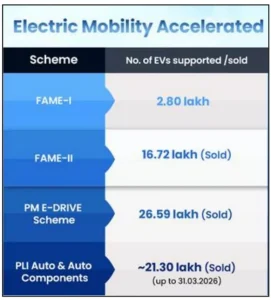
- FAME India Scheme: Faster Adoption and Manufacturing of Hybrid and Electric Vehicles (FAME) India Scheme was launched in April 2015 and implemented in two phases, Phase I (2015–2019) and Phase II (2019–2024).
- Its key objectives are to accelerate the adoption of hybrid and electric vehicles through upfront purchase incentives and to build robust public charging infrastructure
PM E-DRIVE Scheme: ₹10,900 crore scheme supporting over 28 lakh EVs, charging infrastructure, and public transport electrification.
- PLI Scheme for Automobile & Auto Components: Promotes Advanced Automotive Technology and EV manufacturing with domestic value addition.
- PLI Scheme for ACC Battery Storage: ₹18,100 crore scheme to establish 50 GWh domestic battery manufacturing capacity.
- Scheme for Promotion of Manufacturing of Electric Passenger Cars (SPMEPCI): Encourages domestic EV manufacturing and investment.
- State Initiatives: As of December 2025, 29 States/UTs had notified EV policies, while four were in the draft stage.
- Incentives include capital subsidies, stamp duty waivers, land allotment, and SGST reimbursement.
- Tamil Nadu, Maharashtra, Karnataka, Gujarat, Haryana, and Uttar Pradesh have developed robust EV manufacturing ecosystems.
- Delhi EV Policy focuses on reducing vehicular emissions and improving air quality through large-scale EV adoption and replacement of polluting commercial vehicles.
India’s Targets

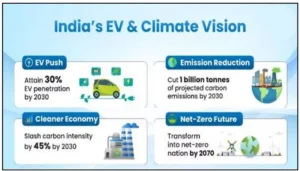
- EV Adoption Target: India aims to ensure 30% of all vehicle sales are electric by 2030, aligned with the EV30@30 initiative.
- Charging Infrastructure Expansion: India plans to establish 1.32 million charging stations by 2030 to support large-scale EV adoption.
- Global Manufacturing and Net-Zero Vision: India seeks to become a globally competitive EV manufacturing and export hub while reducing oil imports and contributing to its Net Zero by 2070 commitment.
Click to Know UPSC OnlyIAS Coaching Centres
Conclusion
A robust EV ecosystem will strengthen India’s energy security, industrial competitiveness, clean mobility, and leadership in the global green transportation transition