Despite being a traditional safe-haven, gold prices have declined since the onset of the West Asian conflict, reflecting shifting investor behaviour and market dynamics.
- In India, 24-carat gold, which was trading close to ₹1.9 lakh per 10 grams in late January, has dropped to around ₹1.3 lakh per 10 grams.
About Gold as an International Commodity
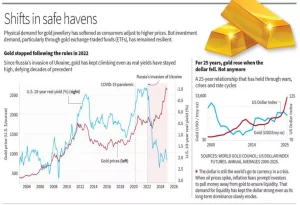
- Gold is a globally traded commodity with uniform quality standards (e.g., 24-carat purity), making it easily acceptable across countries.
- It is priced internationally in U.S. dollars, linking its value closely to exchange rate movements and global financial conditions.
- Gold serves as a store of value and hedge against inflation, especially during economic and geopolitical uncertainty.
- It is actively traded on major commodity exchanges such as the London Bullion Market Association and COMEX, ensuring high liquidity and transparent pricing.
Factors Deriving Gold Demand
- Gold demand is driven by multiple factors including investment demand, jewellery consumption (especially in countries like India and China), and central bank purchases.
- Its supply is relatively limited and depends on mining output, recycling, and geopolitical factors, making it sensitive to global shocks.
Enroll now for UPSC Online Course
Gold Reserves in India
- Gold Reserves in India occur mainly in auriferous hard rocks and alluvial (placer) deposits found in river sands.
- The distribution of gold reserves is uneven and largely concentrated in the Peninsular Plateau region.
- Largest resources of gold ore located in Bihar (44%), followed by Rajasthan (25%), Karnataka (21%), West Bengal (3%), Andhra Pradesh (3%), Jharkhand (2%)
- Karnataka commands around 80% of the nation’s total gold output.
- Key Gold Reserves:
-
- Hutti Gold Mines: The Hutti Gold Mines, which began operations in 1947, have remained the primary source of domestically produced gold in India.
- Kolar Gold Fields (KGF): The Kolar Gold Fields, established in 1880, dominated India’s gold production for several decades until their closure in 2001, nearly eight decades after the commencement of operations at Hutti.
- Jonnagiri Gold Mine: Jonnagiri is set to become the first large-scale gold mine to commence production in independent India, marking a significant development in the country’s gold mining sector.
Fall in Gold Prices: Reasons
Since the onset of the West Asian crisis, factors that usually support gold, low interest rates, and a weaker dollar, have all moved in the opposite direction. For Example:
- Rise in Interest Rate Expectations: Higher inflation expectations have led markets to anticipate that central banks will keep interest rates higher for longer, reducing the attractiveness of gold.
- Increase in Bond Yields: Rising yields on government bonds provide fixed returns, making them more attractive compared to gold, which is a non-yielding asset.
- Strengthening of the U.S. Dollar: Higher expected interest rates also make dollar-denominated assets such as U.S. Treasury bonds are more attractive.
- As money flows into these assets, the dollar strengthens — and a stronger dollar makes gold more expensive for foreign buyers, dampening demand.
- Higher Opportunity Cost of Holding Gold: As interest rates rise, the opportunity cost of holding gold increases since investors forego interest income from alternative assets.
- Profit Booking After Record Highs: Gold prices had reached historic highs, prompting investors to book profits, which contributed to the decline.
Why Does Gold Usually Rise in a Crisis?
- Safe Haven Demand: Gold acts as a safe-haven asset, as investors shift towards it during periods of economic uncertainty to preserve wealth.
- Non-Interest Bearing Nature: Gold does not generate interest or dividends; therefore, when returns on assets like U.S. Treasury Bonds decline, gold becomes relatively more attractive.
- Interest Rate & Bond Yield Effect: During crises, falling interest rates and bond yields reduce the opportunity cost of holding gold, leading to increased demand.
- Dollar Factor: Gold is globally priced in US Dollar; hence, a weaker dollar makes gold cheaper for foreign buyers, boosting demand and prices.
- Combined Macroeconomic Effect: A combination of low interest rates, weak dollar, and high uncertainty creates favourable conditions for a rise in gold prices.
- Inflation Hedge: Gold serves as a hedge against inflation, helping investors protect their purchasing power during economic instability.


 27 Mar 2026






.png)






 Current Affairs




 GS Foundation
 Optional Course
 Combo Courses
 Degree Program