Indian Space Research Organisation has successfully conducted the Second Integrated Air Drop Test (IADT-02) to test safe landing of the crew module for Gaganyaan Mission.
UPSC Online Preparation
About the Gaganyaan Integrated Air Drop Test
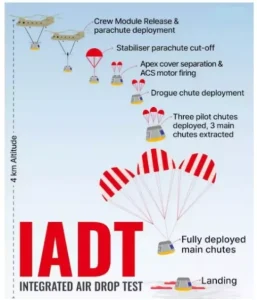
- The test validated the Crew Module’s parachute-based deceleration system, crucial for controlled descent.
- Purpose: The test focuses on the most critical phase of Gaganyaan, the safe return of astronauts, ensuring reliable descent and splashdown systems.
- Test Procedure: A simulated crew module is air-dropped from altitude and descends using a multi-stage parachute system to test stability and deceleration.
- Safe Landing Mechanism: It confirmed the system’s ability to reduce high re-entry velocity to safe limits for splashdown in the sea.
Gaganyaan Orbital Module
- Components: The Gaganyaan Mission orbital module consists of Crew Module (CM) for astronauts and Service Module (SM) for propulsion.
- De-orbiting Mechanism: The Service Module thrusters perform de-orbiting manoeuvres to bring the spacecraft back towards Earth.
- Service Module Separation: After de-orbiting, the SM separates and burns up during re-entry due to intense atmospheric heat.
Click to Know UPSC OnlyIAS Coaching Centres
Gaganyaan Mission
- Gaganyaan Mission is India’s first mission to send humans into space.
- Objective: To send a crew of 3 astronauts to Low Earth Orbit (~400 km) for about 3 days and bring them back safely.
- Launch Vehicle: The mission will use Human-Rated LVM3 (HLVM3), modified for high safety and reliability.
- Tests for Safety: Missions like IADT, Pad Abort Test (PAT), and Test Vehicle flights are conducted to validate systems before the manned mission.
- Safety Systems: Includes Crew Escape System, Life Support System, and Thermal Protection System for safe launch and re-entry.
|
How Will Gaganyaan Crew Land?
- Controlled Re-entry: The Crew Module follows a precise re-entry corridor and will re-enter Earth’s atmosphere at ~7,800 m/s carrying astronauts.
- Aerobraking: The module will lose most of its kinetic energy through aerobraking, where atmospheric drag slows it down significantly.
- Aerobraking is the process by which a spacecraft slows down by using Earth’s atmosphere, where air resistance (drag) reduces its speed without using fuel.
- Parachute-Based Descent: At ~12 km altitude, a multi-stage parachute system will deploy sequentially to further reduce speed and stabilise descent.
- Controlled Splashdown: The module will land in the Bay of Bengal, with water acting as a natural shock absorber.
- Elliptical Landing Zone: Due to high forward momentum and minimal lateral control, the module lands within an elongated elliptical zone.
- Post-Landing Stabilisation: Parachutes will be released and flotation bags will inflate automatically to keep the module upright and stable.
- Tracking & Location: The module will transmit GPS signals, homing beacons, and visual markers (dye, strobe lights) for quick identification.
- Recovery by Indian Navy: The Indian Navy will retrieve the module using divers, flotation collars, and ships to safely extract the astronauts (Gaganyatris).


 10 Apr 2026





.png)






 Current Affairs




 GS Foundation
 Optional Course
 Combo Courses
 Degree Program