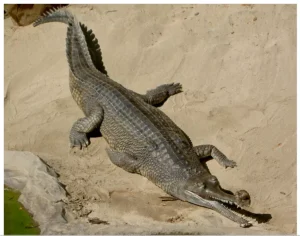
Illegal Sand Mining Threatens Gharials in National Chambal Sanctuary

14 Mar 2026

Illegal Sand Mining Threatens Gharials in National Chambal Sanctuary

The Supreme Court of India Bench of Justice Vikram Nath and Justice Sandeep Mehta took suo motu cognisance of media reports highlighting illegal sand mining threatening the ecology of the National Chambal Sanctuary.

  • The court noted that extensive sand mining forced relocation of Gharial populations, but even the new habitat areas in Madhya Pradesh were later affected by mining.
  • Earlier, the National Green Tribunal (NGT) had taken cognisance of the 2022 report “Digging up the Chambal” and directed authorities to monitor and curb illegal mining.
    • The report highlighted the role of organised sand mafias, using tractor-trolleys and unregistered vehicles to extract sand and transport it illegally.
    • Weak enforcement and lack of coordination among law-enforcement agencies have enabled mining mafias to operate aggressively against forest officials.
    • Geographical conditions—low rainfall and exposed sandbanks—allow mining activities to continue throughout the year.

About Gharials

National Chambal Sanctuary

  • Scientific Name: Gavialis gangeticus
  • Appearance: Gharials exhibit sexual dimorphism. 
    • They have long, slender snouts with interlocking sharp teeth.
    • Males have a bulbous snout tip resembling an inverted pot giving the name Gharial.
  • Diet: Primarily fish-eating, helping maintain aquatic ecosystem balance.
  • Sacred Significance: In Indian mythology, often depicted as the divine mount of Goddess Ganga.
  • Distribution: Historically, the Gharial range spanned to the Indus, Ganga, Brahmaputra and Mahanadi-Brahmani-Baitrani River systems of India, Bhutan, Bangladesh, Nepal and Pakistan.
  • Presently, their major population occurs in three tributaries of the Ganga River: the Chambal and the Girwa Rivers in India and the Rapti-Naryani River in Nepal.
  • Breeding Season: November to January; nesting occurs March to May on sandbanks and islands.
  • Ecosystem Role: Help maintain clean rivers by consuming carrion.

Also Read | UPSC Result 2025

Threats to Gharial Population

  • Historical Threats: Overhunting for skins, trophies, eggs, and traditional medicine.
  • Modern Threats
    • Habitat destruction: Dams, irrigation canals, river course changes, and sand mining.
    • Pollution: Industrial and agricultural waste harming river ecosystems.
    • Fishing Activities: Gill nets cause accidental deaths, even in protected areas.

Conservation status of  Gharials

  • The National Chambal Sanctuary (NCS) recorded 2,456 gharials in 2024, showing successful conservation efforts.
  • Gharial populations declined by 80% between the 1950s-60s but later saw a steady recovery until 1997.
  • Between 1997 and 2006, the population dropped by 58%, from 436 to 182 adults.
  • Gharials are extinct in Myanmar and Bhutan, with small uncertain populations in Pakistan, Nepal, and Bangladesh.

Conservation Efforts in India

  • Captive Breeding (1975-1982): 16 breeding centers established to rear and release hatchlings.
  • Reintroduction in Punjab (2017-2020): Gharials were reintroduced in the Sutlej and Beas rivers.
  • Key Sanctuaries: National Chambal (MP), Katerniaghat (UP), Son River (MP), and Satkosia Gorge (Odisha).
  • Threat Management: Illegal sand mining banned, pollution monitored, and strict fishing regulations enforced.
  • Community Involvement: Local communities engaged in habitat protection and awareness programs to reduce conflicts.

About National Chambal Sanctuary (NCS)

  • Located on the Chambal River near the tripoint of Rajasthan, Madhya Pradesh and Uttar Pradesh.
  • It was first declared in Madhya Pradesh in 1978, and now constitutes a long narrow eco-reserve co-administered by the M.P , U.P and Rajasthan.
  • Protects a 435-km stretch of the Chambal River, one of India’s cleanest rivers.
  • Home to 290+ bird species, including Indian Skimmers (80% of India’s population).
  • Acts as a breeding ground for gharials, helping revive populations in other states.

Check Out UPSC CSE Books

Visit PW Store

online store 1

Conservation Crocodile species found in India

Species Scientific Name Habitat IUCN Status WPA, 1972 Schedule
Gharial Gavialis gangeticus Freshwater rivers (Chambal, Ganga, Brahmaputra) Critically Endangered Schedule I
Mugger Crocodile Crocodylus palustris Freshwater lakes, rivers, marshes Vulnerable Schedule I
Saltwater Crocodile Crocodylus porosus Estuaries, coastal mangroves, brackish water Least Concern Schedule I

Need help preparing for UPSC or State PSCs?

Connect with our experts to get free counselling & start preparing

Aiming for UPSC?

Download Our App

      
Quick Revise Now !
AVAILABLE FOR DOWNLOAD SOON
UDAAN PRELIMS WALLAH
Comprehensive coverage with a concise format
Integration of PYQ within the booklet
Designed as per recent trends of Prelims questions
हिंदी में भी उपलब्ध
Quick Revise Now !
UDAAN PRELIMS WALLAH
Comprehensive coverage with a concise format
Integration of PYQ within the booklet
Designed as per recent trends of Prelims questions
हिंदी में भी उपलब्ध

<div class="new-fform">


    </div>

    Subscribe our Newsletter
    Sign up now for our exclusive newsletter and be the first to know about our latest Initiatives, Quality Content, and much more.
    *Promise! We won't spam you.
    Yes! I want to Subscribe.