The India-AI Impact Summit 2026, held in New Delhi, marked a historic pivot from the “Safety-First” regulatory models of the West toward an “Impact-First” developmental paradigm.
- Attracting five lakh visitors, the summit signaled India’s emergence as a technological standard-setter for the Global South.
- Recently, ahead of India hosting the Global AI Summit (Feb 16–20, 2026), Switzerland announced its intent to host the next edition in Geneva in 2027, reflecting the emerging institutionalisation of international cooperation on AI governance and regulation.
Key Highlights of the India-AI Impact Summit 2026
New Delhi Declaration
- Democratizing AI Resources:
- Access & Infrastructure: Emphasizes that affordable connectivity and robust digital infrastructure are essential prerequisites for AI deployment.
- Global Equity: Inspired by “Vasudhaiva Kutumbakam,” the goal is to make AI resources accessible to all nations to benefit their citizens.
- Key Initiative: The Charter for the Democratic Diffusion of AI, a voluntary framework to promote foundational resources and local innovation.
- Economic Growth and Social Good:
- Scalability: Highlights open-source applications and accessible approaches to drive wide-scale adoption and adaptability across sectors.
- Practical Platforms: Focuses on the replication of successful AI use cases to drive development.
- Key Initiative: The Global AI Impact Commons, a platform for sharing and scaling successful AI deployments across regions.
- Secure and Trusted AI:
- Trust Foundations: Prioritizes security and robustness throughout the AI lifecycle to maximize societal benefits.
- Policy & Technical Standards: Encourages industry-led voluntary measures and technical solutions to protect the public interest.
- Key Initiative: The Trusted AI Commons, a collaborative repository of benchmarks, tools, and best practices.
- AI in Science:
- Research Infrastructure: Focuses on removing structural barriers to increase the availability of AI for scientific R&D.
- Cross-Border Collaboration: Aims to pool expertise and resources to accelerate scientific discovery.
- Key Initiative: The International Network of AI for Science Institutions, connecting scientific communities to accelerate impactful adoption.
- Access for Social Empowerment:
- Inclusion: Leverages AI to provide knowledge, services, and opportunities to all sections of society.
- Knowledge Exchange: Facilitates the sharing of learning and scalable practices specifically aimed at social upliftment.
- Key Initiative: A collaborative platform for exchanging scalable practices that advance social empowerment.
- Human Capital:
- Skill Development: Targets AI literacy, workforce training, and the education of public officials to prepare for an AI-driven economy.
- Future Readiness: Emphasizes the need for vocational upgrading and international reskilling initiatives.
- Key Initiatives: Voluntary guiding principles for reskilling and a playbook on AI workforce development.
- Resilience, Innovation, and Efficiency:
-
- Sustainability: Addresses the high demand for energy and natural resources, advocating for the development of energy-efficient systems.
- Local Innovation: Aims to keep AI systems affordable to accelerate local development and shared goals.
- Key Initiatives: Voluntary Guiding Principles for efficiency and a Playbook on Advancing Resilient AI Infrastructure.
|
- The New Delhi Declaration & Charter for Democratic Diffusion: Endorsed by 89 countries and international organizations (with Bangladesh as the final signatory), this document formalizes a shift toward the “Democratic Diffusion” of AI.
-
- It mandates that foundational resources— specifically high-performance compute (HPC) and vetted datasets—be treated as a Global Public Good to prevent “Technological dependency.”
- Sarvajan Hitaya Philosophy: The declaration explicitly embeds the Indian ethos of “Sarvajan Hitaya, Sarvajan Sukhaya” (Welfare of All, Happiness of All), establishing AI as a Global Public Good—similar to the digital architecture of UPI and Aadhaar.
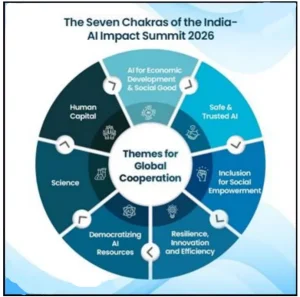
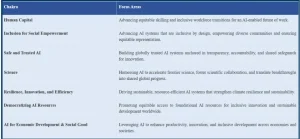
- The Seven Chakras of Action: The summit deliberations were organized around seven thematic pillars (Chakras), ranging from Human Capital Development to Energy-Efficient AI, ensuring a holistic approach to technological growth (refer images).
- The MANAV Vision (PM Modi’s Human-Centric Blueprint):
-
- M – Moral Systems: Establishing Global Ethical Guardrails to mitigate socio-cultural biases in algorithms.
- A – Accountable Governance: Implementing Verifiable Transparency through algorithmic audits and transparent oversight.
- N – National Sovereignty: Asserting Data Sovereignty, ensuring that data generated by citizens remains under national jurisdiction.
- A – Accessible & Inclusive: Prioritizing “Linguistic Justice” by supporting all 22 official Indian languages to prevent a “digital intelligence divide.”
- V – Valid & Legitimate: Mandating Proof of Origin and watermarking for AI content to ensure outputs are legally valid and traceable.
- Frontier AI Impact Commitments: Major global and domestic tech firms signed voluntary frameworks to evaluate AI systems for global contexts, specifically pledging to publish anonymized usage data to help developing nations track AI’s economic impact.
- Economic & Research Windfall:
- Additionally, $20 billion was pledged specifically for frontier deep-tech research, moving India beyond a service-oriented economy toward a research-led powerhouse.
- Infrastructure Investment Breakdown: The $250 billion commitment specifically targets the “physicality” of AI.
- This includes ₹2.9 lakh crore from Amazon and ₹1.5 lakh crore from Microsoft for building 1GW AI-ready Data Centers.
- Sarvam-105B & BharatGen: The launch of Sarvam-105B—a multi-billion parameter Mixture of Experts (MoE) model—demonstrated India’s ability to build sovereign foundation models that are optimized for voice-first interactions in Indic languages, outperforming Western models on local cultural benchmarks.
- IndiaAI Mission 2.0: The government announced a transition to Mission 2.0, aiming to onboard 38,000 sovereign GPUs into the national compute portal, moving India closer to “Compute Autonomy.”
- Indigenous Technological Milestones: The launch of Sarvam AI’s multi-billion parameter LLMs demonstrated India’s capacity to build efficient, open-source models that outperform Western counterparts on localized benchmarks.
About Artificial Intelligence (AI)
- Refers: Artificial Intelligence is a branch of Computer Science that aims to create systems capable of Reasoning (using rules to reach conclusions), Learning (acquiring information and rules for using it), and Self-Correction.
- Objective: To drive economic growth, productivity enhancement, and national security, reflecting the view that AI leadership is a determinant of geopolitical power, economic competitiveness, and strategic autonomy.
- Technology Focus: AI technology focuses on building systems that can exhibit various intelligent behaviors, including:
- Machine Learning (ML): A subset of AI, ML enables systems to learn from data and improve over time without being explicitly programmed.
- Natural Language Processing (NLP): Aims to enable machines to understand, interpret, and respond to human language.
- Computer Vision: The ability of machines to interpret and make decisions based on visual inputs, such as images or video.
- Robotics: Combines AI with sensors and actuators to enable machines to interact with and perform tasks in the physical world.
- Deep Learning: A specialized area of ML that uses neural networks with many layers to process large amounts of data, often leading to breakthroughs in areas like speech and image recognition.
Classification of Artificial Intelligence
- Narrow AI (Weak AI): Task-specific systems designed to perform well-defined functions such as facial recognition, speech processing, recommendation engines, or language translation (e.g., Bhashini).
- Represents the current and dominant form of AI in real-world use.
- General AI (Strong AI): A theoretical form of AI capable of understanding, learning, and applying intelligence across any domain, comparable to human cognitive abilities such as reasoning, abstraction, and common sense.
- Does not yet exist; raises profound ethical and governance questions.
- Generative AI: A specialised subset of AI (largely within Narrow AI) that can generate new content—including text, images, audio, video, and code—by learning statistical patterns from large datasets (e.g., ChatGPT, Gemini, DALL·E).
- Economically disruptive due to its impact on creativity, productivity, and labour markets.
|
Significance of the India-AI Impact Summit 2026
- Strategic Autonomy in the “Technological competition”: By rejecting the U.S. proposal to build solely on the “American AI Stack,” India asserted its right to develop a sovereign vertical technology stack, ensuring it does not become a permanent “Strategic dependency.”
- Formalization of Pax Silica: By joining the US-led Pax Silica coalition, India has secured its role in the “Silicon Stack.”
- This ensures a “Trusted Corridor” for semiconductor supply chains, from raw minerals to 2nm chip design, directly countering the “Competing semiconductor blocs” of geopolitical rivals.
- Leadership of the Global South: The summit successfully rebranded AI from a “Precautionary regulatory approach” (Western narrative) to a “Developmental enabler” (Indian narrative), positioning AI as Digital Public Infrastructure (DPI).
- Triad of Growth: The event showcased India’s unique Trifecta—the combination of a formidable talent pool, massive domestic capital, and deepening strategic partnerships with global tech giants like OpenAI and Google.
- Public Legitimacy & The Guinness World Record: To move beyond high-level policy and ensure grassroots buy-in, the summit achieved a Guinness World Record for the “Most pledges received for an AI responsibility campaign in 24 hours.
- With over 2.5 lakh citizens (primarily students) pledging to use AI ethically and responsibly, India demonstrated a unique bottom-up commitment to the MANAV vision, proving that the digital transition is a shared national mission rather than just a top-down mandate.
Challenges & Concerns that Need to be Tackled
- The “Voluntary” Paradox: Since the New Delhi Declaration and Frontier Commitments are non-binding, there is a significant risk that tech-superpowers may prioritize commercial secrecy over the promised democratic diffusion.
- Infrastructure Deficits: As highlighted by Sam Altman (OpenAI CEO), the world currently lacks the gargantuan levels of compute power required for India to become a fully AI-first society, with orbital data centers still a decade away.
- Societal Destabilization: The proliferation of deepfakes and fabricated content threatens to destabilize open societies and elections, necessitating a robust mechanism for digital authenticity.
- Labor Disruption: With the IT sector comprising 8% of India’s GDP, the potential for job displacement remains a source of collective anxiety, requiring an unprecedented scale of human capital reskilling.
- Societal Destabilization & The Regulatory Response: While the proliferation of deepfakes remains a threat, the government utilized the summit to notify the IT Amendment Rules 2026.
- This landmark framework formally defines “Synthetically Generated Information” (SGI) and mandates a compressed three-hour takedown window for illegal content.
- Furthermore, it enforces mandatory watermarking and technical metadata traceability, ensuring that AI-generated media can be traced back to its source, thereby preserving digital authenticity in an open society.
Way Forward
- Content Labeling Standards: India should lead the development of “Digital Nutrition Labels,” utilizing mandatory watermarking and source-tracking to distinguish between real and AI-generated media.
- Child-Safe AI Ecosystems: Developing “Family-Guided” AI spaces, ensuring that AI tools for education are as strictly curated as school syllabi.
- Energy-Infrastructure Synergy: To meet the massive power demands of AI while staying committed to Net Zero targets, India must accelerate nuclear and green-energy-powered data centers.
- Institutionalizing the Baton: Establishing a permanent International Secretariat for AI Summits to move beyond the current “baton-passing” model and ensure continuity in global tech governance.
Conclusion
The India-AI Impact Summit 2026 was a defining moment where India transitioned from a passive recipient of technology to an active architect of the global digital order. By championing the MANAV vision, India has successfully balanced the geopolitical contest for power with a human-centric commitment to development. The summit proves that for India, AI is not just a tool for fortune, but the cornerstone of a Sovereign, Inclusive, and Trusted future.


 23 Feb 2026







.png)






 Current Affairs




 GS Foundation
 Optional Course
 Combo Courses
 Degree Program