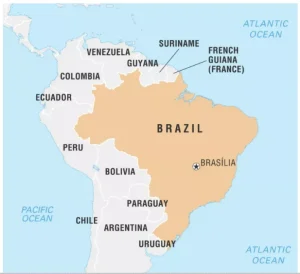
Recently, the Brazilian President Luiz Inácio Lula da Silva visited India at the Indian PM Narendra Modi’s invitation.
Key Outcomes of the Brazilian President’s Visit (2026)
- Joint Declaration on Digital Partnership for the Future: This establishes a strategic framework for a digitally empowered future.
 A cornerstone of this is the Open Planetary Intelligence Network (OPIN), which seeks to leverage Digital Public Infrastructure (DPI) to accelerate climate action and sustainable development goals.
- Trade and Economic Cooperation: India and Brazil have set an ambitious target to boost their bilateral trade to 30 billion dollars by 2030, up from the previous goal of 20 billion dollars.
- Critical Minerals and Rare Earth Elements: A Memorandum of Understanding (MoU) was signed to secure value chains in Rare Earths and Critical Minerals, essential for the transition to green energy and high-tech manufacturing.
- This is complemented by a specific pact on Mining for the Steel Supply Chain.
- Strategic Health Collaboration: A vital MoU was signed between the Brazilian Health Regulatory Agency (ANVISA) and India’s Central Drugs Standard Control Organization (CDSCO) to expedite regulatory approvals.
- Additionally, private-sector partnerships between Fiocruz and Indian firms like Biocon and Lupin focus on Research & Development (R&D) for socially determined and oncological diseases.
- Traditional Knowledge Digital Library (TKDL) Access: In a major move for intellectual property rights, Brazil’s National Institute of Intellectual Property (INPI) was granted access to India’s Traditional Knowledge Digital Library, a database managed by the Council of Scientific and Industrial Research (CSIR) to prevent the misappropriation of ancient medicinal knowledge.
- Defense and Maritime Security: The leaders welcomed a trilateral MoU between Mazagaon Dock Shipbuilders Limited (MDL) and both Navies for the maintenance of Scorpene-class submarines, linking India’s Atmanirbhar Bharat (Self-Reliant India) initiative with Brazil’s defense industrial base.
About India-Brazil Relations
- Historical and Civilizational Foundations:
- Five Centuries of Connectivity: The link traces back to the 16th century, when Goa and Brazil were pivotal nodes in the Portuguese Imperial Empire.
- This legacy is preserved in shared culinary traditions, textile patterns, and architectural motifs that reflect a long-standing trans-oceanic exchange.
- The “Gir” Connection: The vast majority of Brazilian cattle are of Indian origin (Zebu breeds such as Gir and Kankrej).
- This genetic link remains a cornerstone of Brazil’s multibillion-dollar agribusiness and serves as a unique symbol of biological diplomacy.
- Modern Soft Power: Awareness of India was revolutionized in the 21st century by the popular telenovela “Caminho das Indias” (Paths of India), while the “Filhos de Gandhy” (Sons of Gandhi) in Salvador continues to integrate Gandhian principles of non-violence into the world-famous Brazilian Carnival.
- Political Cooperation and Multilateral Leadership:
- Reciprocal Multilateralism: Both nations align on the principle of Strategic Autonomy, refusing to be marginalized in a bipolar world order. Brazil’s foreign policy often mirrors India’s vision of a multipolar globe.
- UNSC Reform (G4): As members of the G4 (India, Brazil, Germany, Japan), both nations are intensifying their joint pursuit of permanent membership in the UN Security Council, arguing that a body excluding a combined population of nearly 1.6 billion people lacks global efficacy and legitimacy.
- BRICS Chairship 2026: Under India’s current presidency, the focus is on “Building for Resilience, Innovation, Cooperation and Sustainability.”
- President Lula has pledged full support for India’s humanity-first approach, ensuring that the BRICS and IBSA (India-Brazil-South Africa) forums remain voices for inclusive growth.
- Parliamentary Diplomacy: High-level exchanges have reached a peak, with Speaker Om Birla leading a delegation to the BRICS Parliamentary Forum in Brasília (June 2025) and Dr. Shashi Tharoor leading a strategic delegation to discuss counter-terrorism mechanisms following the 2025 Pahalgam attack.
- Economic and Energy Relations:
- Brazil remains India’s preeminent trading partner in Latin America, with both leaders targeting a USD 30 billion bilateral trade goal by 2030.
- Trade Dynamics: For the 2024-25 fiscal year, bilateral trade accounted for USD 12.20 billion. Indian exports reached USD 6.77 billion (dominated by organic chemicals, diesel, and pharmaceuticals), while imports from Brazil stood at USD 5.43 billion (crude petroleum, soybean oil, and gold).
- Investment Footprint: Indian investments in Brazil have surpassed USD 6 billion, featuring giants like TCS, Infosys, and Sun Pharma.
- Conversely, Brazilian investments in India total approximately USD 1 billion, led by firms such as Vale (mining) and WEG (electric motors).
- Oil and Gas Synergy: Brazil is India’s largest upstream oil investment destination in the Americas.
- Indian PSUs like OVL and BPRL have invested over USD 3.5 billion in deepwater blocks, with a renewed focus on BM-SEAL-11 and emissions reduction technologies.
- Defense, Security, and Space:
- Defense Industrial Linking: A major 2026 outcome is the trilateral MoU between Mazagaon Dock Shipbuilders Limited and both Navies for the maintenance of Scorpene-class submarines.
- This effectively bridges India’s Atmanirbhar Bharat with the Brazilian Defense Industrial Base.
- Cyber & Space: Cooperation has expanded through the India-Brazil Cyber Dialogue (est. 2025) to combat cross-border cybercrime and online radicalization.
- In space, agencies are now exploring joint satellite design and data sharing for climate and environmental monitoring.
- Bio-Energy, Agriculture, and Health:
- Global Biofuel Alliance (GBA): As co-founders, both nations are driving the “Belém 4x Pledge,” which aims to quadruple global sustainable fuel use by 2035.
- This aligns India’s National Biofuel Policy with Brazil’s RenovaBio program.
- Agri-Tech & Food Security: The MAITRI 2.0 program promotes cross-incubation for start-ups in animal genetics and food processing.
- India remains a major exporter of agrochemicals (USD 1B+) while importing Brazilian pulses and cotton.
- Health Sovereignty: A 2026 agreement between ANVISA (Brazil) and CDSCO (India) aims to expedite approvals for affordable quality medicines, particularly for oncological and rare diseases.
- Soft Power and Education:
- Yoga and Wellness: Following the 2024 inclusion of Yoga in the public school curriculum in Mato Grosso do Sul, wellness tourism has spiked.
- The 2025 Padma Shri awarded to Jonas Masetti for his work in Vedanta further illustrates the deep spiritual bond.
- Educational Mobility: New MoUs between IIIT-Bangalore and Brazil’s Ministry of Education are fostering a new generation of Digital Public Infrastructure (DPI) professionals.
PWOnlyIAS Extra Edge:
Cooperation in Multilateral Fora
- BRICS (Brazil, Russia, India, China, South Africa): Both are key drivers in shaping BRICS’ agenda as major emerging economies.
- They use BRICS to:
- Promote multipolarity and reform of global governance.
- Strengthen South-South cooperation.
- Collaborate on issues like sustainable development, trade, finance, and digital governance.
- BASIC (Brazil, South Africa, India, China): Formed in 2009 for coordinated climate action at the UNFCCC.
- India and Brazil:
- Advocate climate justice and equity-based principles (CBDR-RC).
- Emphasize financial and technological support for developing countries under the Paris Agreement.
- IBSA (India-Brazil-South Africa Dialogue Forum): A platform of three democracies from different continents (est. 2003).
- Focus areas:
- Development cooperation, poverty eradication, inclusive growth.
- Coordinated stance on global issues in forums like the UN, WTO, and WHO.
- Promote a rules-based, democratic, and just international order.
- G4 (India, Brazil, Germany, Japan): India and Brazil jointly support each other’s permanent UNSC membership bid.
- Work to:
- Reform the UN Security Council to reflect 21st-century realities.
- Enhance the voice of the Global South in international decision-making.
|
Significance of India-Brazil Relations
The partnership between India and Brazil has evolved from a traditional friendship into a Strategic Necessity grounded in the shared pursuit of Strategic Autonomy.
- Multilateral Synergy & Global Leadership: With India assuming the BRICS Chairship in 2026 under the theme “Building for Resilience, Innovation, Cooperation, and Sustainability,” both nations have synchronized their agendas to represent the Global South.
- They utilize the India-Brazil-South Africa (IBSA) Forum as a “democratic core” of emerging economies to champion a rules-based, yet equitable, international order.
- Comprehensive Global Governance Reform: As members of the G4 (India, Brazil, Germany, Japan), both nations maintain an unwavering demand for the reform of the United Nations Security Council (UNSC).
- They argue that the exclusion of major powers representing 1.4 billion people (India) and the largest economy in Latin America (Brazil) renders the UN’s “prescriptions” for global peace increasingly ineffective and illegitimate.
- The “Pharmacy and Barn” Paradigm: This strategic complementarity ensures global stability. Brazil, as a leading agribusiness powerhouse (The Barn), provides food and nutritional security, while India, as a global leader in generic pharmaceuticals (The Pharmacy), ensures health equity.
- The 2026 agreement between ANVISA and CDSCO further expedites regulatory approvals for affordable quality medicines.
- Energy and Climate Leadership: As co-founders of the Global Biofuel Alliance (GBA), both countries are steering the global energy transition. Brazil’s leadership in COP30 (Belém) and the launch of the Tropical Forests Forever Facility (TFFF)—strongly supported by India’s Mission LiFE—demonstrate a unified stance on Common But Differentiated Responsibilities (CBDR-RC).
- Resource and Mineral Security: Brazil is a critical supplier of hydrocarbons and minerals. It offers a reliable supply of Lithium, which is indispensable for India’s Electric Vehicle (EV) target (30% by 2030).
- Furthermore, Brazil is India’s largest upstream oil investment destination in the Americas, with over USD 3.5 billion invested by Indian PSUs in deepwater blocks like BM-SEAL-11.
Challenges in the bilateral relationship between India and Brazil
Despite the diplomatic warmth, several structural and geopolitical hurdles remain:
- Trade Competition and Frictions: Both nations are major exporters of agricultural commodities like sugar and meat, leading to market competition.
- A significant point of friction is Brazil’s complaint to the World Trade Organization (WTO) regarding India’s sugarcane subsidies, which Brazil argues distorts global price parity.
- Also, India and Brazil were both the highest taxed countries by the U.S., and both faced further possible tariffs over BRICS ties, Iran trade, and Russian oil imports.
- Market Access and Trade Barriers: The absence of a comprehensive Free Trade Agreement (FTA) limits growth.
- Reaching the USD 30 billion trade target by 2030 is hindered by Non-Tariff Barriers (NTBs), such as stringent phytosanitary requirements affecting Indian Basmati rice and anti-dumping duties on industrial goods.
- The “China Factor”: China remains Brazil’s largest trading partner and a primary infrastructure investor.
- This deep economic entanglement can occasionally limit Brazil’s strategic alignment with India’s Indo-Pacific orientation, as Brazil remains heavily focused on the South Atlantic theater.
- Logistical “Distance Tax”: The lack of direct shipping routes and inadequate maritime connectivity across the Atlantic results in high freight costs, making bilateral trade less competitive compared to regional alternatives.
- Transnational Security Threats: Both leaders expressed grave concern over cross-border terrorism and violent extremism, specifically citing 2025 terror incidents in Pahalgam and New Delhi.
- Additionally, environmental crimes like illegal mining and wildlife trafficking pose a growing threat to their mega-diverse ecosystems.
Way Forward
To transform this partnership into a resilient “negotiating bloc,” the following steps are essential:
- Expansion of the India-MERCOSUR PTA: Transitioning the 2004 Preferential Trade Agreement (PTA) into a more comprehensive economic partnership will broaden market access for High-Value Manufacturing, moving beyond a simple exchange of commodities like oil and soy.
About India–MERCOSUR Preferential Trade Agreement (PTA)
- India–MERCOSUR Preferential Trade Agreement (PTA) signed in 2004, operational since 2009.
- Covers about 450–450+ tariff lines with concessions from both sides.
- Major traded items:
- India’s exports: Pharmaceuticals, chemicals, machinery, textiles.
- India’s Imports: Edible oils, leather, iron ore, and minerals.
|
- Strengthening Defense and Space Ties: Deepening cooperation through technology transfer and co-production—exemplified by the 2026 trilateral MoU for Scorpene-class submarine maintenance will contribute to regional stability and reduce dependence on Western defense OEMs.
- Institutionalizing Food and Energy Security: Establishing a stable supply chain mechanism for essential commodities (edible oils, pulses, and fuels) to insulate both nations from global shocks like the 2025-26 tariff wars.
- Enhancing Connectivity and Soft Power:
- Educational Mobility: Leveraging the MAITRI 2.0 Cross-Incubation Program and the 10-year reciprocal visa validity to increase academic exchanges between institutions like IIIT-Bangalore and Brazilian universities.
- Cultural Diplomacy: Utilizing the popularity of Bollywood and Yoga (now in Brazilian public school curricula) to bridge the gap in public familiarity and strengthen people-to-people ties.
Conclusion
The New Delhi Summit 2026 elevated the India–Brazil Strategic Partnership to a “Partnership with Higher Purposes.” Rooted in peace and equity, it advances SDG-7 (clean energy) and SDG-17 (global partnerships), with cooperation in DPI, critical minerals and governance reform, signalling a push for a multipolar, human-centric Global South order.


 24 Feb 2026







.png)






 Current Affairs




 GS Foundation
 Optional Course
 Combo Courses
 Degree Program