Recently, the Prime Minister of Canada, Mark Carney, paid an official visit to India, marking the first bilateral trip by a Canadian leader since 2018.
- This was Prime Minister Carney’s first visit to India after taking over as the Prime Minister of Canada.
- This visit is the culmination of progress made during two specific high-level meetings in 2025, the G7 Summit in Kananaskis, Canada (June 2025) and the G20 Summit in Johannesburg, South Africa (November 2025).
Key Outcomes of the Visit
- Strategic Energy and Natural Resources:
 Civil Nuclear Cooperation: India and Canada strengthened bilateral nuclear ties through a major Canadian Dollars (CAD) $2.6 billion agreement between Canada’s Cameco and India’s Department of Atomic Energy securing a 10-year long-term uranium supply to ensure fuel security for India’s expanding civil nuclear energy sector.
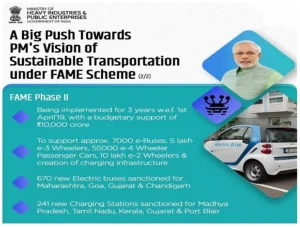
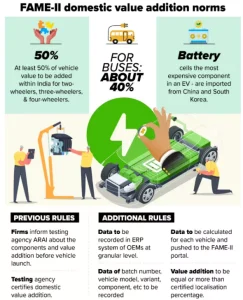
- Critical Minerals Partnership: Both nations signed a Memorandum of Understanding (MOU) to build secure supply chains for minerals like lithium and cobalt, essential for Electric Vehicle (EV) batteries, clean energy technologies and the FAME-II scheme.
- Fossil Fuel Exports: Canada expressed its intent to become a primary supplier of Liquefied Natural Gas (LNG) and heavy crude oil to India, supported by Canada’s goal to produce 50 million tonnes of LNG annually by 2030.
- Global Alliances: India welcomed Canada as a new member of the International Solar Alliance (ISA) and a full member of the Global Biofuels Alliance (GBA) to accelerate the global transition to green energy.
About International Solar Alliance (ISA)
- Launched by India and France at COP21 (2015), the ISA is a treaty-based intergovernmental organization aimed at the massive deployment of solar energy.
- Primary Objective: Mobilize USD 1,000 billion in solar investments by 2030 and reduce the cost of technology and financing.
- The “Towards 1000” Strategy:
- 1,000 GW of solar energy capacity.
- 1,000 million people are provided with clean energy access.
- 1,000 million tonnes of CO2 emissions are mitigated annually.
- Headquarters: Gurugram, India (the first international body headquartered in India).
- Key Update (2026): Canada has officially joined the ISA, broadening the alliance’s financial and research base. This partnership focuses on battery storage and smart grid integration—essential for stabilizing intermittent solar power.
About Global Biofuels Alliance (GBA)
- Launched by India during the 2023 G20 Summit in New Delhi, the GBA is modeled after the ISA but focuses on the sustainable production and trade of biofuels.
- Primary Objective: To position biofuels (like ethanol, biodiesel, and compressed biogas) as a central solution for the energy transition, particularly in the aviation and heavy transport sectors.
- Founding Pillars: India, the USA, and Brazil (who together account for over 80% of global ethanol production).
- Core Focus Areas:
- Standards: Harmonizing international standards for biofuel quality and sustainability.
- Market Building: Creating a virtual marketplace to connect technology providers with end-users.
- FAME-II & E20 Integration: Aligning with India’s goal of 20% ethanol blending by 2025-26.
- Key Update (2026): Moving from “Observer” to Full Member, Canada has committed to the GBA to collaborate on Sustainable Aviation Fuel (SAF) and waste-to-energy technologies.
|
- Trade and Economic Architecture:
- Comprehensive Trade Agreement: The leaders officially resumed negotiations for the Comprehensive Economic Partnership Agreement (CEPA), adopting a structured CEPA Roadmap to conclude talks by end-2026 and setting an ambitious target to expand bilateral trade to CAD 70 billion by 2030.
- The $50 Billion Milestone: While the long-term goal for 2030 remains $70 billion (including services), the Indian PM specifically highlighted a more immediate “next-level” target of $50 billion in bilateral trade to be achieved within the next five years.
- New Financial Dialogue: A new “Finance Ministers’ Economic and Financial Dialogue” was launched to streamline institutional capital flows, specifically targeting Canadian pension funds (which have already invested over $100 billion in India).
- Reconstituted CEO Forum: A high-level India-Canada CEO Forum was established to allow top business leaders to directly advise governments on reducing trade barriers and increasing private investment.
- Agricultural Innovation – Pulse Protein Centre of Excellence: A proposal was advanced to establish a Canada–India Pulse Protein Centre of Excellence at NIFTEM Kundli, Haryana, to promote high-quality plant protein research.
- The initiative aims to integrate Saskatchewan’s production capacity with India’s consumption needs, thereby strengthening food and nutritional security in both countries.
- Science, Technology, and Space:
- Space Exploration: The Indian Space Research Organisation (ISRO) and the Canadian Space Agency (CSA) signed an arrangement to cooperate on Space Robotics, human spaceflight missions, and satellite-based quantum communications.
- Artificial Intelligence (AI) for Healthcare: Both countries agreed to co-develop AI-assisted diagnostic tools specifically designed for “distance medicine” to provide high-quality healthcare to citizens living in remote or rural areas.
- Trilateral Tech Partnership: A trilateral MOU was signed between Australia, Canada, and India (ACITI) to collaborate on semiconductor manufacturing, cybersecurity, and the “Internet of Things” (IoT).
- Security and Defence Cooperation:
- Institutional Linkages: Canada appointed a permanent Defence Attaché to its mission in India, while India accredited its Defence Attaché in Washington D.C. to Canada, ensuring direct military-to-military communication.
- Maritime Security: Both nations launched a Maritime Security Partnership to conduct joint naval training and exercises, ensuring the Indo-Pacific region remains free, open, and inclusive for international trade.
- Counter-Terrorism and Law Enforcement: A shared workplan was created to tackle violent extremism, organized crime, and the illegal trafficking of drugs (specifically fentanyl precursors) and cyber-financial fraud.
- Defence Dialogue & GSOIA: Both leaders agreed to launch a formal “India-Canada Defence Dialogue”. More importantly, they agreed to negotiate a General Security of Information Agreement (GSOIA), which is a prerequisite for sharing high-level classified military technology and intelligence.
- “Transnational Repression” vs. “Sovereignty”: The 2026 Joint Statement included a compromise in language where both sides affirmed a commitment to the rule of law in combating “transnational repression” (addressing Canadian concerns) while simultaneously respecting “sovereignty and territorial integrity” (addressing Indian concerns).
- Education and Talent Mobility:
- Research Internships: The Globalink Research Internship program was expanded via an MOU between India’s AICTE (All India Council for Technical Education) and Canada’s MITACS, allowing 300 Indian students to conduct research in Canada annually.
- Talent Strategy: A new Joint Talent and Innovation Strategy was introduced to simplify the movement of skilled professionals and researchers between the two countries in priority sectors like green tech and AI.
- Indigenous Engagement: Both leaders agreed to promote the Bharat Tribal Festival (BTF) as a platform to exchange traditional knowledge and support the economic empowerment of tribal and indigenous communities.
- Physical Presence: A significant addition to the “Living Bridge” is the agreement to facilitate Canadian universities opening physical campuses in India, aligning with India’s National Education Policy (NEP) 2020.
- This moves the relationship beyond just “student exports” to “institutional presence.”
- Specific Energy Sector Outcomes:
- SMR Collaboration: Beyond the $2.6 billion Uranium deal, there was a specific mention of collaborating on Small Modular Reactors (SMRs) and advanced reactor technologies for decentralized power generation.
- Renewable Energy Summit: The leaders announced the first India-Canada Renewable Energy and Storage Summit to be held later in 2026 to operationalize the ISA and GBA memberships.
India-Canada Relations
- Early Foundations (1947–1960s): Diplomatic ties were established in 1947.
- The relationship was initially very warm; Canada’s “Colombo Plan” provided significant developmental aid to India, and India’s Constitution adopted the Canadian Federal Model, which features a strong Central government with residuary powers.
- The Nuclear Freeze (1974–2010): Relations suffered a major setback after India’s first nuclear test (Operation Smiling Buddha) in 1974.
- Canada, having supplied the CIRUS nuclear reactor, accused India of violating peaceful-use agreements and suspended nuclear cooperation for nearly 36 years.
- The 1998 Nuclear Freeze: Following India’s Pokhran-II tests, Canada was among the leading nations to impose stringent economic and technological sanctions, marking the second major “freeze” in ties after the 1974 “Smiling Buddha” test.
- Strategic Elevation (2015): The relationship was upgraded to a Strategic Partnership during PM Narendra Modi’s landmark visit to Canada.
- This shifted the focus toward Energy Security and the “Living Bridge”—the nearly 2 million-strong Indian diaspora in Canada.
- Arctic Geopolitics & Polar Research: As an Observer in the Arctic Council, India can leverage Canada’s position to study Arctic ice-melt impacts on the Indian Monsoon and engage in global maritime governance.
- Indo-Pacific Convergence: Highlight the synergy between Canada’s Indo-Pacific Strategy (2022) and India’s SAGAR doctrine, focusing on naval deployments and Maritime Domain Awareness (MDA).
- The Diplomatic Crisis (2023–2025): Tensions reached an all-time high following allegations regarding the killing of a Canadian citizen (Hardeep Singh Nijjar).
- This led to the suspension of visa services, the expulsion of high-ranking diplomats, and a complete halt in trade negotiations.
- The 2026 Reset: The visit of PM Mark Carney in early 2026 signifies a “Pragmatic Thaw,” where both nations have agreed to decouple core economic interests from political and security disagreements.
About Canada
- Political Geography and Location:
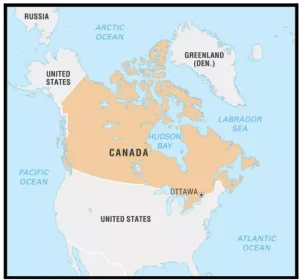
- Sovereign Position: Situated in the northernmost part of North America, Canada is the second-largest country globally by total land area (trailing only Russia).
- Transcontinental Maritime Bounding: It is uniquely bounded by three oceans: the Arctic (North), the Atlantic (East), and the Pacific (West).
- The “Longest Frontier”: It shares the world’s longest bi-national land border with the United States (stretching across the south and the non-contiguous state of Alaska in the northwest).
- Maritime Border Specifics: It shares maritime boundaries with Greenland (a Danish territory) to the northeast and the French archipelago of Saint Pierre and Miquelon in the southeast.
- Capital: Ottawa
- Physiography and Climatic Zonation:
- Arctic & Subarctic: Characterized by permafrost and tundra.
- Prairie: The “breadbasket,” vital for grain and pulse production.
- Great Lakes-St. Lawrence: The industrial and population heartland.
- Cordilleran: High-altitude alpine climate.
- Atlantic (East) & Pacific (West) Coasts: Influenced by maritime currents.
- Major Mountain Systems:
- Western Cordillera: Includes the Rocky Mountains and the St. Elias Mountains (hosting Mount Logan, Canada’s highest peak).
- The Laurentian Mountains: Part of the ancient Canadian Shield in the east.
- Hydrography: Rivers and Lakes
- The Great Lakes System: A chain of five lakes—Superior, Huron, Erie, Ontario, and Michigan.
- These form a natural border with the US; however, Lake Michigan is the only one located entirely within US territory.
- Strategic Rivers:
- Mackenzie River: The longest in Canada; critical for Arctic drainage.
- Saint Lawrence River: Acts as a massive hydraulic link between the Great Lakes and the Atlantic Ocean.
- Yukon River: Flowing through the northwest, significant for history and mineral wealth.
- Resource Superpower:
- Energy Minerals: One of the world’s largest producers of Uranium (High-grade deposits in the Athabasca Basin).
- Agricultural Stabilizers: The global leader in Potash (essential for India’s fertilizer security).
- Industrial Base: Rich in Nickel, Zinc, Iron Ore, Copper, and Gold.
- Future Tech Minerals: Significant reserves of Rare Earth Elements (REEs), Cobalt, and Lithium, which are central to the India-Canada Critical Minerals Partnership (2026).
|
Significance of India-Canada Bilateral Relations
- This partnership acts as a pillar of the Western ‘de-risking’ strategy from China, integrating India’s manufacturing ambitions with Canada’s reserves to reduce vulnerability to Chinese market dominance in the EV and semiconductor ecosystems.
- Bilateral Trade: Bilateral trade between India and Canada stood at $8.66 billion in FY 2024-25, with India exporting goods worth $4.22 billion and importing $4.44 billion.
- Energy and Nuclear Security: Canada is a global Energy Superpower.
- As India seeks to achieve “Net Zero” emissions, Canada is a critical supplier of Uranium for India’s civil nuclear program and Clean Energy technologies like Small Modular Reactors (SMRs).
- Food and Nutritional Security: Canada is the largest global producer of Potash (a vital fertilizer component) and Pulses (lentils).
- These exports are indispensable for India’s Agricultural Productivity and meeting the protein requirements of its population.
- The “Living Bridge” (Diaspora): The Indian diaspora in Canada is one of the most successful and politically influential globally.
- They serve as a massive source of Remittances and act as a cultural and economic bridge between the two democracies.
- The educational sector remains a cornerstone of the relationship, with nearly 400,000 Indian students acting as a vital link for talent exchange and research collaboration.
- Geopolitical Convergence: Both nations are committed to a Free, Open, and Inclusive Indo-Pacific.
- Canada’s interest in joining the Indian Ocean Rim Association (IORA) as a Dialogue Partner aligns with India’s SAGAR (Security and Growth for All in the Region) vision.
- The “Middle East” Clause: Reflecting the 2026 geopolitical context, the leaders included a joint stance on the conflict in the Middle East, calling for de-escalation and the protection of civilians—showing a shared vision on global stability beyond just the Indo-Pacific.
- IORA & Arctic: India explicitly backed Canada’s interest in becoming a Dialogue Partner in the Indian Ocean Rim Association (IORA).
Challenges in India-Canada Relations
- Sovereignty, Extremism, and the “Legal Gap”: The primary irritant is the presence of Separatist Movements in Canada. This creates a fundamental disconnect:
- Political Space vs. Freedom of Expression: India remains concerned about groups challenging its territorial integrity, while Canada cites domestic legal constraints and liberal standards of expression.
- The New Democratic Party (NDP)-Liberal Nexus: India perceives Canada’s domestic political alliances (specifically the Liberal-NDP alliance) as a constraint on executive action due to vote-bank compulsions.
- Foreign Interference Allegations: A “clash of sovereignties” has emerged following Canada’s 2025 Public Inquiry, which labeled India a “prominent actor” in Canadian electoral processes, leading to mutual accusations of domestic meddling.
- Khalistan Issue: It is a structural friction point in India-Canada relations, rooted in the clash between India’s territorial integrity and Canada’s liberal interpretation of freedom of expression for its politically influential Sikh diaspora.
- While ties hit a nadir in 2023 following allegations surrounding the death of Hardeep Singh Nijjar, the 2026 Strategic Reset has transitioned the relationship toward “compartmentalization.”
- Transnational Organized Crime & Security: Beyond ideology, the security landscape has shifted toward tangible criminal threats:
- The Nexus: Growing evidence suggests a link between drug cartels, human traffickers, and extremist groups.
- Emerging Threats: The smuggling of Fentanyl precursors and cyber-financial fraud are now major bilateral security priorities.
- Diplomatic Trust and Intelligence Deficit: The transition from “quiet diplomacy” to “Megaphone Diplomacy” (public accusations via media) has damaged Institutional Trust.
- Intelligence-Sharing Slowdown: Recent crises have caused friction in bilateral coordination, potentially affecting broader cooperation within frameworks related to the Five Eyes partners.
- Structural Trade and Regulatory Hurdles: Despite economic complementarity, the Comprehensive Economic Partnership Agreement (CEPA) remains stalled due to:
- High Indian Tariffs: Primarily on Canadian dairy and wine.
- Canadian SPS Measures: Stringent Sanitary and Phytosanitary standards (SPS) that restrict Indian agricultural exports.
- Strain on the “Living Bridge”: The flow of people is facing a “reverse talent flow” due to economic and policy shifts:
- Student Vulnerability: Indian study permit applications dropped by 40% in 2023-24, driven by Canada’s housing crisis and rising living costs.
- Policy Caps: The 2024-25 caps on international student visas (a 35% reduction) have diminished Canada’s attractiveness as a primary destination.
Way Forward
- Institutionalizing “Quiet Diplomacy” & Judicial Rigor: Moving away from “Megaphone Diplomacy” requires a return to discrete, high-level institutional channels:
- Permanent NSA-Level Dialogue: Establish a consistent, quiet channel between National Security Advisors to handle sensitive grievances regarding extremism and territorial integrity away from public optics.
- Judicial Over Political Framing: Prioritize the use of the Mutual Legal Assistance Treaty (1994) and Extradition Treaty (1987). This shifts the burden of proof from political rhetoric to “actionable intelligence” and judicial evidence.
- Strategic Decoupling: Adopt a doctrine of “de-hyphenation,” ensuring that volatile political contestations over the diaspora do not bleed into high-value economic sectors.
- Security & Law Enforcement Coordination: The bilateral security architecture must evolve to address the “Extremist-Crime Nexus”:
- Upgraded Joint Working Group: Enhance the Joint Working Group on Transnational Crime to provide real-time intelligence exchange.
- Targeting the Nexus: Specific focus must be placed on the intersection of drug trafficking (fentanyl precursors), human smuggling, and cyber-financial fraud.
- Tech Sovereignty: Expand the Australia-Canada-India (ACITI) partnership to build “Trusted Digital Ecosystems,” focusing on quantum communications and AI-assisted healthcare.
- Finalizing Trade & Industrial Architecture: Economic ties should serve as the “ballast” of the relationship, targeting a CAD 70 billion trade goal:
- CEPA Conclusion: Fast-track the Comprehensive Economic Partnership Agreement (CEPA) by the end of 2026 to provide legal certainty and diversify supply chains.
- Critical Minerals Integration: Move beyond a “buyer-seller” model toward deep industrial integration within the Minerals Security Partnership (MSP). This includes joint ventures in Lithium, Cobalt, and Nickel to support India’s FAME-II (EV) scheme and semiconductor ecosystems.
- Resource Security: Insulate the Energy Track—specifically Uranium and LNG supplies—from political friction to ensure uninterrupted national resource security.
- Building Societal and Institutional Buffers: To withstand shifts in the domestic political landscape, the relationship requires “cushioning” at the non-governmental level:
- Track 1.5 & 2 Diplomacy: Strengthen ties through think-tank dialogues and university partnerships, such as the Pulse Protein Centre of Excellence.
- Institutional Stability: These societal buffers create a layer of resilience, ensuring that people-to-people and academic ties remain functional even when diplomatic channels are strained.
About Track 1.5 Diplomacy (The Hybrid Bridge)
- This involves a mix of Government Officials (participating in an unofficial capacity) and Non-State Actors (think tank experts, business leaders, and academics).
- Primary Function: It acts as a “testing ground” for new policy ideas.
- It allows officials to discuss sensitive issues—like Extradition Treaties or Comprehensive Economic Partnership Agreement (CEPA) roadblocks—without the political risk of a formal commitment.
- Key Example: The Canada-India Track 1.5 Dialogue on Innovation, Growth and Prosperity, co-led by Gateway House: Indian Council on Global Relations and the Centre for International Governance Innovation (CIGI).
- This forum keeps communication open on Artificial Intelligence (AI) and Critical Minerals even during diplomatic freezes.
About Track 2 Diplomacy (The Unofficial Safety Valve)
- This is conducted entirely by Non-Officials, such as retired diplomats, retired military officers, academics, and Civil Society Organizations (CSOs).
- Primary Function: To engage in “blue-sky thinking” and build long-term trust.
- It focuses on Societal Buffers—addressing deep-seated cultural or historical grievances that active politicians find too volatile to touch.
- Key Example: Joint initiatives between the Asia Pacific Foundation of Canada (APF Canada) and the Ananta Aspen Centre (AAC).
- These dialogues often result in “Non-Papers” (informal policy suggestions) that help de-escalate tensions by humanizing the conflict away from the media spotlight.
|
Conclusion
The India-Canada relationship is defined by the 3C Framework– Convergence on Indo-Pacific security, Complementarity in energy and food resources, and persistent Contestation over domestic extremism. Moving forward, a “Strategic Rebalancing” and “Decoupling” are vital to insulate critical economic synergies from these deep-seated political frictions.


 3 Mar 2026



.png)




 Current Affairs




 GS Foundation
 Optional Course
 Combo Courses
 Degree Program