India and the European Union (EU) have concluded official-level negotiations for the proposed free trade agreement to boost trade and strengthen economic ties between the two.
India–European Union Free Trade Agreement
- The India–EU Free Trade Agreement is a comprehensive trade pact between India and the European Union (EU) aimed at reducing tariffs and boosting bilateral trade and investment.
 History: Negotiations began decades ago (initial talks in 2007, resumed in 2022) and were concluded on 27 January 2026 after long-pending discussions.
 - What It Includes: Covers trade in goods, services, investment, IPR, sustainability, and standards between India and the European Union.
- Next Steps: While the negotiations and political conclusion are done, the pact still needs formal ratification by India’s Parliament and the European Parliament and Council before it fully comes into force.
- With this deal EU has become India’s 22nd FTA partner.
Significance of India-EU FTA
- Unprecedented Market Access for India: Over 99% of Indian exports (by trade value) gain preferential (zero or reduced tariff) entry into the EU market.
- Strategic Importance: The FTA is often referred to by leaders as the “mother of all deals” highlighting its importance in global trade diversification.
- The deal covers a market of roughly 2 billion people and close to 25 % of global GDP, making it a major global trade pact.
- Boost to Labour-Intensive and Export-Oriented Sectors: Sectors like textiles, apparel, leather, footwear, marine products, gems & jewellery, handicrafts, and engineering goods will see tariffs reduced to zero upon entry into force.
- Opportunities in Agriculture and Processed Foods: Enhanced access for items like tea, coffee, spices, fresh fruits/vegetables, and processed foods, strengthening rural livelihoods and India’s position as a global supplier.
- Automobile Sector: Reciprocal, quota-based liberalization allows EU automakers higher-end access to India, while enabling future “Make in India” production and exports from India to the EU.
- Services and Mobility Framework: Ambitious commitments in services (India gains access to 144 EU sub-sectors in IT/ITeS, professional services, education, etc.; EU to 102 Indian sub-sectors).
- Trade Diversification: Amid global trade uncertainties (including potential US tariff policies), the FTA diversifies India’s export markets, reduces over-reliance on any single partner, and builds resilient supply chains.
- Support for “Viksit Bharat @2047”: Aligns with India’s vision of becoming a developed nation by 2047 through inclusive growth, innovation, job creation, and competitiveness in manufacturing/services.
Key outcomes of India-EU Summit
- The 16th India-EU Summit was held in January, 2026, in New Delhi.
- It was co-chaired by Prime Minister Narendra Modi, European Commission President Ursula von der Leyen, and European Council President Antonio Costa.
- India-EU Free Trade Agreement (FTA): India-EU FTA was concluded.
- Adoption of ‘Towards 2030: A forward-looking comprehensive strategic agenda endorsed at the summit to elevate cooperation through 2030.
- It focuses on four pillars: Prosperity and sustainability, technology and innovation, security and defence, connectivity and global issues, plus enablers like people-to-people ties.
- This replaces the previous 2025 Roadmap, aiming for deeper, coordinated action in a complex geopolitical environment.
- Signing of the India-EU Security and Defence Partnership: A landmark framework that enables closer cooperation on maritime security, defence industry/technology, cyber/hybrid threats, counterterrorism, space, non-proliferation, and joint initiatives/exercises.
- Comprehensive framework for cooperation on mobility: This is the first mobility-related agreement signed at the EU level with India, aimed at facilitating structured movement of skilled professionals.
- Green Hydrogen Task Force: Established to deepen collaboration on production, technology, standards, and supply chains for green hydrogen.
- Disaster risk management and emergency response: Arrangement between India’s National Disaster Management Authority (NDMA )and EU’s Directorate-General for European Civil Protection and Humanitarian Aid Operations (DG-ECHO) for better preparedness, coordination, and response to natural disasters.
- Financial/regulatory cooperation: MoU between Reserve Bank of India (RBI) and European Securities and Markets Authority (ESMA) for recognition of clearing houses and closer coordination.
- Renewal of India-EU scientific and technological cooperation agreement: The agreement on scientific and technological cooperation has been renewed for the 2025–2030 period.
India–European Union Relationship
- The India-EU relationship is a comprehensive strategic partnership rooted in shared values like democracy, rule of law, multilateralism, and a rules-based international order.
- It has grown into a multifaceted engagement spanning trade, investment, security, technology, climate action, and more.
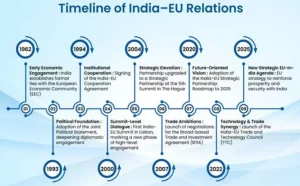
- Historical Background: India established diplomatic relations with the European Economic Community (predecessor to the EU) in 1962, one of the earliest such ties.
- 1993: Joint Political Statement signed.
- 2000: First India-EU Summit in Lisbon, launching regular summit-level dialogue.
- 2004: Upgraded to Strategic Partnership at The Hague Summit.
- Since 2004, 15 summits have been held prior to the landmark 16th EU-India Summit in New Delhi in January 2026.
- The relationship has deepened significantly after 2020 due to geopolitical shifts, supply-chain diversification, and Indo-Pacific focus.
- Key Institutional Mechanisms:
-
- India-EU Trade and Technology Council (TTC): Launched February 2023 (announced April 2022); coordinates on trade, trusted technology, digital, green tech, and security.
- Connectivity Partnership: Launched 2021; covers transport, digital, energy, and people-to-people ties.
- India-Middle East-Europe Economic Corridor (IMEC): Announced September 2023 with partners.
Economic and Trade Ties
- Bilateral trade volume reached approximately, making the EU India’s largest goods trading partner.
- The EU is one of India’s largest trading partners, with bilateral trade in goods with the EU worth $136.53 billion in 2024-25 (exports worth $75.85 billion and imports at $60.68 billion).
- The EU market accounts for about 17% of India’s total exports, and EU’s exports to India constitute 9% of its total overseas shipments.
- Growth: Nearly 90% increase over the past decade.
- Investment: EU is the leading foreign investor in India (FDI stock €140.1 billion in 2023, up from €82.3 billion in 2019); more than 6,000 European companies are currently operating in India.
About the European Union (EU)
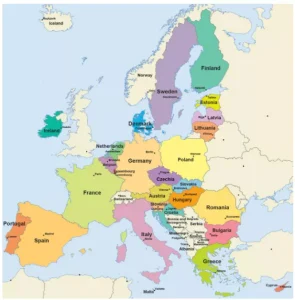
- The European Union is an economic and political union of 27 European countries.
- They work together to promote peace, stability, prosperity, and shared values.
- Founded: Began in 1951 (as the European Coal and Steel Community) with 6 founding members; evolved into the modern EU through treaties like the Treaty of Rome (1957) and Lisbon Treaty (2009).
- Member States: 27 countries (United Kingdom left in 2020 via Brexit).
- Currency: The euro (€) is used by 21 member states of the Eurozone (recent addition: Bulgaria adopted the euro on January 1, 2026).
- Key Institutions: The EU has a unique transnational structure with shared decision-making.
- European Commission: Acts as the executive; proposes laws, enforces EU rules, manages the budget.
- European Parliament: Directly elected by citizens; co-legislates and approves the budget.
- European Council: Heads of state/government set overall political direction and priorities.
- Court of Justice of the European Union: Ensures uniform application of EU law.
- European Central Bank: Manages the euro and monetary policy for the eurozone.
|
Conclusion
Overall, the India-EU partnership has evolved into a forward-looking, comprehensive alliance. The 16th India-EU Summit and FTA conclusion represent a historic leap, positioning both as key pillars in each other’s global strategies amid geopolitical shifts.


 27 Jan 2026





.png)






 Current Affairs




 GS Foundation
 Optional Course
 Combo Courses
 Degree Program