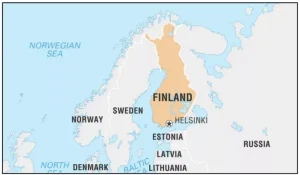
During the Raisina Dialogue 2026, Alexander Stubb, President of Finland, visited India and both nations elevated ties to a Strategic Partnership in Digitalisation and Sustainability.
Key Outcomes of India–Finland Talks

- Strategic Partnership in Technology: India and Finland agreed to deepen cooperation in emerging technologies such as artificial intelligence, quantum computing, and 6G telecommunications through a dedicated joint task force.
- Agreements on Mobility, Environment and Statistics: Both countries signed agreements on migration and mobility, environmental cooperation, and statistical collaboration to enhance talent exchange, sustainability initiatives, and data-driven governance.
- Institutional Mechanisms for Cooperation: A Joint Working Group on digitalisation and a consular dialogue mechanism were established to strengthen economic engagement, innovation partnerships, and people-to-people connections.
- Trade Expansion Target: India and Finland set a goal to double bilateral trade by 2030 while promoting stronger linkages between startup ecosystems and innovation-driven industries.
About India–Finland Relations
- India and Finland maintain cordial diplomatic relations based on cooperation in technology, education, innovation, sustainability, and global governance.
- Origin of Diplomatic Relations: Diplomatic relations between India and Finland were established in 1949, and interactions have gradually expanded through high-level visits, economic engagement, and scientific collaboration.
- Trade and Economic Relations: Bilateral trade between India and Finland ranges between €1.5–2 billion annually, with Finland maintaining a slight surplus mainly in goods trade.
- Investment and Corporate Presence: More than 100 Finnish companies, including Nokia, Wärtsilä, Fortum, and UPM, operate in India across telecommunications, energy, manufacturing, and sustainable technologies.
Significance of India–Finland Relations
- Digital and Technological Cooperation: Finland’s advanced technological expertise complements India’s large digital market, enabling collaboration in AI, 6G networks, digital infrastructure, and resilient technology ecosystems.
- Sustainability and Circular Economy Partnership: Finland’s global leadership in circular economy practices supports India’s climate and sustainability goals through cooperation in clean energy, environmental protection, and sustainable technologies.
- Strategic and Global Governance Cooperation: India and Finland share common positions on multilateralism, institutional reforms, counter-terrorism, and maintaining a rules-based international order, strengthening cooperation within Europe and the Nordic region.
Conclusion
The India–Finland strategic partnership reflects a convergence of technological innovation, sustainability goals, and global governance priorities, strengthening India’s engagement with the Nordic region and the European technological ecosystem.