Recently, the Indian Prime Minister visited Malaysia (7–8 February 2026), reaffirming the India–Malaysia Comprehensive Strategic Partnership (2024).
It was Prime Minister Modi’s third visit to Malaysia, and the first after the elevation of the India-Malaysia bilateral relationship to a Comprehensive Strategic Partnership in August 2024.
Key Outcomes of the Visit
- Political Framework and Multilateral Synergy:
- Elevation of Ties: Both leaders reaffirmed the Comprehensive Strategic Partnership (CSP) established in 2024, emphasizing that the relationship has moved beyond traditional trade toward a partnership based on high-tech synergy and strategic trust.
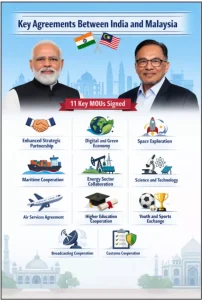 ASEAN Centrality and Act East Policy: The Indian Prime Minister expressed appreciation for Malaysia’s successful chairmanship of the Association of Southeast Asian Nations (ASEAN) in 2025.
- Both nations pledged to align the ASEAN Outlook on the Indo-Pacific (AOIP) with India’s Indo-Pacific Oceans Initiative (IPOI) to ensure a free and open maritime domain.
- BRICS and Global Governance: A significant outcome was India’s support for Malaysia as a BRICS Partner Country.
- Malaysia welcomed India’s 2026 BRICS Chairmanship, with both sides agreeing that such platforms are essential for a more representative and equitable international order.
- United Nations Reforms: Malaysia reiterated its consistent support for India’s claim for Permanent Membership in a reformed United Nations Security Council (UNSC).
- Additionally, both sides renewed the Memorandum of Understanding on United Nations Peacekeeping Cooperation.
- Economic, Digital, and Financial Connectivity:
- Fintech Integration (UPI-PayNet): In a major boost to digital payments, NPCI International Payments Limited (NIPL) and PayNet Malaysia reached an agreement to interlink the Unified Payments Interface (UPI) with Malaysia’s DuitNow.
- This enables real-time, low-cost cross-border remittances and QR-based payments for tourists, students, and businesses.
- Local Currency Settlement Framework: To reduce dependency on third-party currencies like the US Dollar, the Reserve Bank of India (RBI) and Bank Negara Malaysia (BNM) were directed to fast-track the mechanism for invoicing and settling bilateral trade in the Indian Rupee (INR) and the Malaysian Ringgit (MYR).
- Malaysia–India Digital Council (MIDC): This newly formalized body will serve as the apex strategic mechanism to drive bilateral engagement in Artificial Intelligence (AI), Cybersecurity, and Digital Public Infrastructure (DPI).
- Trade Facilitation and Industrial Cooperation:
- Trade Agreement Reviews: Both leaders underscored the importance of reviewing the ASEAN–India Trade in Goods Agreement (AITIGA) to make it more facilitative and relevant to modern trade practices.
- They also encouraged the optimum utilization of the Malaysia–India Comprehensive Economic Cooperation Agreement (MICECA).
- Semiconductor Value Chain: An Exchange of Notes was signed to build a resilient semiconductor supply chain. This includes a landmark partnership between Indian Institute of Technology (IIT) Madras Global and the Advanced Semiconductor Academy of Malaysia to focus on workforce development and technical innovation.
- Sustainable Palm Oil and Food Security: Acknowledging India’s status as a major consumer, Malaysia reaffirmed its commitment to being a reliable supplier of Sustainable Palm Oil.
- Both sides agreed to collaborate on downstream value-added palm products and establish resilient supply chains for staple food commodities.
- Defence and Security Cooperation:
- The Su-30 Forum: Terms of Reference were finalized for the Su-30 Forum, providing a dedicated platform for the Indian Air Force and the Royal Malaysian Air Force to collaborate on the maintenance, spares, and upgrades of their shared Sukhoi-30 fighter jet fleets.
- Counter-Terrorism Initiatives: Both nations declared a “Zero Tolerance” policy toward terrorism. They agreed to co-chair a Table-Top Exercise (TTX) under the ASEAN Defence Ministers’ Meeting Plus (ADMM-Plus) framework in 2026 to enhance regional counter-terror readiness.
- Governance and Anti-Corruption: A new Memorandum of Understanding was signed specifically for Cooperation in Combating and Preventing Corruption, facilitating better coordination between India’s Central Bureau of Investigation (CBI) and the Malaysian Anti-Corruption Commission (MACC).
- Maritime Security: The establishment of the Strategic Affairs Working Group (SAWG) and the inaugural Malaysia–India Security Dialogue will focus on intelligence sharing and ensuring freedom of navigation in line with UNCLOS (United Nations Convention on the Law of the Sea) 1982.
- Social Welfare, Health, and Cultural Links:
- Labor and Social Security: A Memorandum of Collaboration was signed between India’s Employees’ State Insurance Corporation (ESIC) and Malaysia’s Social Security Organisation (PERKESO) to safeguard the welfare and social security of Indian workers employed in Malaysia.
- Healthcare and Traditional Medicine: The leaders agreed to the deployment of Traditional Indian Medicine (TIM) experts to Malaysian hospitals. Furthermore, an MoU between the Central Council for Research in Homoeopathy (CCRH) and the University of Cyberjaya will promote joint research and academic exchanges.
- Education and Skills: India invited Malaysian students to utilize the “Study in India” program. Both nations also signed an agreement on Technical and Vocational Education and Training (TVET) to align student skills with the requirements of high-tech industries.
- Thiruvalluvar Centre and Scholarships: To celebrate civilizational links, a Thiruvalluvar Centre was established at Universiti Malaya, alongside the launch of dedicated Thiruvalluvar Scholarships for Malaysian students wishing to pursue higher studies in India.
- Environmental Commitment: Malaysia officially ratified the framework agreement for the India-led International Big Cat Alliance (IBCA), reinforcing a shared commitment to wildlife conservation and biodiversity.
PWOnly IAS Extra Edge
About Malaysia
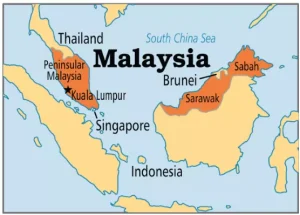
- Geopolitics & Maritime Strategy: Malaysia is a key littoral state of the Strait of Malacca, the world’s busiest shipping lane where roughly 60% of India’s eastbound trade passes.
- It is a founding member of ASEAN and will serve as the ASEAN Chair in 2025, making it a primary pillar of India’s Act East Policy.
- Unique Political System: It is a Federal Constitutional Monarchy with a unique rotational monarchy system where the King (Yang di-Pertuan Agong) is elected every five years from among the nine hereditary Malay rulers.
- The government follows the Westminster parliamentary model.
- Geographic Division: The country is uniquely split by the South China Sea into Peninsular Malaysia (West) and East Malaysia (on Borneo island).
- It borders Thailand and Singapore in the west, and Indonesia and Brunei in the east.
- Climate & Terrain: Malaysia experiences an equatorial climate characterized by high humidity and consistent rainfall.
- It is home to Mount Kinabalu (Sabah), the highest peak in Southeast Asia, and the Lenggong Valley, which holds the oldest human remains found outside Africa.
- Economic Drivers: Malaysia is a global leader in sustainable palm oil and a critical hub in the global semiconductor value chain, accounting for ~13% of global back-end manufacturing (testing and packaging).
- The “Bumiputera” & Diaspora: The population is multi-ethnic, with the Bumiputera (ethnic Malays and indigenous groups) making up ~70%. Malaysia hosts the third-largest Indian diaspora (2.9 million) and the second-largest Person of Indian Origin (PIO) community globally.
|
About India-Malaysia Relations
- Historical and Civilizational Foundations: The relationship between India and Malaysia is anchored in over two millennia of shared maritime history across the Indian Ocean.
- Ancient Maritime Networks: Civilizational contact was catalyzed by trade, religion, and linguistic exchange.
- The influence of Hindu-Buddhist traditions and Sanskrit is etched into the cultural and historical fabric of the Malay Peninsula.
- The Chola Legacy: Between the 9th and 13th centuries, the Chola Empire served as a pivotal bridge.
- Under monarchs like Rajaraja Chola I and Rajendra Chola I, the dynasty established vast maritime routes and exerted political influence over parts of present-day Malaysia (Srivijaya and Kedah/Kadaram).
- This era facilitated a permanent cultural imprint, visible in the architectural styles and royal titles of Malaysia.
- Literary Adaptations: The Ramayana stands as a testament to shared heritage.
- The Malay literary adaptation, the Hikayat Seri Rama, localizes the Sanskrit epic while preserving its core ideals of righteousness.
- Cultural landmarks like the Sri Veera Hanuman Temple further exemplify this architectural and narrative fusion.
- Political and Strategic Convergence: India and Malaysia have transitioned from historical friends to modern strategic partners, particularly under the Act East Policy.
- Comprehensive Strategic Partnership (CSP): Elevated in August 2024, this partnership signifies a shift toward deeper political trust and institutionalized cooperation.
- Multilateral Alignment: High-level interactions, such as the February 2026 visit, reinforce a shared vision for global governance.
- Malaysia has consistently advocated for India’s Permanent Membership in a reformed United Nations Security Council (UNSC) and supported India’s 2026 BRICS Chairmanship.
- Regional Security: Both nations emphasize ASEAN Centrality. Malaysia’s strategic position along the Strait of Malacca makes it a linchpin in India’s maritime connectivity and security strategy in the Indo-Pacific.
- Trade and Economic Synergy: Economics remains the “fulcrum” of the bilateral tie, governed by robust institutional frameworks.
- Trade Profile (2024-25): Total bilateral trade reached US$ 19.86 billion. This consists of US$ 7.32 billion in Indian exports (mineral fuels, engineering goods, organic chemicals, and bovine meat) and US$ 12.54 billion in imports (palm oil, electrical machinery, and wood).
- Investment and Finance: Between 2000 and 2025, Malaysia’s cumulative investment in India stood at approximately US$ 1.27 billion.
- Currency and Fintech Innovation: A major breakthrough in July 2022 allowed for trade settlement in Indian Rupees (INR). Most recently, in 2026, the interlinking of India’s UPI with Malaysia’s PayNet (DuitNow) has revolutionized cross-border financial transactions.
- Regulatory Framework: Trade is facilitated through the Comprehensive Economic Cooperation Agreement (CECA) and the ASEAN-India Trade in Goods Agreement (AITIGA), the latter of which is currently under review to further ease market access.
About ASEAN-India Trade in Goods Agreement (AITIGA)
- Institutional Origin & Scope: The AITIGA originated from the 2003 Framework Agreement and entered into force on January 1, 2010.
- Crucially, it only covers physical goods; trade in Services and Investment are governed by separate agreements (signed in 2014) which together form the ASEAN-India Free Trade Area (AIFTA).
- The “Modernization” Mandate (2026): Following the 21st ASEAN-India Summit, a comprehensive review is underway with a target conclusion in early-to-mid 2026.
- The goal is to make the pact “modern and balanced,” particularly after India opted out of the RCEP, making AITIGA its primary trade vehicle in the Indo-Pacific.
- Correction of Trade Asymmetry: India’s central objective is reducing a massive trade deficit that surged from $8 billion (2010) to over $45 billion (2025).
- India is pushing for symmetrical tariff liberalization, seeking to have ASEAN members match India’s commitment of liberalizing at least 80% of tariff lines.
- Product-Specific Rules (PSR) for Origin: India is negotiating to move away from the generic 35% local value addition rule toward stricter Product-Specific Rules.
- This is a strategic move to prevent “circumvention”—the rerouting of Chinese-made goods through ASEAN countries to claim zero-duty access to the Indian market.
- Tariff Categorization & “Special Products”: The agreement uses a tiered system- Normal Track (0% duty), Sensitive Track (4–5%), and an Exclusion List.
- Notably, India maintains unique protections for “Special Products” (Crude & Refined Palm Oil, Coffee, Black Tea, and Pepper) which are critical for domestic agricultural security.
- Beyond Tariffs (NTBs & Digital): The 2026 update emphasizes the removal of Non-Tariff Barriers (NTBs) such as complex quotas and technical standards.
- Additionally, it integrates modern financial pillars like Local Currency Settlement (e.g., INR-Ringgit) and cross-border UPI linkages with ASEAN payment systems to lower transaction costs.
|
- Defence and Security Cooperation: The security partnership has evolved into a sophisticated framework for regional stability.
- Cornerstone MoU: The 1993 MoU on Defence Cooperation, significantly amended in July 2023, enables extensive joint ventures and procurement projects.
- Military Interoperability: Strategic bonds are sharpened through regular joint exercises:
- Harimau Shakti (Army)
- Samudra Laksamana (Navy)
- Udara Shakti (Air Force)
- Industrial Collaboration: The inauguration of Hindustan Aeronautics Limited’s (HAL) regional office in Kuala Lumpur marks a new era in aerospace and maintenance cooperation, particularly regarding the shared Sukhoi-30 platforms.
- Diaspora and People-to-People Ties: The human bridge between the two nations is one of the strongest in the world.
- Demographics: Malaysia is home to roughly 2.95 million people of Indian origin—the second-largest PIO community globally. This predominantly Tamil-speaking community is a vital force in Malaysia’s socio-economic and political landscape.
- Cultural Diplomacy: The Netaji Subhash Chandra Bose Indian Cultural Centre (NSCBICC) in Kuala Lumpur serves as a hub for Indian classical arts, Yoga, and Hindi language education.
- Social and Consular Support: To better serve this community and bolster commerce, India announced a new Consulate General in Kota Kinabalu, Sabah, in 2026.
- Addressing Challenges: Both governments remain engaged in resolving non-traditional security issues, including illegal migration, human trafficking, and the protection of labor rights under the 2026 ESIC-PERKESO social security agreement.
Strategic Significance of India-Malaysia Relations
The significance of the India-Malaysia relationship in 2026 is defined by a transition from traditional diplomacy to a high-tech, security-driven alliance.
- Maritime Sovereignty & Indo-Pacific Balance: Geography dictates that Malaysia is the gateway to India’s “Act East” Policy.
- Chokepoint Security: Shared guardianship of the Strait of Malacca—through which 60% of India’s eastbound trade passes—is critical for Freedom of Navigation.
- Geopolitical Trust: The opening of an Indian Consulate in Kota Kinabalu (Sabah) near the South China Sea signifies a new level of strategic alignment and maritime domain awareness.
- ASEAN Centrality: Malaysia’s support for India’s UNSC Permanent Membership and India’s backing of Malaysia’s 2025 ASEAN Chairmanship and BRICS aspirations cement their roles as regional stabilizers.
- The “Silicon Shield”- Industrial Interdependence: The most transformative pillar of the relationship is the Semiconductor Value Chain integration.
- Supply Chain Resilience: By pairing Malaysia’s mature back-end ecosystem (13% of global testing and packaging) with India’s front-end design talent, the two nations have built a “Silicon Shield” to de-risk from geopolitical shocks.
- High-Tech Synergy: Collaboration between the Advanced Semiconductor Academy of Malaysia and IIT Madras ensures a steady pipeline of specialized workforce to lead the global digital economy.
- Strategic Autonomy & De-dollarization: India and Malaysia are pioneering a model for the Global South to reduce dependence on Western financial systems.
- Local Currency Settlement (LCS): The promotion of INR and Ringgit for trade settlement shields bilateral commerce from US Dollar volatility.
- Fintech Integration: The interlinking of UPI and PayNet (DuitNow) facilitates real-time, low-cost cross-border payments, empowering SMEs and the 1.4 million Indian tourists visiting Malaysia annually.
- Defence & Security Convergence: The relationship has moved past historical “friction points” toward a “zero-tolerance” stance on security threats.
- Industrial Collaboration: As both nations operate Su-30 fighter jets and Scorpene submarines, the HAL regional office in Kuala Lumpur serves as a hub for shared Maintenance, Repair, and Overhaul (MRO).
- Counter-Terrorism: Jointly co-chairing the ADMM-Plus Expert Working Group, both nations have aligned their intelligence-sharing to tackle cross-border terrorism and maritime piracy.
- The “Living Bridge”- Civilizational Soft Power: The relationship is uniquely “future-proofed” by its deep human foundations.
- Diaspora Influence: The 2.9 million people of Indian origin in Malaysia (the 3rd largest globally) act as a permanent economic and cultural conduit.
- Knowledge Diplomacy: The establishment of the Thiruvalluvar Centre and shared recognition of Ayurveda blend 2,000 years of history with modern institutional cooperation.
Challenges & Friction Points in India-Malaysia Relations
While the partnership is in an “unprecedented phase of speed and depth,” it must navigate deep-seated historical irritants and emerging structural competition.
- Political & Ideological Friction:
- The “Internal Matters” Sensitivity: India remains highly sensitive to external commentary on Jammu & Kashmir and the Citizenship Amendment Act (CAA).
- While PM Anwar Ibrahim shifted to a more pragmatic stance in 2024–2026, labeling Kashmir a “domestic issue,” occasional echoes of UN resolutions remain a potential trigger for diplomatic “firefighting.”
- The Zakir Naik Deadlock: The presence of the fugitive preacher in Malaysia remains a persistent “low-intensity” thorn.
- Despite discussions during the February 2026 visit, the extradition remains stalled due to technical legal procedures and domestic political sensitivities in Malaysia.
- Counter-Terrorism Alignment: While both nations condemn cross-border terrorism, their definitions occasionally diverge.
- Bridging the gap between India’s security-first approach and Malaysia’s human rights-centric legal framework is a constant diplomatic challenge.
- Trade Imbalance & Economic Hurdles:
- The US$ 5 Billion Deficit: India faces a persistent trade deficit with Malaysia (approx. US$ 5.22 billion in FY 2024-25).
- India is aggressively pushing for a review of AITIGA (ASEAN-India Trade in Goods Agreement) to address Non-Tariff Barriers and gain better market access for its Pharmaceuticals and IT Services.
- Palm Oil Dependency: India is the world’s largest buyer of Malaysian palm oil, but its “Atmanirbhar” (self-reliance) push via the National Mission on Edible Oils threatens Malaysia’s long-term market share.
- Rules of Origin (RoO): India remains concerned about “circumvention,” where Chinese goods are rerouted through Malaysia to exploit lower tariffs, leading to stricter enforcement that can slow down legitimate trade.
- Strategic & Geopolitical Divergence:
- The China Factor: Malaysia maintains a “hedging” strategy with Beijing, its largest trading partner.
- Unlike India, Malaysia is a member of RCEP and has significant Belt and Road Initiative (BRI) investments, creating a “quiet diplomacy” approach that occasionally clashes with India’s more assertive Indo-Pacific stance.
- Semiconductor Competition: While the 2026 MoC on Semiconductors promotes cooperation, both nations are essentially competing for the same Global Investment Pool.
- India’s PLI (Production Linked Incentive) schemes aim to attract the very “back-end” manufacturing that Malaysia currently dominates.
- Quad vs. ASEAN Centrality: Malaysia remains wary of the Quad, fearing it might undermine ASEAN Centrality.
- Balancing India’s security-led vision with Malaysia’s economic-led neutrality remains a core diplomatic task.
- Labor & Human Connection Issues:
- Worker Welfare: With nearly 2.9 million people of Indian origin and a growing migrant workforce, the “Living Bridge” is also a source of friction.
- Issues regarding ethical recruitment, human trafficking, and the protection of seafarers require continuous, high-level institutional oversight.
- Digital Standards: As the Malaysia-India Digital Council (MIDC) works on AI and Fintech, differing national standards on data sovereignty and cybersecurity could act as a bottleneck for full digital integration.
Way Forward
- Economic Transformation- “From Commodities to Chips”: The primary objective is to move beyond the traditional dependency on palm oil toward value-chain integration.
- The Semiconductor Corridor: Operationalizing the 2026 MoC, both nations will link India’s “front-end” design talent (via the India Semiconductor Mission) with Malaysia’s “back-end” expertise in Assembly, Testing, and Packaging (ATP).
- Digital Financial Integration: Following the February 2026 launch of UPI in Malaysia, the next step is to expand the UPI-PayNet linkage to include small-scale trade and real-time B2B remittances, making cross-border business as seamless as domestic transactions.
- AITIGA Review: Both nations have pledged to finalize the ASEAN-India Trade in Goods Agreement (AITIGA) review by year-end to address the trade imbalance and modernize “Rules of Origin.”
- Strategic & Security Architecture: The partnership now treats the Strait of Malacca as a shared security responsibility.
- Maritime Domain Awareness (MDA): Institutionalizing real-time data sharing on merchant vessel movements to combat piracy and non-traditional threats.
- Defense Industrial Hub: Moving from joint exercises to joint production. The HAL regional office will lead the development of a regional Maintenance, Repair, and Overhaul (MRO) hub for shared platforms like the Su-30 fighter jets and Dornier aircraft.
- Counter-Terrorism Co-Chairmanship: Malaysia will host the ADMM-Plus Expert Working Group Table-Top Exercise in 2026, co-chaired with India, to solidify a “zero-tolerance” regional response to cross-border terrorism.
- Institutional & Cultural Anchoring: The “Living Bridge” is being institutionalized to ensure long-term stability regardless of political shifts.
- Consular Presence: The opening of the Consulate General in Johor Bahru and a proposed office in Sabah will serve the 3-million-strong diaspora and boost maritime trade.
- Social Security Pact: Finalizing the ESIC-PERKESO agreement to provide a safety net for Indian workers in Malaysia, addressing long-standing concerns regarding labor welfare and ethical recruitment.
- Knowledge Diplomacy: Establishing the Thiruvalluvar Centre at Universiti Malaya and expanding IIT Madras-Malaysia collaborations to create a specialized talent pool for the green energy and semiconductor sectors.
- Geopolitical Coordination:
- BRICS & ASEAN: India will actively support Malaysia’s transition to Full BRICS Membership during India’s 2026 BRICS Presidency, while Malaysia continues to champion India’s Permanent UNSC seat.
- Indo-Pacific Alignment: Synergizing India’s IPOI (Indo-Pacific Oceans Initiative) with the ASEAN Outlook on the Indo-Pacific (AOIP) to ensure a rules-based order that respects ASEAN Centrality.
Conclusion
The 2026 elevation of ties marks a strategic pivot, anchoring the partnership in technological interdependence and maritime security. By institutionalizing mutual trust, both nations have transformed a civilizational bond into a resilient, modern alliance driving Indo-Pacific stability.


 9 Feb 2026







.png)






 Current Affairs




 GS Foundation
 Optional Course
 Combo Courses
 Degree Program