Recently, Sheikh Mohamed bin Zayed Al Nahyan visited India, marking his fifth visit in a decade and third official visit as UAE President.
- During this Visit, India and the United Arab Emirates agreed to significantly deepen their Comprehensive Strategic Partnership.
List of Outcomes
- Strategic Defence Cooperation:
- Letter of Intent (LoI) between India and UAE was signed to establish a Strategic Defence Partnership Framework Agreement and expand cooperation in the defence industry.
- Trade and Economic Expansion:
- Target to double bilateral trade to USD 200 billion by 2032.
- Strengthen MSME linkages via Bharat Mart, Virtual Trade Corridor, and Bharat–Africa Setu to promote MSME products across West Asia, Africa and Eurasia.
- India and the UAE signed an LoI to promote UAE investment in the Dholera Special Investment Region (Gujarat).
- Energy Security Cooperation:
- A 10-year LNG supply agreement between HPCL and ADNOC Gas was concluded, enabling India to import 0.5 MMTPA of LNG starting in 2028.
- Civil Nuclear Collaboration:
- Cooperation to be expanded in advanced nuclear technologies, including large reactors and Small Modular Reactors (SMRs).
- This partnership will be enabled by India’s SHANTI Act, 2025, covering nuclear safety and operations & maintenance.
- Digital and Financial Integration:
- UAE Companies at GIFT City: First Abu Dhabi Bank (FAB) will open a branch at GIFT City, Gujarat.
- India and UAE will explore the establishment of Digital/Data Embassies under mutually recognised sovereignty frameworks.
- Space Sector Collaboration:
- An LoI was signed between IN-SPACe (India) and the UAE Space Agency to develop joint space infrastructure, promote commercial space activities, support start-ups, and enable training and exchange programmes.
- Food Security and Agricultural Trade
- APEDA (India) and UAE’s Ministry of Climate Change & Environment signed an MoU on food safety and technical standards to facilitate exports of rice and agricultural products from India.
- Science, Technology and Innovation:
- India and UAE agreed in principle to establish a supercomputing cluster in India under the AI India Mission.
- The facility will support research, innovation, and commercial applications for both public and private sectors.
- Cultural Cooperation:
- UAE to provide artefacts for National Maritime Heritage Complex (Lothal).
- Agreement to establish a ‘House of India’ in Abu Dhabi.
- Promotion of youth exchanges, university linkages, student mobility.
India – UAE Bilateral Relations
- Political Relations
- Diplomatic Ties (1972–73): Established in 1972, embassy opened in India in both countries.
- Transformation Post-2015: PM Narendra Modi visit to the UAE in 2015, the first by an Indian PM in 34 years, marking the beginning of a Comprehensive Strategic Partnership.
- Multilateral Cooperation
- Both are part of key groupings such as BRICS, I2U2 (India–Israel–UAE–USA), UFI Trilateral (UAE–France–India), and India–Middle East–Europe Economic Corridor (IMEEC).
- Defence Cooperation
- Bilateral and multilateral exercises such as Gulf Star-1, PASSEX, Desert Cyclone (India–UAE) and Desert Knight (India–France–UAE) enhance maritime security and interoperability.
- Economic and Commercial Relations
- Bilateral trade increased from USD 180 million (1970s) to USD 100.05 billion in FY 2024–25.
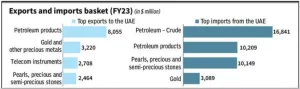 UAE is currently India’s 3rd largest trading partner and 2nd largest export destination, while India is the UAE’s 2nd largest trading partner.
- Investment Cooperation
- Bilateral Investment Treaty (BIT) signed in February 2024 (effective August 2024) strengthens investor protection and transparency.
- Foreign Direct Investment: UAE is India’s 7th largest source of FDI, with cumulative inflows of USD 22.85 billion (2000–2025).
- Indian ODI: India’s Overseas Direct Investment (ODI) to the UAE stood at USD 16.54 billion (2000–2025).
- India–UAE CEPA (2022): Comprehensive Economic Partnership Agreement (CEPA) signed on 18 February 2022, effective 1 May 2022.
- Tariffs on more than 80 percent of products were either slashed or eliminated, the non-oil trade reached US$50 billion between May 2022, and April 2023.
- CEPA targets USD 100 billion in non-oil trade by 2030.
- Financial and Digital Connectivity:
- Local Currency Settlement System (2023): MoU between RBI and UAE Central Bank enabling trade in INR and Dirham.
- Ongoing initiatives:
- Integration of UPI with UAE’s AANI payment system
- Interlinking RuPay (India) and JAYWAN (UAE) card networks
- Remittances: In 2024, Indian expatriates sent $21.6 billion to India from the UAE, representing 19.2% of the country’s total dollar inflows, making it the 2nd largest source after the US.
- Energy Security: UAE is India’s 4th largest source of crude oil and 2nd largest source of LNG and LPG.
- Cultural Relations
- Indian Diaspora: UAE hosts approximately 4.3 million Indians, making it the largest expatriate community.
- Cultural Landmark: Inauguration of BAPS Mandir (2024) in Abu Dhabi symbolises deepening civilisational tie
- Education Cooperation
- Indian Schools: 108 Indian curriculum schools (CBSE & Kerala Board) operate in the UAE, supported by a CBSE Regional Office in Dubai.
- Higher Education: Institutions like IIT Delhi–Abu Dhabi Campus, BITS Pilani, Manipal, Amity, Symbiosis and IIM Ahmedabad (Dubai) and Indian Institute of Foreign Trade (IIFT Expo City Dubai) are operational in UAE.
Challenges to India – UAE Relations
- Non-Tariff Barriers (NTBs) in Trade: UAE’s Sanitary and Phytosanitary (SPS) measures and Technical Barriers to Trade (TBT) have constrained Indian exports.
- Mandatory Halal certification particularly in poultry, meat, and processed food products.
- China’s Cheque-Book Diplomacy: China’s aggressive deployment of low-interest loans, infrastructure financing, and investments in the Gulf has intensified competition.
- Chinese firms often crowd out Indian companies in strategic sectors such as ports, logistics, telecom, and infrastructure, limiting India’s economic footprint in the region.
- UAE’s Financial Support to Pakistan: The UAE remains a significant lender to Pakistan, which poses concerns for India given Pakistan’s involvement in cross-border terrorism.
- In January 2025, UAE agreed to extend the repayment time of loan $2 billion.
- India perceives the risk that such financial assistance may indirectly undermine its national security interests.
- Regional Instability in West Asia: Conflicts involving Israel–Palestine–Lebanon, with indirect involvement of Iran and the US, pose risks to regional stability.
- The Ongoing Crisis in Iran further challenges the stability in the region.
- Trade Imbalance and Economic Adjustments: Despite growing trade volumes, a persistent trade deficit remains.
- India’s total goods exports to the UAE stood at $36.63 billion in FY25, while imports stood at $63.40 billion, with a trade deficit of $26.76 billion
- Kafala System and Labour Welfare Concerns: The Kafala sponsorship system continues to raise concerns regarding the rights and welfare of Indian migrant workers, especially blue-collar labourers.
Way Forward
- Institutionalise Strategic Dialogue Mechanisms:
- India should establish an institutionalised 2+2 Dialogue (Foreign and Defence Ministers) with the UAE, similar to arrangements with the US and Russia, to provide a structured platform for addressing security, regional stability, defence cooperation and strategic concerns in a rapidly evolving West Asian landscape.
- Enhance Dialogue on Labour Welfare and Human Rights:
- India should engage in sustained and constructive dialogue with UAE authorities to address concerns related to the Kafala sponsorship system.
- India can advocate for greater labour mobility, improved working conditions and alignment with international labour standards, while recognising recent reforms undertaken by the UAE.
- Deepen Trade Diversification:
- Effective implementation of CEPA must focus on improving transparency and predictability in the use of Non-Tariff Barriers (NTBs) through regular information sharing on labelling, licensing, import monitoring and surveillance requirements, thereby ensuring smoother market access for Indian exports.
- Strengthen Economic Partnerships:
- Both countries should encourage joint ventures and strategic partnerships in infrastructure, logistics, fintech, healthcare and clean energy to enhance value-addition and mitigate trade imbalances.
- Leveraging UAE’s capital surplus and India’s large market and manufacturing capabilities can generate mutual economic resilience and reduce dependence on high-value imports.


 20 Jan 2026






.png)






 Current Affairs




 GS Foundation
 Optional Course
 Combo Courses
 Degree Program