While the Economic Survey highlights structural weaknesses in India’s R&D ecosystem, the broader civil services reform discourse—such as the 2nd ARC, Hota Committee, and Parliamentary Committees—supports the case for institutionalising scientific expertise through a dedicated technical cadre like the Indian Scientific Service.
India’s Scenario in Science & Technology (S&T)
India possesses a robust scientific foundation, yet it faces a structural paradox within its bureaucracy:
- The Governance Mismatch: While India has built world-class institutions like the Council of Scientific and Industrial Research (CSIR) and the Indian Council of Agricultural Research (ICAR), government scientists are often governed by the Central Civil Services (Conduct) Rules, 1964.
- These rules prioritize administrative discipline over scientific independence.
- Reactive Policy Inputs: Currently, scientific inputs are often “commissioned” only for immediate needs, such as litigation or regulatory crises.
- This makes research time-bound and narrow rather than a continuous force that guides policy through long-term foresight.
- The “Valley of Death”: The Economic Survey 2025-26 highlights that while India excels at basic research, it often fails to translate those findings into market-ready products.
- There is a missing link between laboratory innovation and industrial application.
The Four Pillars of Progress (2026)
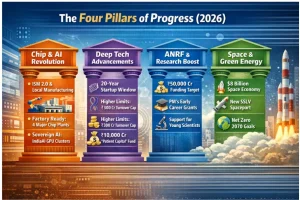
- The Computer Chip & AI Revolution: India is currently running the India Semiconductor Mission (ISM) 2.0, which was given a new push in the 2026-27 Union Budget.
- Factory Ready: Four major plants for making computer chips are expected to start commercial production this year.
- Local Materials: While the first phase was about assembling chips, ISM 2.0 focuses on making the equipment and chemicals needed for chip-making right here in India.
- Sovereign AI: Through the IndiaAI Mission, the government is building national GPU clusters (super-powerful computer networks). This gives Indian startups the “computing power” they need so they don’t have to rely on foreign Big Tech companies.
- Support for Deep Tech (Complex Tech): In February 2026, the government changed the rules to support Deep Tech—innovations in areas like Biotechnology, Quantum Computing, and New Materials.
- 20-Year Window: Deep Tech companies can now be called “startups” for 20 years (instead of 10). This acknowledges that real science takes a long time to reach the market.
- Higher Limits: These startups can now have a turnover of up to ₹300 crore (up from ₹200 crore) and still get government benefits.
- Patient Capital: A new ₹10,000 crore fund provides “patient money”—loans and investments for high-tech projects that might take years to become profitable.
- The New Funding Body- ANRF: The Anusandhan National Research Foundation (ANRF) is now fully active. It replaces older systems to make research more organized.
- The Goal: It aims to provide ₹50,000 crore in funding between 2023 and 2028.
- Fair Funding: In early 2026, it launched the Prime Minister’s Early Career Research Grant to give money to younger scientists and researchers in state universities, not just the famous IITs (Indian Institutes of Technology).
- Space and Green Energy:
- Space Economy: India is aiming for an $8 billion space industry by the end of 2026. A second spaceport for Small Satellite Launch Vehicles (SSLV) is almost finished, helping private companies like Skyroot and Agnikul launch more satellites.
- Net Zero 2070: A 2026 NITI Aayog (the government’s top policy think tank) report focuses on Green Hydrogen and a Circular Economy (recycling everything) to help India become a developed nation (Viksit Bharat) while protecting the environment.
|
Why the Need is Arising for the Indian Scientific Service (ISS)?
- Complexity of Emerging Sectors: Generalist administrators often lack the deep technical grounding required to regulate complex fields like Artificial Intelligence (AI), Quantum Technology, or Bio-manufacturing.
- Scientific Integrity and Independence: Administrative rules demand neutrality, but scientific progress requires the freedom to question assumptions.
- The ISS would provide Distinct Service Rules that allow scientists to formally record assessments—such as ecological risks or technological limitations—even when they challenge official policy.
- Global Competitiveness: Negotiating international standards for semiconductor supply chains or carbon credits requires “Scientist-Diplomats” who understand the technical granularities of global trade and technology.
- Strategic Resilience: To lead in Climate Action and Public Health, India requires a cadre that values evidence-based decision-making alongside administrative efficiency.
Key Features of a Proposed Indian Scientific Service (ISS)
To institutionalise scientific expertise within governance and address the growing complexity of technology-driven policymaking, a proposed Indian Scientific Service (ISS) may incorporate the following structural features:
- Direct Integration: Placing technical experts at the heart of decision-making in ministries such as the Ministry of Electronics and Information Technology (MeitY), the Ministry of Environment, Forest and Climate Change, and the Department of Biotechnology.
- Structured Career Progression: Unlike the current system where scientists lack a clear path to high-level authority, the ISS would provide a defined trajectory to influence national policy.
- Dynamic and Performance-Linked Incentives: To address the issue of brain drain, the ISS may adopt performance-linked pay structures and research-based incentives to attract and retain top-tier talent.
- Formal Weight of Advice: Ensuring scientific advice is not merely advisory but becomes a mandatory and recorded component of the policy formulation process, strengthening evidence-based governance.
PWOnlyIAS Extra Edge:
Constitutional Provisions- The Legal Bedrock for Science and ISS
The Constitution of India provides a clear mandate for the state to foster science and for the Parliament to create specialized services to manage national challenges.
- Fundamental Duties- The “Scientific Temper” Mandate:
- Article 51A(h): It is a Fundamental Duty of every citizen to develop “scientific temper, humanism and the spirit of inquiry and reform.”
- Significance: This is a unique constitutional feature. The ISS is seen as an institutional mechanism to fulfill this duty by ensuring that state policy is guided by logic and evidence rather than dogma.
- Seventh Schedule- Legislative Competence: Under Article 246, the distribution of legislative powers between the Union and States includes several entries that necessitate a specialized scientific cadre:
- Union List (List I):
- Entry 65: Union agencies for professional, vocational, or technical training, and the promotion of special studies or research.
- Entry 66: Coordination and determination of standards in institutions for higher education or research and scientific and technical institutions.
- Entry 6: Atomic energy and mineral resources.
- Entry 49: Patents, inventions, and designs.
- Concurrent List (List III):
- Entry 25: Education, including technical education and medical education (where both Centre and States can legislate, requiring a unified service like the ISS for coordination).
- Article 312- Creation of New All-India Services: The most direct constitutional route for creating the Indian Scientific Service is Article 312.
- Provision: If the Rajya Sabha declares by a resolution (supported by not less than two-thirds of the members present and voting) that it is necessary in the national interest, Parliament may by law provide for the creation of one or more All-India Services common to the Union and the States.
- Application: Just as the Indian Forest Service (IFS) was created in 1966, the ISS can be established under this article to manage technically intensive sectors across India.
- Article 309- Recruitment and Conditions of Service: This article empowers the Parliament (or the President/Governor until the Parliament acts) to regulate the recruitment and conditions of service of persons appointed to public services.
India’s Initiatives and Actions
The push for an Indian Scientific Service (ISS) is supported by several recent flagship programs designed to build a “Strategic Resilience” ecosystem.
- Anusandhan National Research Foundation (ANRF): Established via the ANRF Act 2023, this is the apex body providing strategic direction to research.
- Recent Progress: As of February 2026, the ANRF has launched the Partnerships for Accelerated Innovation and Research (PAIR) and the MAHA MedTech Mission to bridge the gap between universities and industry.
- It acts as the “institutional parent” for the proposed ISS by seeding a culture of high-performance R&D.
- The BioE3 Policy (2024-2026): Stands for Biotechnology for Economy, Environment, and Employment. It focuses on High-Performance Biomanufacturing.
- Recent Progress: In early 2026, the government established the Moolankur BioEnabler Network, a grid of Bio-AI Hubs.
- This policy serves as a “testing ground” for ISS-style governance, where scientists lead the transition to a $300 billion bio-economy by 2030.
- Vigyan Dhara Scheme: Consolidated three major science schemes into a single unified umbrella with an outlay of ₹10,579 crore (up to 2025-26).
- Objective: To improve the efficiency of fund utilization and encourage school-to-industry innovation.
- Research Development and Innovation (RDI) Fund: A ₹1 lakh crore pool of “patient capital” launched to provide long-term, low-interest loans for private-sector-led R&D in deep-tech sectors like Quantum Computing and Green Hydrogen.
|
Challenges that Need to be Countered
- Low Research Spending: India’s Gross Expenditure on Research and Development (GERD) is still only about 0.64% of GDP.
- For comparison, the USA spends about 3.5% and China spends 2.4%.
- Private Sector Gap: In other countries, private companies pay for most of the research. In India, the government still does most of the heavy lifting.
- Experts are calling for a Research-Linked Incentive (RLI) scheme—similar to the successful manufacturing incentives—to encourage private companies to invest in R&D.
- The Hierarchy Conflict- Generalist vs. Specialist: Merging a specialized cadre like the Indian Scientific Service (ISS) into a system traditionally dominated by generalist hierarchies may lead to friction regarding seniority, career progression, and decisional authority.
- In the current “Steel Frame,” specialists often report to generalists, which can lead to a “glass ceiling” for technical experts.
- Example: The recurring tension in the Ministry of Health and Family Welfare, where specialized medical professionals (like those from the Central Health Service) often report to administrative officers.
- This has historically led to demands for “parity” and “independent decision-making power,” as seen during the management of the COVID-19 pandemic and subsequent health policy rollouts.
- Recruitment Rigour- Balancing Merit with Aptitude: Scientific excellence is measured by years of peer-reviewed research, laboratory breakthroughs, and advanced academic credentials (Ph.D./Post-Doc) rather than the ability to clear a single, high-pressure general examination.
- Designing a recruitment process through the Union Public Service Commission (UPSC) that balances standardized administrative testing with highly specialized scientific merit is a significant challenge.
- Example: The Lateral Entry debates of 2024-25.
- While the government attempted to bring in experts at the Joint Secretary level, the process faced scrutiny over whether a “one-size-fits-all” exam can accurately judge the technical depth required for specialized roles in departments like the Ministry of Electronics and Information Technology (MeitY) or Green Hydrogen missions.
- The “Symbolic” Risk- Science as a “Decoration”: There is a profound danger that without institutional safeguards, the role of scientists could remain purely advisory or symbolic.
- The Economic Survey 2025-26 warns against “Science as a decoration,” where technical experts are used to give a policy a “scientific look” without having the power to influence its core direction.
- Example: The controversy surrounding Environmental Impact Assessments (EIA).
- In several recent infrastructure projects, such as the Great Nicobar Development Plan, critics and scientists argued that technical warnings regarding seismic risks and biodiversity loss were sidelined by administrative urgency.
- Without an ISS to formally record these “technical dissents,” the scientific input remains a footnote rather than a gatekeeper.
- Integration with the “Valley of Death”: The ISS must overcome the structural barrier between basic research and market application.
- Most government scientists are currently confined to labs (like CSIR) and have no formal role in the Ministry of Commerce or Department of Promotion of Industry and Internal Trade (DPIIT) to facilitate commercialization.
- Example: Despite India’s lead in Deep-Tech research, the commercialization of indigenous 6G technologies or Quantum Key Distribution (QKD) has faced delays.
- This is often attributed to the lack of “Scientist-Administrators” who can navigate both the laboratory complexities and the bureaucratic procurement rules required to scale these technologies for the market.
| Global Best Practices- Models for India |
| Country |
Key Initiative / Practice |
Relevance to India |
| USA |
Scientific Integrity Policies (e.g., at NIH and HHS) |
- Protects government scientists from political interference.
- Ensures that research findings cannot be suppressed or manipulated for “political convenience.”
|
| UK |
Government Science & Engineering (GSE) Profession |
- A cadre of over 10,000 members across the government.
- Every ministry has a Chief Scientific Adviser (CSA) supported by a structured team of specialists.
|
| France |
National Protection of Scientific Potential |
- A strict public-private partnership system to protect intelligence and sensitive technology from foreign interference while allowing for innovation.
|
| Japan |
National Strategy for Critical & Emerging Tech (CET) |
- Prioritizes 20 technology areas (like AI and Bio) and integrates specialists directly into Economic Security decision-making.
|
Way Forward
- Legislative Backing and Institutional Safeguards: The government should introduce a Scientific Integrity Act. This legislation would formally recognize the Indian Scientific Service (ISS) and provide legal protection for “evidence-based dissent.”
- By law, scientific assessments on matters like Environmental Impact Assessments or Vaccine Safety should be placed on the official record.
- This ensures that even if the final policy decision lies with elected authorities, the scientific warnings or uncertainties are transparent and preserved for public accountability.
- Implementing a Hybrid Recruitment and Selection Model: The recruitment for the Indian Scientific Service (ISS) should move away from the traditional “general aptitude” model. Instead, it should adopt a Hybrid Selection Framework:
- National Level Testing: To ensure the rigor of an All-India Service.
- Peer-Reviewed Evaluation: Incorporating a weightage for a candidate’s research contributions, patents, and advanced academic standing (Ph.D./Post-Doctoral work).
- Lateral Entry: Allowing mid-career induction of top-tier scientists from the private sector or global research bodies to bring in cutting-edge expertise in sectors like Quantum Computing and Space-Commerce.
- Creation of Specialized Cadres under a Unified Service: To avoid the “generalist trap” within the scientific community itself, the Indian Scientific Service (ISS) should be organized into distinct, domain-specific sub-cadres. Each cadre would have its own career path and training modules:
- Indian Environmental and Ecological Service (IEES): To spearhead Climate Action and Net Zero commitments.
- Indian Regulatory Science Service (IRSS): To streamline the “Valley of Death” by creating clear, scientifically sound regulations for the Bio-economy and Deep-Tech sectors.
- Indian Public Health and Biomedical Service (IPHBS): To institutionalize pandemic preparedness and manage Universal Healthcare infrastructure.
- Bridging the “Valley of Death” through Lab-to-Market Integration: The Indian Scientific Service (ISS) should act as the primary bridge between the Anusandhan National Research Foundation (ANRF) and the private sector.
- ISS officers should be stationed as Technical Directors within ministries to oversee the Research Development and Innovation (RDI) Fund.
- Their role would be to ensure that basic research conducted in government labs is commercially viable and meets the standards required for global semiconductor supply chains and bio-manufacturing.
- Reforming Service Rules and Performance Incentives: The Central Civil Services (Conduct) Rules, 1964 must be amended specifically for the Indian Scientific Service (ISS).
- The new rules should prioritize Scientific Integrity over administrative “neutrality.”
- Furthermore, to attract the best minds and prevent brain drain, the government should implement Dynamic Pay Scales.
- These would include performance-linked incentives and research grants, making a career in government governance as prestigious and financially rewarding as a career in global academia or the private R&D sector.
- Fostering a Culture of “Scientist-Diplomats”: In an era of Techno-Nationalism, India needs officers who can represent the country in international forums like the IPCC (Intergovernmental Panel on Climate Change) or the World Health Organization (WHO).
- The Way Forward includes training ISS officers in Science Diplomacy, enabling them to negotiate global technical standards and intellectual property rights that favor India’s Strategic Resilience.
Conclusion
The proposal for an Indian Scientific Service reflects the growing need to embed scientific expertise within governance as policymaking becomes increasingly technology-intensive. With constitutional backing under Article 312, safeguards for scientific integrity, and structured integration into ministries, the ISS can strengthen evidence-based administration while supporting India’s vision of Viksit Bharat @2047.


 16 Feb 2026








.png)






 Current Affairs






 GS Foundation
 Optional Course
 Combo Courses
 Degree Program