India has submitted its 7th National Report to the Convention on Biological Diversity (CBD), assessing the country’s progress towards the 2030 global biodiversity targets under the Kunming–Montreal Global Biodiversity Framework (KMGBF) adopted in 2022.
Key Findings of the Report
- Limited Progress Toward 2030 Targets: Out of 23 national biodiversity targets, only two targets — biodiversity-inclusive land and sea-use planning (NBT1) and ecosystem restoration (NBT2) — are clearly on track for 2030.
- Growth in Forest and Tree Cover: India’s forest and tree cover has reached 827,357 sq km (25.17% of geographical area), with an increase of 1,445.81 sq km between 2021–2023.
- Ecosystem Restoration Efforts: India has pledged to restore 26 million hectares of degraded land by 2030 under the Bonn Challenge, with 24.1 million hectares already restored or under restoration.
- Conservation Success of Flagship Species: The report highlights recovery of key species such as:
- Bengal Tiger – Population at 3,167
- Asiatic Lion – Increasing population
- Indian Rhinoceros – Stable or rising population
It also includes the first national assessment of the Snow Leopard population.
- Agriculture and Biodiversity Integration: Trees Outside Forests (TOF) contribute significantly to national tree cover, while agroforestry now occupies about 8.65% of India’s geographical area.
Preparation of the Report
- Prepared by the Ministry of Environment, Forest and Climate Change (MoEFCC).
- Technical coordination by the National Biodiversity Authority.
- Supported by the United Nations Development Programme (UNDP) under the Global Environment Facility (GEF-8 Umbrella Programme).
- Inputs from 33 central ministries and departments, with monitoring across 142 biodiversity indicators.
|
Conservation and Ecosystem Status
- Protected Area Coverage: Currently, just over 5% of India’s geographical area is designated as formal protected areas (national parks, wildlife sanctuaries, etc.).
- Efforts are ongoing to identify Other Effective Area-Based Conservation Measures (OECMs) outside protected areas.
- Mangroves and Carbon Stock: Mangrove cover has increased modestly and forest carbon stock has risen to about 7,285.5 million tonnes, indicating ecosystem recovery and climate benefits.
- Land Degradation Concerns: Around 29.77% of India’s geographical area (about 97 million hectares) continues to face land degradation, highlighting the scale of ecological pressure.
Key Challenges that need to be Tackled
- Limited Data on Non-Flagship Species: While conservation data exists for flagship species, information on lesser-known species and other taxa remains limited.
- Fragmented Biodiversity Monitoring: Biodiversity data is spread across multiple ministries and agencies, with varying methodologies and monitoring intervals.
- Environmental Pressures: Ecosystems face growing threats from climate change, floods, droughts, forest fires, and habitat fragmentation.
- Policy–Implementation Gap: Although policy alignment with global biodiversity goals is strong, actual implementation and measurable outcomes remain uneven.
Way Forward
- Expand Conservation Coverage: Increase protected areas and Other Effective Area-Based Conservation Measures (OECMs) to meet the 30×30 conservation target.
- Strengthen Biodiversity Monitoring: Develop standardised indicators and unified data systems for biodiversity assessment.
- Focus on Ecosystem Restoration: Accelerate restoration of degraded lands and ecosystems to meet national commitments.
- Broaden Species Conservation: Expand conservation efforts beyond flagship species to include lesser-known taxa and ecosystem biodiversity.
About Convention on Biological Diversity (CBD)
- Refers: Also known as the Biodiversity Convention or UNCBD, it’s a multilateral treaty aimed at conserving biological diversity, ensuring sustainable use of its components, and promoting fair sharing of benefits from genetic resources utilization.
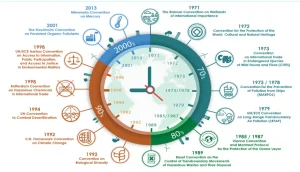
- The CBD was made available for signature on June 5, 1992, during the Rio de Janeiro Earth Summit and officially came into force on December 29, 1993.
- Ratification: It is a legally binding treaty and has been ratified by 196 countries. Notably, the United States is the only UN member state that has not ratified it.
- India is also a party to the Convention.
- CBD’s Governing Body: Conference of Parties (COP)
- It consists of the governments that have ratified the treaty.
- Secretariat: Montreal, Canada.
- Three Objectives:
- Conservation of biological diversity (genetic diversity, species diversity, and habitat diversity).
- Sustainable use of biological diversity.
- The fair and equitable sharing of the benefits arising out of the utilization of genetic resources.
- Two internationally binding agreements were adopted within the framework of the Convention on Biological Diversity.
- Cartagena Protocol: Adopted in 2000 and entered into force in 2003.
- It regulates the transboundary movement of Living Modified Organisms (LMOs)
- The Nagoya Protocol: Adopted in 2010
- It establishes a legally binding framework for access to genetic resources and the fair and equitable sharing of the benefits arising from their use.
- Key Protocols under CBD:
- Cartagena Protocol on Biosafety (2000): Regulates the safe handling, transport, and use of living modified organisms (LMOs).
- Nagoya Protocol (2010): Establishes a framework for access to genetic resources and fair benefit sharing (ABS).
- Recent Global Framework: In 2022, Parties adopted the Kunming–Montreal Global Biodiversity Framework, which sets global targets to halt and reverse biodiversity loss by 2030, including the “30×30” target of protecting 30% of the world’s land and oceans.
- India and CBD:
- India implements CBD commitments through the Biological Diversity Act, 2002.
- Institutional mechanisms include the National Biodiversity Authority, State Biodiversity Boards, and Biodiversity Management Committees (BMCs) at the local level.
|


 7 Mar 2026







.png)






 Current Affairs




 GS Foundation
 Optional Course
 Combo Courses
 Degree Program