India’s Bid for Full Membership in the International Energy Agency (IEA)

24 Feb 2026

English

हिन्दी

India’s Bid for Full Membership in the International Energy Agency (IEA)

The International Energy Agency (IEA) recently welcomed progress on India’s request for full membership. While India has been an Associate Member since 2017, transitioning to full membership involves significant legal and strategic shifts.

About the International Energy Agency (IEA)

  • The International Energy Agency (IEA) is an independent intergovernmental organisation.
  • IEA Headquarters: Paris
  • Members: 32 member countries, 13 association countries, 5 accession countries. 
    • India had joined the  International Energy Agency as an association country in 2017.
  • It was established in 1974 in response to the 1973 oil crisis under the framework of the OECD (Organisation for Economic Co-operation and Development).
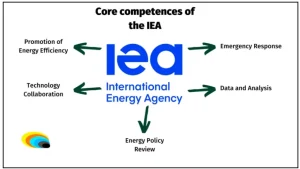
  • It offers policy recommendations, analysis, and data on the global energy sector.
  • It was Initially focused on 
    • Addressing oil supply disruptions
    • International Energy AgencyProviding market data
    • Promoting energy conservation
    • Fostering international technical collaboration.
  • Over time, the IEA’s scope expanded to cover the entire global energy system, including traditional and cleaner energy sources.
    • It includes renewable energy sources like solar, wind, and biofuels, as well as nuclear power and hydrogen technologies.
  • Report Publications of the International Energy Agency
    • World Energy Outlook Report.
    • World Energy Investment Report.
    • World Energy Statistics.
    • World Energy Balances.
    • Energy Technology Perspectives.
    • India Energy Outlook Report.

Check Out UPSC CSE Books

Visit PW Store
online store 1

IEA’s Mandatory Requirements for Members

  • The OECD Link: Historically, to be a member of the IEA, a country must be a member of the Organisation for Economic Co-operation and Development (OECD).
    • India’s Stance: India is not a member of the OECD and has shown no immediate inclination to join the “rich nations’ club.”
  • Strategic Oil Reserves: Members must hold oil stocks equivalent to at least 90 days of their prior year’s net imports. Currently, India’s strategic petroleum reserves (SPR) plus oil company stocks cover roughly 66-70 days.
  • Demand Restraint: Members must have programs in place to reduce national oil consumption by 7% to 10% during supply disruptions.

Need help preparing for UPSC or State PSCs?

Connect with our experts to get free counselling & start preparing

Aiming for UPSC?

Download Our App

      
Quick Revise Now !
AVAILABLE FOR DOWNLOAD SOON
UDAAN PRELIMS WALLAH
Comprehensive coverage with a concise format
Integration of PYQ within the booklet
Designed as per recent trends of Prelims questions
हिंदी में भी उपलब्ध
Quick Revise Now !
UDAAN PRELIMS WALLAH
Comprehensive coverage with a concise format
Integration of PYQ within the booklet
Designed as per recent trends of Prelims questions
हिंदी में भी उपलब्ध

<div class="new-fform">


    </div>

    Subscribe our Newsletter
    Sign up now for our exclusive newsletter and be the first to know about our latest Initiatives, Quality Content, and much more.
    *Promise! We won't spam you.
    Yes! I want to Subscribe.