India has adopted a new GDP series with 2022–23 as the base year, released by the Ministry of Statistics and Programme Implementation, leading to revisions in growth and sectoral estimates.
- The current revised new GDP series has received largely positive responses from economists, who describe it as comprehensive, realistic, and credibly executed.
Key Highlights of the Revised GDP Series
- Greater Stability in Real Growth Rates: Real GDP growth for 2023–24 onwards is now more stable (7.1–7.6%) compared to the earlier volatile range (6.5–9.2%).
- Downward Revision in Nominal GDP Size: The nominal size of the economy has been reduced by 3–4% due to improved data coverage, updated methodology, and refined deflation techniques.
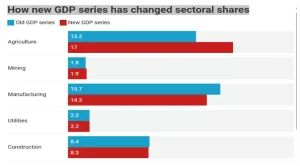
- Recalibration of Sectoral Contributions: Manufacturing, services, and agriculture shares have been reassessed, reshaping perceptions about key growth drivers.
Agricultural Share Under Revised GDP Series
- Upward Revision in Agriculture Size: Under the new GDP series (base year 2022–23), the agriculture, livestock, forestry and fishing sector is estimated to be about 5% larger in current prices than earlier estimates.
Reasons for the Increase in the Farm Sector’s Share in the New GDP Series
- Shift Towards High-Value Cash Crops: The new GDP series better captures the growing shift from traditional food grains to high-value crops like fruits and vegetables.
- These crops generate higher profits, thereby increasing Gross Value Added (GVA) and expanding the measured size of the farm sector.
- Reduction in Energy Input Costs: The value added in agriculture has risen due to a decline in fuel costs.
- Farmers are increasingly replacing diesel pumps with electricity and solar-powered irrigation systems.
- Role of PM-KUSUM Scheme: The PMKUSUM scheme has subsidized solar irrigation pumps since 2019, reducing diesel dependence and input costs, thereby increasing net value added and making the farm sector appear larger in the revised GDP estimates.
|
- Higher Share in GDP: Due to the 3–4% downward revision in nominal GDP, agriculture’s share increased to 18.2% in 2022–23 compared to 16.5% in the old series.
- Continued Structural Decline: Despite the higher revised share, agriculture’s contribution continues to decline over time, standing at 16.2% in 2025–26 (compared to 15.2% in the old series).
Manufacturing Sector Share in the New GDP Series
- Higher Average Growth in the Revised Series: Under the new GDP series, the manufacturing sector has recorded a stronger and more consistent average growth rate of 11.2% during 2023-24 to 2025-26.
Reasons for Higher Manufacturing Estimates
- Improved Data Sources: The improved data sources specifically, for the informal sector, by way of the Annual Survey of Unincorporated Sector Enterprise (ASUSE) and the Periodic Labour Force Survey (PLFS).
- Abandonment of the single-deflator method for estimating real GVA.
|
- Moderate Growth in the Old Series: In contrast, the old GDP series showed an average manufacturing growth of 8% over the same period.
- Base Effect Influence in 2023-24: The old series reflected a sharp 12.3% growth in 2023-24 mainly due to a favourable base effect, which temporarily boosted growth figures.
- Improved Measurement and Sectoral Weight: The revised methodology provides a better estimation of manufacturing activity, resulting in the sector emerging as a stronger driver of overall economic growth.
Informal Economy in the New GDP Series
- Correction of Informal Sector Underestimation: One major criticism of India’s GDP data was the inadequate measurement of the informal (unorganised) sector, as estimates relied heavily on proxies derived from the formal sector.
- The new series attempts to correct this distortion.
- Mixed Impact Across Sectors: While manufacturing appears to have benefited from stronger informal sector performance under improved measurement, other sectors show a downward revision.
- The services category: Trade, Repair, Hotels & Restaurants, Transport, Storage, Communication & Broadcasting Services has seen its Gross Value Added (GVA) fall by nearly 25% on average annually between 2022–23 and 2025–26 under the new estimates.
- A significant portion of this sector operates informally, and improved data collection suggests its earlier size may have been overestimated.


 3 Mar 2026







.png)






 Current Affairs




 GS Foundation
 Optional Course
 Combo Courses
 Degree Program