Mass Drug Administration 2026: India’s Push to Eliminate Lymphatic Filariasis

11 Feb 2026

Mass Drug Administration 2026: India’s Push to Eliminate Lymphatic Filariasis

The Union Health Minister launched the Annual Nationwide Mass Drug Administration (MDA) Campaign for eliminating Lymphatic Filariasis (LF) across 12 endemic States.

About Mass Drug Administration (MDA) Campaign

  • Campaign Objective: The MDA campaign aims to interrupt transmission, reduce morbidity, and ensure preventive drug coverage among at-risk populations
  • Geographical Coverage: The 2026 round is being implemented across 719 blocks in 124 districts spanning 12 endemic States.
  • Unified Annual Model: India has shifted from biannual to a single annual MDA round to improve logistics, supervision, and surveillance efficiency.
  • Drug Compliance Approach: Directly Observed Treatment (DOT) is emphasised to ensure actual consumption of anti-filarial medicines.
  • Implementing Agency: MDA implemented under the leadership of the National Centre for Vector Borne Diseases Control (NCVBDC).
  • Nodal Ministry: Ministry of Health and Family Welfare.
  • Institutional and Community Convergence:
    • Primary Healthcare Role: Ayushman Arogya Mandirs support screening, early detection, and treatment access.
    • Financial Protection: Hydrocele surgery coverage under AB-PMJAY reduces out-of-pocket expenditure.
    • Multi-Sectoral Collaboration: Ministries such as Panchayati Raj, Women & Child Development, and Rural Development aid mobilisation

About Lymphatic Filariasis (LF)

  • Nature of Disease:
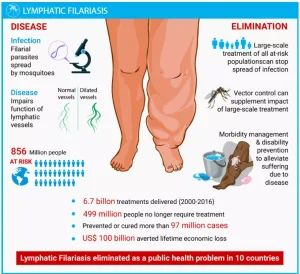
    • Lymphatic Filariasis (LF), commonly known as Elephantiasis, is a Neglected Tropical Disease (NTD).
    • Caused by filarial parasites transmitted by female Culex mosquitoes.
    • The disease is usually acquired in childhood, and it causes long-term hidden damage to the lymphatic system.
  • Symptoms:
    • Lymphoedema (swelling of limbs).
    • Elephantiasis (skin thickening).
    • Hydrocele (scrotal swelling in males).
  • Socio-Economic Impact: The disease imposes livelihood losses, productivity decline, and deep social stigma on affected individuals and families.
  • Lymphatic FilariasisCause and Transmission:
    • Cause: LF is caused by thread-like filarial parasites belonging to the Filariodidea family of nematodes (roundworms).
    • The three primary species responsible for infection are:
      • Wuchereria bancrofti (accounts for about 90% of cases)
      • Brugia malayi
      • Brugia timori
    • Transmission Cycle:
      • Adult worms reside in the lymphatic vessels and produce microfilariae that circulate in the bloodstream.
      • When mosquitoes bite an infected individual, they ingest microfilariae and later transmit infective larvae to another person, thereby continuing the transmission cycle
  • Current Burden: As of 2024, over 6.20 lakh cases of lymphoedema and 1.21 lakh cases of hydrocele have been reported in endemic districts
    • Geographical Spread: LF remains endemic in 348 districts across 20 States/UTs.

Hydrocele surgery, or hydrocelectomy, is a medical procedure performed to remove or repair a hydrocele, a fluid-filled sac that forms around the testicle, causing swelling in the scrotum.

  • Treatment:
    • There is no complete cure for lymphatic filariasis, but elimination is possible by interrupting transmission.
    • The World Health Organization recommends preventive chemotherapy through Mass Drug Administration (MDA).
    • MDA involves giving annual doses of medicines to the entire population living in at-risk areas.
    • These medicines have limited effect on adult worms but effectively reduce microfilariae in the blood.
    • By reducing microfilariae levels, MDA prevents mosquitoes from spreading infection further
  • WHO Response: WHO launched the Global Programme to Eliminate Lymphatic Filariasis (GPELF) in 2000.
    • GPELF aims to eliminate LF as a public health problem through preventive chemotherapy and morbidity management.
  • Elimination Strategy: India has adopted a five-pronged strategy to eliminate LF by 2027, ahead of the global SDG target of 2030.
    • Five-pronged Strategy
      • Mass Drug Administration (Central Pillar): Directly observed treatment to ensure compliance.
      • Vector Control Measures: Strengthening mosquito control ecosystem.
      • Morbidity Management and Disability Prevention: Timely hydrocele surgeries and medicine distribution.
      • Surveillance Strengthening: Digital reporting via Integrated Health Information Portal (IHIP) and updated line lists.
      • Community Mobilisation: Address public hesitancy and ensure household-level awareness.

Check Out UPSC CSE Books

Visit PW Store

online store 1

National Deworming Day is observed on 10 February and 10 August.

Enroll in SRIJAN Prelims Crash Course

Need help preparing for UPSC or State PSCs?

Connect with our experts to get free counselling & start preparing

Aiming for UPSC?

Download Our App

      
Quick Revise Now !
AVAILABLE FOR DOWNLOAD SOON
UDAAN PRELIMS WALLAH
Comprehensive coverage with a concise format
Integration of PYQ within the booklet
Designed as per recent trends of Prelims questions
हिंदी में भी उपलब्ध
Quick Revise Now !
UDAAN PRELIMS WALLAH
Comprehensive coverage with a concise format
Integration of PYQ within the booklet
Designed as per recent trends of Prelims questions
हिंदी में भी उपलब्ध

<div class="new-fform">


    </div>

    Subscribe our Newsletter
    Sign up now for our exclusive newsletter and be the first to know about our latest Initiatives, Quality Content, and much more.
    *Promise! We won't spam you.
    Yes! I want to Subscribe.