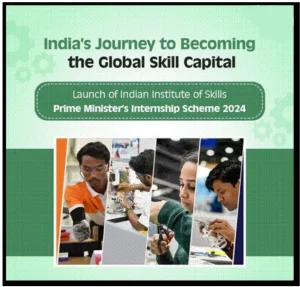
Despite training over 1.40 crore candidates under the Pradhan Mantri Kaushal Vikas Yojana between 2015 and 2025, India’s skilling ecosystem faces significant challenges in quality, industry trust, and workforce integration.
About Skill Development
- Refers: Skill Development refers to the systematic acquisition of employable competencies—technical, vocational, digital, and soft skills—that enhance an individual’s productivity, employability, and income potential.
- In India, it is a critical enabler for converting the demographic dividend into economic growth.
About Pradhan Mantri Kaushal Vikas Yojana (PMKVY)
- The PMKVY is the flagship skill development scheme of the Ministry of Skill Development and Entrepreneurship (MSDE).
- Launch & Progress: Launched in 2015, it is currently in its fourth phase (PMKVY 4.0), which is slated to run through 2026.
- Aim: To enable Indian youth to take up industry-relevant skill training to secure better livelihoods and to recognize the prior skills of the existing workforce.
- Core Pillars of the Scheme: The program is structured around three main delivery models to ensure no one is left behind:
- Short Term Training (STT): Designed for school/college dropouts or the unemployed. It offers National Skills Qualifications Framework (NSQF)-aligned technical training (typically 150–600 hours) along with soft skills, digital literacy, and entrepreneurship.
- Recognition of Prior Learning (RPL): Focuses on the informal workforce. It assesses and formally certifies existing skills, providing “bridge courses” to fill knowledge gaps and improve employability.
- Special Projects: Targeted initiatives for marginalized groups, difficult terrains (border areas/aspirational districts), or specialized roles (e.g., training jail inmates or tribal youth).
- Key Features of PMKVY 4.0 (The 2026 Roadmap): The current phase has been reimagined to be demand-driven rather than supply-driven:
- Future-Ready Skills: A massive push toward Industry 4.0 roles, including AI, Robotics, Drone Technology, Mechatronics, and 5G.
- Skill India Digital Hub (SIDH): A unified “Aadhaar-based” platform that acts as a Digital Skill Passport, tracking a learner’s progress and linking them directly to jobs and apprenticeships.
- Academic Integration: In line with NEP 2020, certifications now earn credits via the Academic Bank of Credits (ABC), allowing vocational skills to count toward formal college degrees.
- On-the-Job Training (OJT): Mandatory workplace exposure for many roles to ensure “learning by doing” and stronger industry-connect.
- Micro-Credentials & Stackable Certificates: To provide maximum flexibility, the government has introduced modules starting from just 7.5 hours.
- These credits are stored in the Academic Bank of Credits (ABC), allowing learners to “stack” short-term certifications to eventually earn a full diploma or degree.
- Eligibility Criteria:
- General Age Group: Indian nationals between 15 and 45 years are eligible for most training programs.
- Extended Age for RPL: For the Recognition of Prior Learning (RPL) component, the age limit is extended up to 59 years to support the existing informal workforce in getting certified.
- Primary Targets: The scheme is specially designed for school/college dropouts and unemployed youth who want to gain a job-ready skill.
- Documentation: A valid Aadhaar Card and an Aadhaar-linked bank account are mandatory for registration and receiving incentives via Direct Benefit Transfer (DBT).
- Financial Benefits and Incentives:
- Zero Cost Training: Candidates do not pay any tuition or assessment fees. The entire cost is borne by the Ministry of Skill Development and Entrepreneurship (MSDE).
- Cash Reward: Every candidate who successfully clears the assessment and receives a certificate is awarded a monetary incentive of ₹500 as a token of encouragement.
- Kaushal Bima (Insurance): To provide social security, every certified candidate receives a 3-year Accidental Insurance cover of ₹2 lakhs at no cost.
- Travel and Boarding: In specific cases, such as Special Projects in difficult terrains or for marginalized groups, the scheme may provide stipends for travel and boarding to ensure the training is truly accessible.
- Empowerment and Inclusion:
- Mahila Shakti (Women): There is a massive push for women’s participation, with dedicated centers and courses designed to bring more women into the formal workforce.
- Marginalized Communities: Priority is given to candidates from SC/ST communities and Persons with Disabilities (PwD) to ensure equitable social mobility.
- Geographic Focus: Special focus is placed on Aspirational Districts, border areas, and Left-Wing Extremism (LWE) affected regions to bring development to India’s most remote corners.
- Direct Support for Career Growth:
-
- Digital Skill Passport: Through the Skill India Digital Hub, every certified candidate receives a QR-coded, verifiable digital certificate that acts as a “passport” to global and domestic job markets.
- Placement and Entrepreneurship: Training centers are mandated to provide placement assistance. Furthermore, a PMKVY certificate makes it easier for youth to apply for Mudra Loans (up to ₹10 lakhs) to start their own small businesses.
|
Need for Skill India in Achieving Viksit Bharat @2047
- Economic Imperative:
 Low Employability Levels: As per the India Skills Report (ISR) 2026, India’s overall employability has risen to 56.35% (from 54.8% in 2025), reflecting a rapid shift towards a “skills-first” economy shaped by AI and global labor mobility.
- Also, for the first time in five years, women’s employability (54%) has surpassed men’s (51.5%), which is largely attributed to the rise of hybrid work models and targeted digital skilling in Tier-2 and Tier-3 cities.
- Productivity Challenge: The Economic Survey highlights that India’s labour productivity remains significantly below advanced economies, making skilling essential for sustained high GDP growth.
- MSME-Led Job Creation: With over 110 million people employed in MSMEs (Ministry of MSME), Skill India is critical to transform youth from job seekers to job creators, strengthening the backbone of the economy.
- Industry 4.0 Readiness:
- Emerging Skill Demand: Government policy documents identify AI, robotics, semiconductors, drones, EVs, and advanced manufacturing as future growth engines.
- Make in India Constraint: The National Manufacturing Policy and PLI schemes require a workforce skilled in automation, IoT, and smart factory systems, making Skill India a critical enabler.
- Digital Divide: Platforms such as the Skill India Digital Hub address digital literacy gaps, especially in rural and informal sectors.
- Social Imperative:
- Women’s Workforce Participation: The Economic Survey consistently notes that increasing female labour force participation is one of the fastest ways to raise GDP; targeted skilling is central to this objective.
- Rural and Marginalised Outreach: Schemes like Jan Shikshan Sansthan focus on grassroots skilling, reducing distress migration and informal vulnerability.
- Upward Mobility: Vocational training provides pathways into formal, higher-wage sectors, helping reduce inter-generational inequality.
- Global Opportunity:
- Global Labour Mobility: Alignment of qualifications through National Skills Qualifications Framework (NSQF) enhances international acceptance of Indian skills.
- Remittances and Soft Power: Skilled migration strengthens foreign remittance inflows and enhances India’s economic diplomacy, as recognised in official migration and labour policy documents.
Key Initiatives and Actions taken by India
- Structural & Policy Initiatives:
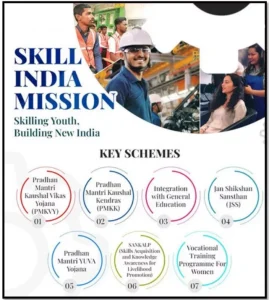
- Skill India Mission (2015): A national mission to train 400+ million youth in industry-relevant skills through formal and informal skilling channels.
- National Education Policy (NEP) 2020: A landmark shift that integrates vocational education into schools and colleges.
- It aims for 50% of learners to have exposure to vocational education by 2025.
- National Credit Framework (NCrF): This policy breaks down “educational silos” by allowing students to earn academic credits for technical skills, making vocational training a mainstream career choice.
 National Skills Qualifications Framework (NSQF): Organizes qualifications into levels based on knowledge and skills, ensuring that Indian certifications meet international standards for global mobility.
- Large-Scale Training Programs:
- Pradhan Mantri Kaushal Vikas Yojana (PMKVY): The flagship scheme providing short-term training and certification.
- PMKVY 4.0 now focuses on Industry 4.0 skills like AI, 3D printing, and drones.
- PM-SETU (Oct 2025): The Pradhan Mantri Skilling and Employability Transformation through Upgraded ITIs is a centrally sponsored scheme with an investment of ₹60,000 crore.
- Hub-and-Spoke Model: It aims to transform 1,000 Government ITIs into Centres of Excellence (200 Hubs and 800 Spokes).
- Industry Ownership: Clusters are managed by Special Purpose Vehicles (SPVs) anchored by industry partners, moving the system toward a “Government-owned, Industry-managed” model.
- National Centres of Excellence (NCE): Established via the Union Budget 2025-26, five NCEs are being set up with global partnerships to train youth in “frontier skills” like Green Hydrogen, Semiconductors, and Advanced Robotics.
- National Federated Skill & Workforce Registry: Finalized in the Kaushal Manthan 2026, this registry acts as a unified digital database to improve the “searchability” of skilled workers for domestic and global employers.
- PM Vishwakarma: Specifically targets traditional artisans and craftspeople (like carpenters and goldsmiths), providing them with modern tools, credit support, and digital marketing skills.
- Workplace & Apprenticeship Integration:
- National Apprenticeship Promotion Scheme (NAPS): This scheme incentivizes industries to hire apprentices by sharing the cost of stipends.
- It bridges the gap between classroom theory and workplace reality.
- Skills Acquisition and Knowledge Awareness for Livelihood Promotion (SANKALP) & Skill Strengthening for Industrial Value Enhancement (STRIVE): These are World Bank-supported projects aimed at improving the quality of training in ITIs and strengthening the “Skill India” infrastructure at the state and district levels.
- Digital & Technological Enablers:
- Skill India Digital Hub (SIDH): A unified platform that acts as the “Aadhaar of Skilling.”
- It provides a Digital Skill Passport, links learners to job opportunities, and uses AI to suggest courses based on market demand.
- Skill India International Centres: Established to prepare Indian youth for global jobs.
- These centers focus on language training and technical certifications required in countries like Japan, Germany, and the UAE.
- Social and Inclusive Skilling:
- Jan Shikshan Sansthan (JSS): Focuses on providing vocational skills to non-literates and school dropouts in rural areas, particularly targeting women and marginalized groups to ensure equitable growth.
- National Skill Development Corporation (NSDC): A public-private partnership that funds private training providers to scale up high-quality vocational institutes across the country.
Challenges that need to be Tackled
- The Aspiration and Economic Gap:
- Low Aspirations: Vocational training is still seen as a secondary option for those who cannot succeed in formal academics.
- The 4% Training Deficit: Only 4.1% of India’s workforce has formal vocational training, compared to 44%–70% in OECD countries.
- This creates a massive “skill poverty” in the labor market.
- Modest Economic Gains: Data shows that wage increases from training are inconsistent.
- If a certified plumber earns the same as an uncertified one, there is no visible improvement in quality of life, killing the incentive to get skilled.
- Educational Silos: Higher education does not integrate skilling.
- Most students only seek post-degree skilling as a desperate measure after failing to find a job, rather than as a core part of their studies.
- The Industry and Market Alignment Gap:
- Low Recruitment Utility: Most employers ignore public skilling certifications.
- They prefer their own in-house training systems or private platforms because they don’t trust the quality of government-issued certificates.
- Lack of Co-Design: Industry is often treated as a “customer” of manpower rather than a co-designer of the curriculum.
- Without direct industry stake, the skills taught often become outdated by the time students graduate.
- Uneven Apprenticeship Adoption: While the National Apprenticeship Promotion Scheme (NAPS) is growing, it is mostly used by large companies.
- Small and Medium Enterprises (SMEs), which employ the most people, find the system too complex to join.
- The Missing “Green” & “AI” Pipeline: Emerging sectors like Green Hydrogen, Semiconductors, and AI face a massive “talent vacuum.”
- Current ITIs and centers are not yet equipped to teach these high-end technical skills at scale.
- CAG Audit Observations (2025): A 2025 Comptroller and Auditor General (CAG) report highlighted that despite high certification, only 41% of candidates under short-term training were placed.
- The report called for a more rigorous micro-level skill-gap analysis to ensure job roles align with actual market demand rather than just meeting enrollment targets.
- The Credibility and Accountability Gap:
- Fragmented Responsibility: Unlike technical colleges, the skilling system separates training, assessment, and certification.
- This “diffusion of responsibility” means no single agency is held accountable if a student remains unemployed.
- Weak Signaling Value: Employers find that Sector Skill Council (SSC) credentials hold less weight than traditional degrees.
- Assessments are often binary (pass/fail) rather than graded, offering no insight into a candidate’s actual level of expertise.
- Failure of Mandate: SSCs have focused on quantity (enrollment numbers) rather than quality (job placement).
- Unlike private certifiers (like Google), government bodies don’t lose “brand value” if their students fail to get jobs.
- Digital Divide and Infrastructure: While Skill India Digital is a great step, many rural training centers lack the high-speed internet and modern labs needed for Industry 4.0 training, creating a “Digital Skill Gap” between cities and villages.
- The Geographic and Social Gap:
- Regional Imbalance: Training centers are concentrated in industrialized states like Maharashtra and Tamil Nadu.
- Rural areas and “Aspirational Districts” often lack the infrastructure to provide high-quality technical training.
- Gendered Skilling: Many skilling programs are still male-dominated.
- Barriers like a lack of childcare at training centers or safe transport prevent women from joining high-paying technical trades, limiting the “Mahila Shakti” pillar of Viksit Bharat.
Global Comparisons
- Germany – Dual Education System: Students split time between vocational schools (theory) and companies (practice), earning a stipend from day one.
- Industry bodies (Chambers of Commerce) design the curriculum and examinations, ensuring market-relevant skills.
- Lesson for India: Promote industry-owned training with Micro, Small and Medium Enterprises (MSMEs) as training hubs and 60% shop-floor learning.
- Singapore – SkillsFuture Plus (2026): Skilling is lifelong. Citizens aged 25 and above receive SkillsFuture Credits; mid-career workers (40+) receive monthly allowances to reskill in Artificial Intelligence (AI) or green energy without income loss.
- Lesson for India: Enable lifelong upskilling via a digital skill wallet for workforce adaptability.
- South Korea – Meister High Schools: Elite vocational schools train students for high-technology sectors (semiconductors, robotics) with near-100% employment and full government support for tuition and boarding.
- Lesson for India: Convert Industrial Training Institutes (ITIs) into “Meister Hubs” with modern laboratories and industry linkages to make vocational education a first choice.
- Australia – Apprenticeship Priority List: Skills are data-driven; high-demand sectors receive higher financial incentives for both apprentices and employers.
- Lesson for India: Implement outcome-based funding linked to skill scarcity and placement outcomes.
- Switzerland – Vocational and Professional Education and Training (VPET): Vocational training covers 70% of youth, yet allows smooth transition to university degrees via credit recognition.
- Lesson for India: Strengthen National Credit Framework (NCrF), giving vocational certificates of academic mobility for higher education.
|
Way Forward
- Workplace Integration as the Default Pathway:
- Modernising ITIs (PM-SETU): Convert 1,000 ITIs into Centres of Excellence under a Government-owned, Industry-managed model, allowing industry to determine curricula aligned with market demand.
- Hub-and-Spoke Model: Under PM-SETU, high-tech Hub ITIs should share advanced labs and industry experts with Spoke ITIs, extending quality workplace exposure to rural and semi-urban youth.
- Repositioning Apprenticeships (NAPS): As envisaged under the Skill Resolutions 2026, apprenticeships should become the primary school-to-work pathway, with mandatory On-the-Job Training (OJT) for over 13 lakh apprentices annually to bridge the theory–practice divide.
- MSME Participation: Stipend support can incentivise MSMEs to absorb apprentices, embedding learning within day-to-day business operations.
- Embedded Learning within Formal Education:
- Credit Integration: Vocational skills must be embedded into higher education, enabling students to earn up to 25% of degree credits through NSQF-aligned vocational certifications.
- NEP 2020 Alignment: To achieve the 50% Gross Enrolment Ratio (GER) by 2035, skilling cannot remain a post-graduation add-on, but must be concurrent with degrees.
- Breaking the Silo Culture: Replace post-degree skilling with parallel skilling, ensuring graduates exit with both a formal degree and a verifiable Skill Passport.
- Vocational Skill Labs: Introducing skill labs in Navodaya and Eklavya schools can mainstream vocational education and counter the perception of it being a secondary pathway.
- Accountability for Outcomes, Not Enrolments:
- Economic Pillar, Not Welfare: Skilling programmes must be evaluated on employability and placement outcomes, not merely training numbers.
- Non-performing centres should lose public funding.
- Ownership of the Value Chain: Sector Skill Councils (SSCs) must move beyond standard-setting to outcome ownership, with their credibility tied to market wages and placement rates of certified candidates.
- Outcome-Linked Funding: A Pay-for-Success model should withhold part of government payments until candidates complete six months of verified employment, strengthening accountability across the skilling ecosystem.
- Graded Signalling: Replace Pass/Fail certification with graded proficiency, where higher grades translate into higher entry-level wages, creating market incentives for quality skilling.
- Convergence and Digital Transparency:
- Unified Skilling Architecture: Skill India must move towards system-wide convergence, reducing fragmentation and improving traceability of outcomes.
- One Nation, One Student ID: Through the Skill India Digital Hub, track an individual’s skill journey from school to retirement, creating a trusted, verifiable skills ledger accessible to employers nationwide.
Indian State-Level Best Practices
- Tamil Nadu – Industry-Linked Industrial Training Institutes (ITIs): Tamil Nadu has upgraded select Industrial Training Institutes (ITIs) through direct industry partnerships, especially in automobile and electronics manufacturing clusters.
- Gujarat – Skill Universities and Apprenticeship Focus: Gujarat established Kaushalya – The Skill University and actively promotes apprenticeships with Micro, Small and Medium Enterprises (MSMEs).
- Odisha – World Skill Centres: Odisha set up World Skill Centres in collaboration with global industry partners to deliver advanced technical skills in manufacturing and services.
- Kerala – Lifelong Learning and Digital Skilling: Kerala’s Additional Skill Acquisition Programme (ASAP) integrates school, higher education, and workforce skills, with strong emphasis on digital and future skills.
|
Conclusion
To achieve Viksit Bharat @ 2047, India must transform skilling from a welfare service into an accountable economic pillar. By integrating industry-led training and academic credits, India will bridge the gap between Jan Shakti (People Power) and Rashtra Shakti (National Power), turning its demographic dividend into a global powerhouse.


 8 Jan 2026





.png)






 Current Affairs




 GS Foundation
 Optional Course
 Combo Courses
 Degree Program