Recently, French President Emmanuel Macron visited India to attend the India AI Summit and both countries upgraded ties to a “Special Global Strategic Partnership” under the Horizon 2047 Roadmap (2023).
Horizon 2047 – India-France Strategic Roadmap
- Purpose: To chart the future of India-France relations until 2047, celebrating centenaries of India’s independence and diplomatic ties.
- Adoption: July 2023, during PM Modi’s visit to France.
- Key Areas:
- Defense: Enhanced cooperation, joint projects.
- Space: Strengthened ISRO-CNES collaboration.
- Nuclear Energy: Focus on sustainable solutions via Jaitapur and modular reactors.
- Innovation & Tech: Promoting advancements in AI, cybersecurity, and digital infrastructure.
- Sustainable Development: Climate action, blue economy, clean energy.
- Cultural Exchange: Boosting people-to-people ties.
- Indo-Pacific: Specific roadmap for regional cooperation.
- Objectives: Strategic autonomy, global challenge response, and fostering innovation.
|
- Anti-Hegemonic Alignment: Both leaders explicitly defined the partnership as a move “against hegemony.”
- By advocating for a world order rooted in the Rule of Law and Sovereign Equality, India and France are signaling that they will not be junior partners in a US-China bipolarity.
- Digital Sovereignty & Ethics: Beyond just “AI centers,” the summit highlighted Digital Ethics.
- President Macron’s call for transparent algorithms and AI that respects cultural diversity positions the Indo-French partnership as a global leader in “responsible technology.”
About France
- Mainland France is famously shaped like a Hexagon and is the largest country in Western Europe.
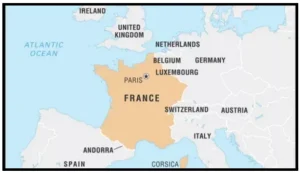 Hemispheric Location: Located in the Northern and Eastern Hemispheres. Hemispheric Location: Located in the Northern and Eastern Hemispheres.- Surrounding Water Bodies:
- North: English Channel (La Manche) and the North Sea.
- West: Bay of Biscay (Atlantic Ocean).
- South: Mediterranean Sea (specifically the Gulf of Lion).
- Bordering Nations:
- Belgium (North)
- Luxembourg (Northeast)
- Germany (East) — Boundary follows the Rhine River.
- Switzerland (East) — Separated by the Jura Mountains.
- Italy (Southeast) — Separated by the Alps.
- Monaco (Southeast enclave)
- Andorra (Southwest) — Located in the Pyrenees.
- Spain (Southwest) — Boundary follows the Pyrenees Mountains.
- Strategic Maritime “Choke Points” & Islands:
- Strait of Dover: The narrowest part of the English Channel, separating France (Calais) from the UK (Dover).
- Corsica: A large Mediterranean island belonging to France, located north of the Italian island of Sardinia.
- Maritime Reach: Due to its territories, France has the second-largest Exclusive Economic Zone (EEZ) in the world (over 11 million km2), most of which is in the Indo-Pacific.
Overseas France
| Region |
Territory |
Location Detail |
| Indian Ocean |
|
- Key for the “Joint Strategic Vision” with India.
|
| South America |
|
- Borders Brazil and Suriname. Home to the Kourou Space Centre (used by ISRO).
|
| Caribbean |
|
- Part of the Lesser Antilles.
|
| Pacific Ocean |
- New Caledonia & French Polynesia
|
- Rich in nickel and critical minerals.
|
- Physical Boundaries (Natural Dividers):
- Pyrenees: Separates France from Spain.
- Alps: Separates France from Italy and Switzerland (Mont Blanc is the highest peak here).
- Jura Mountains: Separates France from Switzerland.
- Vosges Mountains: Located in the East, near the Rhine valley.
- Massif Central: An ancient highland region in south-central France.
- Important Rivers:
- Seine: Flows through Paris into the English Channel.
- Loire: The longest river in France; flows into the Atlantic.
- Rhône: Rises in Switzerland, flows through Lake Geneva, and empties into the Mediterranean.
- Garonne: Rises in the Pyrenees and flows into the Atlantic via the Gironde Estuary.
|
Key Outcomes of the 2026 Summit
- India-France Year of Innovation 2026: Launched in Mumbai to catalyze cooperation in Deep-Tech, Green Hydrogen, and Space-Tech.
- It connects Indian startups (via platforms like T-Hub) with French ecosystems (like Station F).
- H125 Helicopter Final Assembly Line (FAL): Inaugurated at Vemagal, Karnataka, by Tata Advanced Systems Limited (TASL) and Airbus.
- This is India’s first private-sector helicopter assembly plant, embodying the Atmanirbhar Bharat (Self-Reliant India) vision.
- Defense Co-production: A landmark Joint Venture (JV) between Bharat Electronics Limited (BEL) and Safran to manufacture HAMMER (Highly Agile Modular Munition Extended Range) missiles within India.
- Indo-French Centre for AI in Health: Established at AIIMS (All India Institute of Medical Sciences), New Delhi, to leverage Artificial Intelligence for early diagnosis of neurological and infectious diseases.
| A DTAA is a bilateral tax treaty signed between two nations to ensure that a taxpayer (individual or corporation) does not have to pay tax on the same income in both countries. |
- Amending Protocol to the DTAA: An update to the Double Taxation Avoidance Agreement (DTAA) to modernize tax rules for French investors, specifically halving dividend tax rates for long-term strategic investments.
- Establishment of an Annual Foreign Ministers’ Comprehensive Dialogue: To regularly review the progress of the Horizon 2047 Roadmap.
- Reciprocal Deployment of Armed Forces: An agreement to facilitate the deployment of military officers in each other’s land force establishments, enhancing logistical and operational synergy.
- Cultural Infrastructure: Collaboration on the National Maritime Heritage Complex (NMHC) in Lothal and the opening of a Swami Vivekananda Cultural Centre in France.
- Transport Connectivity: France emerging as a reliable partner for India’s High-Speed Rail Networks.
The Multidimensional Architecture of Relations
- Historical and Political Foundations:
- Strategic Consistency: Since the establishment of diplomatic ties in 1947, France has remained India’s most consistent Western partner.
- Notably, in 1998, France was the first country to sign a Strategic Partnership with India and refused to impose sanctions after the Pokhran-II nuclear tests, recognizing India’s security imperatives.
- Support for Global Ambitions: France remains the most vocal advocate for India’s permanent seat in a reformed United Nations Security Council (UNSC) and its membership in the Nuclear Suppliers Group (NSG).
History of India-France Relations
- Early Interactions (17th–18th Century)
- Colonial Presence: France established its presence in India during the 17th century, competing with the British and Portuguese for trade and territorial control.
- The French East India Company was founded in 1664, and trading posts were established in Pondicherry (now Puducherry), Chandernagore (now Chandannagar), Mahe, Yanam, and Karaikal.
- Anglo-French Rivalry: The Carnatic Wars (1746–1763) between the British and French East India Companies were fought for control over South India.
- The French were eventually defeated, leading to the decline of their territorial ambitions in India.
- Post-Independence Era (1947–1990s):
- Diplomatic Relations: India and France established diplomatic relations in 1947, shortly after India’s independence.
- France supported India’s non-aligned stance during the Cold War and maintained a balanced relationship despite India’s closer ties with the Soviet Union.
- Cultural Ties: The French Institute of Pondicherry (1955) and the Alliance Française network in India played a significant role in promoting cultural and academic exchanges.
- Economic Cooperation: France became a key partner in India’s industrialization efforts, particularly in sectors like energy, aviation, and infrastructure.
- Strategic Partnership (1998–Present):
- Landmark Agreement: In 1998, India and France signed their first-ever Strategic Partnership, marking a new era in bilateral relations. This was India’s first strategic partnership with any country.
- Pillars of Partnership: The partnership is built on three main pillars: defence and security, civil nuclear cooperation, and space collaboration.
- Defence Cooperation: France has been a reliable defence partner, supplying advanced military equipment such as the Mirage 2000 fighter jets and Scorpene submarines.
- Civil Nuclear Cooperation: France played a crucial role in supporting India’s civil nuclear program after the Indo-US nuclear deal (2008).
Key Milestones in the 21st Century
- 2008: France supported India during the NSG (Nuclear Suppliers Group) waiver, enabling India to engage in civil nuclear trade globally.
- 2015: PM Modi visited France, and the two countries agreed to enhance cooperation in renewable energy, urban development, and counter-terrorism.
- 2016: The Rafale deal was signed, marking a significant milestone in defence cooperation.
- 2018: President Emmanuel Macron visited India, and the two countries adopted the Joint Strategic Vision for Cooperation in the Indian Ocean Region.
- 2023: The 25th anniversary of the Strategic Partnership was celebrated, and the Horizon 2047 roadmap was adopted to guide the partnership for the next 25 years.
|
- Defense and Strategic Cooperation- The “Sovereign” Pillar: Defense is the bedrock of this alliance, transitioning from a buyer-seller model to a joint design and production framework.
- Naval & Air Power: Beyond the 36 Rafale jets, the partnership now includes 26 Rafale-Marine jets and the continued indigenization of Scorpène-class submarines (Kalvari-class).
- Interoperability: Regular conduct of high-complexity military exercises such as Varuna (Naval), Garuda (Air Force), and Shakti (Army).
- Example: The Safran-HAL partnership for co-developing high-thrust engines for the AMCA (Advanced Medium Combat Aircraft) program.
- Indo-Pacific Synergy and Maritime Security: As a “resident power” with territories like Réunion Island and Mayotte, France is India’s primary partner in the Western Indian Ocean.
- Maritime Domain Awareness (MDA): Joint use of satellite data and naval facilities to monitor non-traditional threats (piracy, illegal fishing) and ensure a Free, Open, and Inclusive Indo-Pacific (FOIIP).
- Civil Nuclear, Energy, and Space: Nuclear Renaissance: Renewed commitment to the Jaitapur Nuclear Power Project (JNPP) and a new focus on Small Modular Reactors (SMRs) for clean energy transition.
- Space Frontier: Cooperation between ISRO (Indian Space Research Organisation) and CNES (Centre National d’Études Spatiales) on the TRISHNA climate satellite and the Gaganyaan (Human Spaceflight) mission.
Why Does Partnership Matters?
- Strategic Autonomy: Both nations prioritize their right to make independent decisions. For India, France is a bridge to the Global North; for France, India is a gateway to the Global South.
- Technological Sovereignty: By co-developing critical technologies (AI, Semiconductors, Jet Engines), both nations reduce dependence on volatile global supply chains.
- Climate Leadership: As co-founders of the International Solar Alliance (ISA), they lead the global discourse on the Paris Agreement and green finance.
- Counter-Terrorism Solidarity: The tribute at the 26/11 Memorial (Taj Mahal Palace) reaffirms that the partnership is anchored in a shared, uncompromising stance against global terror.
- The “Partnership of the People”: The launch of the Year of Innovation 2026 at the Gateway of India and the cinema-themed lunch (cinema as a bridge) show that the alliance is utilizing Culture and Creative Industries as economic drivers.
- Health & Youth Engagement: Symbolic acts like the Marine Drive jog serve as “lifestyle diplomacy,” targeting the youth demographic and promoting a positive message about health and fitness.
Challenges and Concerns need to be Tackled
- Economic Asymmetry: Despite strategic depth, bilateral trade (~$15.5 billion) remains significantly lower than India’s trade with Germany or the US.
- Implementation Bottlenecks: Legal complexities under the Civil Liability for Nuclear Damage Act (2010) have delayed the Jaitapur project for over a decade.
- Divergent Geopolitics: While aligned on the Indo-Pacific, nuances differ on the Russia-Ukraine conflict (France’s NATO commitments vs. India’s multi-alignment).
Way Forward
- Industrial Integration: Expanding the “Make in India” success of the H125 helicopter to underwater drones and cyber-security systems.
- People-to-People Connectivity: Reaching the target of 30,000 Indian students in France by 2030 through specialized visas and university partnerships.
- Trilateral Cooperation: Strengthening the India-France-UAE and India-France-Australia frameworks to manage regional security without escalating tensions.
Conclusion
The India-France relationship is no longer a mere diplomatic arrangement, it is a Strategic Necessity. As a “Partnership of the People,” it serves as a beacon of stability, proving that trust and shared technological ambition can create a resilient, multipolar world order.


 18 Feb 2026







.png)






 Current Affairs




 GS Foundation
 Optional Course
 Combo Courses
 Degree Program