Recently, the U.S. President Donald Trump threatened intervention if Iran used lethal force against protesters, sharply escalating tensions amid deadly nationwide economic protests.
About the Iran Protests
- Background: Protests began in late December 2025 after a sharp fall in the Iranian rial, worsening inflation, and prolonged economic hardship aggravated by sanctions and conflict.
- Demands: Protesters, including shopkeepers and urban workers, demanded economic relief, currency stabilisation, and better governance rather than regime change.
- Nature of Protests: Initially peaceful demonstrations spread from Tehran to several cities, later turning violent with clashes between security forces and protesters.
- Government Response: Iranian authorities acknowledged economic grievances but labelled violent elements as “rioters,” leading to a security crackdown and reported civilian casualties.
Recent U.S. Interference in Iran
- Sanctions (2018–present): The U.S. withdrew from the 2015 Joint Comprehensive Plan of Action (JCPOA) nuclear deal in 2018 and reimposed severe economic sanctions, severely constraining Iran’s economy.
- Assassination of Qasem Soleimani (2020): The U.S. killed Iran’s top military commander in a drone strike in Baghdad, sharply escalating bilateral hostility.
- Support to Israel (2025): The U.S. backed Israeli airstrikes on Iran’s nuclear facilities in June 2025, followed by direct U.S. strikes and Iranian retaliation against a U.S. base in Qatar.
- Information Warfare (2025): Israeli intelligence agencies openly encouraged Iranian protests through social media messaging, with U.S. political backing.
- Renewed Military Threats (2026): Trump warned of fresh attacks if Iran rebuilt its missile or nuclear capabilities, linking internal protests to external intervention.
About Iran

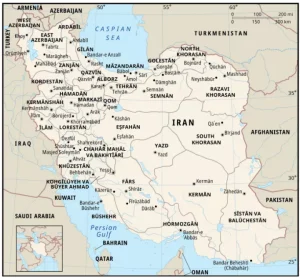
- Location: Iran is a large country in West Asia (Middle East), centred on the Iranian Plateau.
- Borders: It shares land borders with Turkey and Iraq (west); Armenia, Azerbaijan, Turkmenistan, and the Caspian Sea (north); Afghanistan and Pakistan (east); and maritime borders with the Persian Gulf and Gulf of Oman (south).
- Topography: Dominated by the Zagros Mountains in the west and the Alborz Mountains in the north, including Mount Damavand, Iran’s highest peak.
- Deserts: The Dasht-e Kavir and Dasht-e Lut occupy central and eastern regions.
- Climate: Ranges from subtropical along the Caspian coast to arid and semi-arid inland.
- Resources: Rich in oil, natural gas, and minerals such as copper and iron ore.
|
Potential Implications of the Current Situation
- Regional Instability: Escalation risks wider conflict across West Asia, threatening U.S. bases, Israel, and Gulf states.
- Global Energy Markets: Any conflict involving Iran could disrupt oil and gas supplies through the Strait of Hormuz, impacting global prices.
- India’s Interests: India faces risks to energy security, diaspora safety, and maritime trade, while needing to balance ties with Iran, the U.S., and Gulf partners.
- International Norms: Direct intervention over internal protests raises concerns about sovereignty, precedent-setting, and international law.
Conclusion
The Iran crisis reflects the dangerous convergence of internal economic distress and external geopolitical pressure, with serious consequences for regional stability and global strategic interests.