Ladakh Magmatic Arc: Subduction, Neo-Tethys and Himalayan Formation

18 Mar 2026

Ladakh Magmatic Arc: Subduction, Neo-Tethys and Himalayan Formation

Scientists from the Wadia Institute of Himalayan Geology have decoded the 130-million-year evolution of the Ladakh Magmatic Arc.

  • The study provides new insights into subduction processes and the collision between the Indian Plate and Eurasian Plate.

About Subduction

  • Subduction is a geological process in which one tectonic plate moves beneath another and sinks into the Earth’s mantle at a convergent plate boundary.
  • Mechanism: It occurs when an oceanic plate, being denser, collides with a lighter continental or oceanic plate and is forced downward into the mantle.
  • Key Features:
    • Formation of deep oceanic trenches at the plate boundary.
    • Generation of volcanic arcs due to melting of mantle above the subducting plate.
    • Earthquakes occur along the subduction zone due to plate friction and stress.
  • Significance:
    • Drives plate tectonics and mountain building.
    • Responsible for the formation of magmatic arcs, such as the Ladakh Magmatic Arc.
    • Plays a major role in the recycling of crustal materials back into the mantle.
  • Example: The northward subduction of the Neo-Tethys Ocean beneath the Eurasian Plate led to the formation of the Ladakh Magmatic Arc.

Also Read | UPSC Result 2025

Key Findings of Study

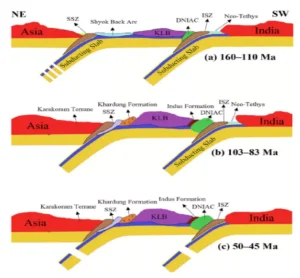
  • Subduction Mechanism: The Ladakh Magmatic Arc was formed due to the northward subduction of the Neo-Tethys Ocean oceanic plate beneath the Eurasian Plate margin.
  • Methodology: The study used geochemical and isotopic analysis of rocks to reconstruct tectonic and magmatic history.
  • Comparative Analysis: Researchers compared data from:
    • Dras–Nidar Island Arc Complex (DNIAC) (pre-collisional stage)
    • Ladakh Batholith (LB) (pre- to syn-collisional stage; part of Kohistan-Ladakh Batholith)
    • Post-collisional mafic dykes
  • Magmatic Control: The long-term magmatic evolution was controlled by the geodynamics of the Neo-Tethys Ocean.
  • Magmatic Episodes: Three major phases of magmatism were identified:
    • 160–110 Ma: Early arc (pre-collisional) magmatism
    • 103–45 Ma: Active arc (syn-collisional) magmatism
    • < 45 Ma: Post-collisional magmatism
  • Geochemical Signatures: Each phase shows distinct geochemical characteristics, reflecting changing tectonic conditions.

About Jurassic to Eocene Period

  • Timeframe: The Jurassic to Eocene spans from 201.3 million years ago (Ma) to 33.9 Ma.
  • Jurassic Period (201.3–145 Ma):
    • Characterized by the breakup of Gondwanaland and the opening of Neo-Tethys Ocean.
    • Extensive volcanic and magmatic activity occurred in island arcs.
    • Major marine sedimentation took place, preserving fossil-rich strata.
  • Cretaceous Period (145–66 Ma):
    • Continued northward drift of the Indian Plate.
    • Formation of subduction-related magmatic arcs such as the pre-collisional Ladakh Arc.
    • Widespread deposition of limestone, sandstone, and shale in the Tethys region.
  • Paleogene Period (66–33.9 Ma), including Eocene:
    • Marks the collision of the Indian and Eurasian plates.
    • Closure of the Neo-Tethys Ocean.
    • Formation of batholiths, syn-collisional magmatism, and the initial uplift of the Himalayas.
  • Significance: This interval preserves the complete record of subduction, arc magmatism, and continental collision in the NW Himalaya.

  • Slab Dynamics: The evolution is closely linked to subducting slab dynamics, involving interaction between:
    • Subducting oceanic slab
    • Sub-arc mantle wedge
    • Overlying continental crust
  • Conclusion: The study establishes a continuous record of subduction to collision processes, explaining the formation and evolution of the Ladakh Magmatic Arc.

About Ladakh Magmatic Arc (LMA)

  • LMA is a belt of igneous rocks in the Trans-Himalaya formed in the period Jurassic to Eocene- 201.3 million years ago to 33.9 Million Year (Ma).
  • Location: Situated in the Ladakh region, extending along the Indus Suture Zone in the Himalayas.
  • Formation: It was formed due to the northward subduction of the Neo-Tethys Ocean oceanic plate beneath the Eurasian margin.
    • In the earliest phase, the region resembled a chain of volcanic islands rising from the Neo-Tethys Ocean. 
      • Rocks from the Dras–Nidar Island Arc Complex preserve evidence of this stage. 
      • Their chemical fingerprints suggest that the magma mainly emerged from the mantle with only a small contribution from sediments dragged down by the subducting oceanic plate.
  • Rock Types: Composed mainly of granites, diorites, and volcanic rocks, indicating past magmatic activity.
  • Tectonic Significance: Marks an ancient subduction zone and provides evidence for plate tectonic processes.
  • Mineral Potential: Associated with metallic mineral deposits like copper and gold.
  • Scientific Importance: Helps in understanding the evolution of the Himalayas and continental collision processes.

Evolution Of The Ladakh Magmatic Arc

Earliest Phase: Island Arc Stage

  • The region resembled a chain of volcanic islands rising from the Neo-Tethys Ocean.
  • Rocks from the Dras–Nidar Island Arc Complex preserve evidence of this stage.
  • Their chemical fingerprints suggest that the magma mainly emerged from the mantle.
  • There was only a small contribution from sediments dragged down by the subducting oceanic plate.

Evolution During Plate Convergence

Ladakh Magmatic Arc

  • The arc evolved as tectonic plates continued to converge.
  • Large bodies of granite known as the Ladakh Batholith formed deep below the ground.
  • These rocks show stronger chemical signals from continental materials.
  • This implies that sediments and crustal fragments were being recycled into the magma.

Effect of Approaching Collision

  • The approaching collision between the Indian Plate and Eurasian Plate began to reshape the entire system.
  • The subducting plate carried more sediments into the mantle.
  • This led to enrichment of magma and changes in its chemistry.

Collision And Himalayan Uplift

  • The two plates eventually collided and the Neo-Tethys Ocean closed.
  • The collision resulted in the uplift of the Himalaya.

Post-Collision Magmatism

  • Even after the main collision, molten rock forced its way upward through cracks.
  • This led to the formation of mafic dykes (narrow sheets of dark volcanic rock cutting through older formations).
  • These later magmas came from a mantle source enriched by earlier tectonic processes.

Check Out UPSC CSE Books

Visit PW Store

online store 1

About Neo-Tethys Ocean

  • The Neo-Tethys Ocean was an ancient ocean located between the Indian Plate and the Eurasian Plate during the Mesozoic to early Cenozoic eras.
  • Origin: It originated after the breakup of Gondwanaland, when the Indian Plate drifted northward, forming a new oceanic crust.
  • Expansion: The ocean expanded significantly during the Jurassic and Cretaceous periods, acting as a major marine basin.
  • Subduction: Its oceanic lithosphere subducted beneath the Eurasian Plate, leading to the formation of magmatic arcs such as the Ladakh Magmatic Arc.
  • Closure: Continuous convergence resulted in the gradual narrowing and eventual closure of the ocean around 55–50 million years ago.
  • Collision: The collision between the Indian and Eurasian plates marked the complete disappearance of the Neo-Tethys Ocean.
  • Evidence: Geological evidence includes ophiolites, marine sediments, and the Indus-Tsangpo Suture Zone.
  • Significance: Its closure played a crucial role in the uplift and formation of the Himalayas.

Need help preparing for UPSC or State PSCs?

Connect with our experts to get free counselling & start preparing

Aiming for UPSC?

Download Our App

      
Quick Revise Now !
AVAILABLE FOR DOWNLOAD SOON
UDAAN PRELIMS WALLAH
Comprehensive coverage with a concise format
Integration of PYQ within the booklet
Designed as per recent trends of Prelims questions
हिंदी में भी उपलब्ध
Quick Revise Now !
UDAAN PRELIMS WALLAH
Comprehensive coverage with a concise format
Integration of PYQ within the booklet
Designed as per recent trends of Prelims questions
हिंदी में भी उपलब्ध

<div class="new-fform">


    </div>

    Subscribe our Newsletter
    Sign up now for our exclusive newsletter and be the first to know about our latest Initiatives, Quality Content, and much more.
    *Promise! We won't spam you.
    Yes! I want to Subscribe.