Recent geopolitical disruptions, most notably the ongoing tensions in the Red Sea crisis and the escalation in the Strait of Hormuz in 2026 have exposed the systemic fragility of global maritime networks.
- The earlier phase of the Red Sea crisis had already led to a steep (~50% decline in traffic) through the Suez Canal, while the 2026 Hormuz tensions have further intensified disruptions, triggering sharp spikes in global freight rates and war-risk insurance premiums.
About Maritime Chokepoints
- Conceptual Understanding: Maritime chokepoints are geographically narrow and strategically significant sea passages—such as straits and canals—through which a disproportionately large volume of global maritime traffic passes.
- These routes serve as critical conduits for international shipping, particularly for energy supplies, containerized goods, and bulk commodities, making them vital nodes in the global transport network.
- Structural Basis of Their Importance: The significance of maritime chokepoints stems from the spatial imbalance in the global economy.
- Hydrocarbon resources are largely concentrated in West Asia, whereas major centers of industrial production and consumption are located in East Asia, Europe, and North America.
- This geographical disconnect necessitates long-distance maritime transportation through a limited number of narrow sea routes.
- Systemic Role in Global Trade and Supply Chains: Maritime chokepoints function as indispensable connectors within global value chains.
- They enable the continuous and efficient movement of goods, energy resources, and intermediate inputs across continents.
- Any disruption in these routes can trigger cascading effects on global trade, energy security, and supply chain stability, underscoring their systemic importance in the world economy.
- Core Structural Characteristics:
- Extreme Concentration of Global Flows: A very limited number of chokepoints sustain the majority of global maritime trade, which reached ~12.3 billion tonnes in 2023 (UNCTAD), implying that any disruption at these nodes has system-wide repercussions for global commerce and economic stability.
- Physical Narrowness and Structural Fragility: Many chokepoints are inherently narrow—for example, the Strait of Malacca narrows to just ~2.8 km at its narrowest point—making them highly susceptible to blockages, accidents, or targeted disruptions, thereby exposing the physical fragility of global trade arteries.
- Limited Substitutability and High Switching Costs: Alternative routes such as the Cape of Good Hope significantly increase travel distances and operational costs, often extending transit time by 10–15 days, thereby making chokepoints structurally indispensable despite their vulnerabilities.
- Amplification of Economic Shocks: Disruptions in chokepoints lead to sharp increases in freight rates, insurance premiums, and delivery delays, as observed during the Red Sea crisis (2024), when container freight rates surged by over 100% (UNCTAD), illustrating how localized disruptions can escalate into global economic shocks.
- Therefore, maritime chokepoints operate as “geo-economic choke nodes” that translate geopolitical tensions into measurable economic disruptions across the world.
Major Maritime Chokepoints and Strategic Corridors
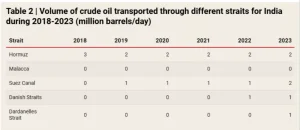
- Strait of Hormuz: It is the most critical global energy chokepoint, that connects the Persian Gulf with the Gulf of Oman, facilitating nearly one-fourth of global oil trade, and acting as the primary artery of hydrocarbon flows from West Asia to global markets.
- Relevance for India: Approximately 40%–50% of India’s crude oil imports transit through this route, making it a cornerstone of national energy security.
- Associated Corridor Linkage: It forms a crucial segment of the Hormuz–Malacca energy corridor, which sustains energy flows to Asian economies.
- Vulnerabilities and Risks: Its location in a geopolitically volatile region exposes it to conflicts, blockades, and military tensions, making global energy supply chains fragile.
- Recent Developments & Impact: The 2026 geopolitical tensions led to shipping disruptions, congestion, and rising war-risk premiums, which translated into inflationary pressures, higher import bills, and macroeconomic stress.
- The Insurance Sovereignty Gap: A critical dimension of the 2026 crisis is the “Insurance Blockade.”
- Since most Indian vessels rely on the International Group of P&I Clubs (based in Europe), spiked war-risk premiums have created an “Insurance Tax” on Indian energy.
- In response, the operationalization of the India P&I Club (2026) has emerged as a vital strategic tool, providing domestic insurance cover to ensure that Indian-flagged tankers can continue transiting volatile zones without being held hostage to global premium volatility.
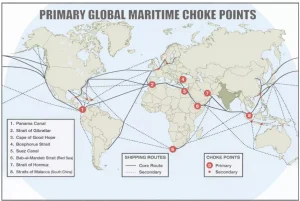 Strait of Malacca: It serves as the primary maritime connector between the Indian Ocean and Pacific Ocean, carrying nearly 30% of global trade, making it a linchpin of Indo-Pacific trade architecture.
-
- Structural Constraint: Its extreme narrowness (~2.8 km at its narrowest point) creates a natural bottleneck, increasing susceptibility to disruptions.
- “Malacca Dilemma”: This structural vulnerability implies that disruptions due to piracy, conflict, accidents, or blockades can severely choke global trade and energy flows.
- Role in Global Corridors: It is central to both the Malacca–Suez trade corridor (East Asia–Europe) and the Hormuz–Malacca energy corridor (West Asia–East Asia), making it systemically important.
- Relevance for India: It is critical for India’s eastward trade, Act East policy, and energy shipments, making it a strategically indispensable yet fragile node.
- The Malacca Dilemma is being countered by India’s transformation of the Andaman & Nicobar (A&N) Islands from a “passive archipelago” into a “strategic springboard.”
- The Great Nicobar Mega Project, specifically the International Container Transshipment Port (ICTP) at Galathea Bay, provides India with a “revolving door” at the mouth of the Malacca Strait.
- This allows for reciprocal vulnerability—the ability to monitor and, if necessary, restrict adversarial maritime flows in response to chokepoint disruptions elsewhere.
- Bab el-Mandeb – Suez Canal System: This system forms the shortest and most efficient maritime route between Asia and Europe, acting as a critical global trade gateway.
- Bab el-Mandeb connects the Red Sea with the Gulf of Aden
- Role in Global Corridors: It constitutes a key segment of the Malacca–Suez corridor, linking Asian manufacturing hubs with European markets.
- Relevance for India: Nearly 30–35% of India’s exports pass through this route, highlighting its importance for trade competitiveness.
- Vulnerabilities: The region is highly exposed to geopolitical instability, piracy, and conflict, particularly in the Red Sea region.
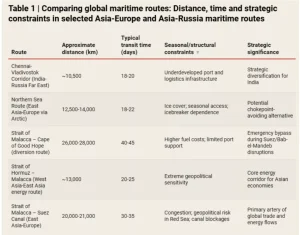
- Recent Disruptions & Impact: The Red Sea crisis led to a ~50% decline in Suez traffic, forcing rerouting via the Cape of Good Hope, resulting in higher costs, longer transit times, and supply chain disruptions.
- The Ever Given blockage further exposed its systemic fragility.
- Alternative and Emerging Strategic Routes:
- Cape of Good Hope Route: Acts as an emergency fallback option during disruptions in Suez/Bab el-Mandeb, but increases distance (26,000–28,000 km) and transit time (40–45 days), leading to higher fuel costs, emissions, and delays, making it economically inefficient.
- The Cape of Good Hope Route connects the Atlantic Ocean with the Indian Ocean.
- Northern Sea Route: Provides a shorter alternative route (12,500–14,000 km) between East Asia and Europe, but remains constrained by seasonal ice cover, infrastructure gaps, and geopolitical competition, making it strategically promising yet operationally uncertain.
- Chennai–Vladivostok Maritime Corridor: Enhances India–Russia Far East connectivity and reduces dependence on traditional chokepoints, though limited by infrastructure and logistical constraints, requiring sustained investment.
- International North-South Transport Corridor (INSTC): A multimodal connectivity corridor linking India with Central Asia, Russia, and Europe, capable of reducing transit time (30–40%) and costs (~20%), thereby enhancing trade efficiency and strategic autonomy.
- India-Middle East-Europe Economic Corridor: Announced during the G20 Summit 2023, it envisions an integrated network of ports, railways, and energy corridors, representing a long-term structural response to chokepoint vulnerabilities, despite current geopolitical challenges.
- India-Middle East-Europe Economic Corridor connects India to UAE, Saudi Arabia, Jordan, Israel, and integrates sea routes (Arabian Sea) with rail and road networks across West Asia.
Maritime Chokepoints as Shock Multipliers in the Global Economy:
- These developments underscore that maritime chokepoints are no longer passive transit routes but have evolved into active transmission channels of global economic shocks, directly influencing India’s inflation dynamics, trade competitiveness, and macroeconomic stability.
- Structural Dependence of India on Maritime Connectivity: The post-1991 phase of economic liberalisation and global economic integration has transformed India into a highly trade-dependent and energy-import reliant economy, wherein maritime connectivity forms the backbone of its external sector.
- Scale and Centrality of Sea-Based Trade: Currently, over 90% of India’s trade (by volume) and nearly 85% of its crude oil imports are transported via sea routes, indicating the structural centrality of maritime logistics to India’s growth model.
|
Significance for India
- Energy Security and Macroeconomic Stability: India’s dependence on maritime energy imports makes chokepoints central to its macroeconomic stability, as disruptions lead to oil price volatility, imported inflation, widening Current Account Deficit, and fiscal stress, thereby impacting economic growth.
 Trade Competitiveness and the “Insurance Effect”: An often overlooked dimension is the impact of war-risk insurance premiums, which rise sharply during geopolitical tensions. This leads to:
- Increased shipping costs across all goods
- Reduced competitiveness of Indian exports
- Disproportionate impact on MSMEs and labour-intensive sectors
- Thus, chokepoint disruptions indirectly erode India’s global trade competitiveness and export performance.
 Strategic and Geopolitical Importance: Chokepoints are central to the Indo-Pacific strategic framework, influencing sea lane security, naval mobility, and geopolitical alignments, thereby shaping India’s role as a regional maritime power and net security provider.
- Supply Chain Stability: In the context of global value chains and just-in-time production systems, uninterrupted maritime connectivity is essential. Disruptions in chokepoints lead to cascading supply chain failures, affecting production, employment, and economic growth.
Challenges that need to be Considered
- Geopolitical Volatility: Chokepoints are located in politically sensitive regions, making them vulnerable to conflicts, strategic rivalries, and geopolitical instability.
- Non-Traditional Security Threats: Emerging threats such as piracy, maritime terrorism, and drone warfare increase operational risks and costs, undermining maritime security.
- Structural Energy Dependence: India’s reliance on imported hydrocarbons creates a deep structural vulnerability to external disruptions.
- Economic Inefficiency of Alternatives: Alternative routes involve higher costs, longer transit times, and logistical challenges, limiting their effectiveness.
- Limited Strategic Control: India’s lack of direct control over chokepoints necessitates reliance on international cooperation and maritime governance frameworks.
- Grey Zone Warfare and Undersea Vulnerabilities: Modern threats have evolved beyond surface blockades to “Grey Zone” tactics.
- The 2026 escalation highlighted the fragility of Critical Underwater Infrastructure (CUI), where state-sponsored non-state actors utilize Unmanned Underwater Vehicles (UUVs) to target data cables and energy pipelines near chokepoints.
- This necessitates a shift from mere surface patrolling to comprehensive Underwater Domain Awareness (UDA).
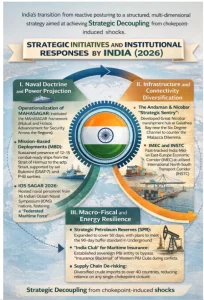
| Strategic Initiatives and Institutional Responses by India (2026) |
| Strategic Pillar |
Key Initiative / Framework |
2026 Operational Impact & Objective |
| Naval Doctrine & Power Projection |
MAHASAGAR Framework |
- Institutionalizes “Federated Security”; focuses on real-time Information Fusion and Underwater Domain Awareness (UDA) to preempt “Grey Zone” tactics (e.g., drone swarms).
|
| Mission-Based Deployments (MBD) |
- Maintains 12–15 combat-ready vessels at “choke nodes” supported by GSAT-7 (Rukmini) and P-8I Poseidon aircraft for a permanent security umbrella.
|
| IOS SAGAR 2026 |
- Hosts 16 IONS member nations for onboard training to create a “Federated Maritime Force” capable of collective action against non-traditional threats.
|
| Infrastructure & Connectivity |
Andaman & Nicobar “Strategic Sentry” |
- Development of the Galathea Bay transshipment hub leverages the Six Degree Channel to act as a “Gatekeeper” to the Malacca Strait.
|
| IMEC & INSTC Operationalization |
- Fast-tracks the India-Middle East-Europe Corridor (IMEC) and utilizes the INSTC as a high-speed multimodal hedge, reducing Europe transit times by 30%.
|
| Maritime Amrit Kaal (Sagarmala 2.0) |
- Investment of ₹3 lakh crore in shipbuilding clusters to reach the Global Top 5 by 2047, ensuring Flag Sovereignty during international crises.
|
| Macro-Fiscal & Energy Resilience |
Strategic Petroleum Reserves (SPR) |
- Maintains a 50-day energy buffer; Phase-II expansion underway to reach the 90-day global benchmark in response to Hormuz tensions.
|
| The “India Club” (Domestic P&I) |
- Operationalized a Sovereign-backed Maritime Insurance entity to bypass Western “Insurance Blackmail” and prohibitive war-risk premiums.
|
| Supply Chain De-risking |
- Diversified crude procurement to 40+ countries; non-Gulf sources (Russia, Africa, Americas) now constitute 60% of total imports.
|
Global Institutional Frameworks and Multilateral Counter-Measures:
- Global Governance & Legal Foundations: This layer provides the international legal mandate and technical standards required for secure transit.
- UNCLOS & The Rule-Based Order: The UN Convention on the Law of the Sea (UNCLOS) remains the bedrock, governing EEZs and international shipping lanes.
- In 2026, its dispute resolution mechanisms (via ITLOS) are the primary tool for mitigating “Grey Zone” conflicts in the South China Sea.
- IMO’s “Resilience 2030” Standards: The International Maritime Organization has moved beyond basic safety (SOLAS/ISPS) toward “Port and Corridor Hardening.”
- India’s Major Ports now utilize IMO-standardized AI Risk Assessment Tools for Predictive Congestion Analytics, allowing for proactive rerouting via the INSTC or Northern Sea Route before chokepoint crises peak.
- International Hydrographic Organization (IHO): The IHO provides the “Data Layer” for maritime safety.
- By mapping vulnerable marine ecosystems and bottlenecks, it facilitates the Underwater Domain Awareness (UDA) necessary to detect sub-sea threats like mining or cable interference.
- Multilateral Operational Integration: These frameworks represent the “teeth” of the system—where navies coordinate to neutralize threats in real-time.
- Multilateral Naval Integration (CMF & CTF-154): India’s coordination with the Combined Maritime Forces (CMF) serves as a Force Multiplier.
- Specifically, involvement in CTF-154 prioritizes “Capacity Building,” empowering littoral states near chokepoints to neutralize low-intensity threats before they trigger Global Supply Chain Shocks.
- The Quad Alliance (U.S., India, Japan, Australia): The Quad has evolved into a high-readiness deterrence engine.
- Through the Malabar Exercises, the four nations ensure Freedom of Navigation (FoN) in the Indo-Pacific, specifically countering hostile actions in the Strait of Malacca and South China Sea.
- Neutral Escort Corridors (Op Aspides & Sankalp): Building on the success of the EU’s Operation Aspides and India’s Operation Sankalp, these navally-protected transit lanes decouple commercial trade from the volatile political hostilities of littoral states.
- Regional “Federated Security” Models: These initiatives distribute the burden of security among local stakeholders to prevent regional power vacuums.
- The “MAHASAGAR” Security Architecture: This 2026 evolution institutionalizes a “Federated Security” model.
- It moves away from superpower reliance, instead utilizing a distributed network of Indian Ocean nations (including IORA members) who share real-time Surface Domain Awareness (SDA) to combat drone swarms and piracy.
- Localized Patrols (MSP & IMPLE): The Malacca Straits Patrol (MSP) and International Maritime Piracy Law Enforcement (IMPLE) serve as the operational blueprints for regional cooperation.
- By sharing intelligence through mechanisms like ReCAAP, these groups have effectively neutralized piracy in the Gulf of Aden and the Strait of Malacca.
- The African Union (AMSS): The AU’s African Maritime Security Strategy acts as the western anchor of this network, securing the Bab el-Mandeb Strait and the Gulf of Guinea through coordinated coastal surveillance.
- Strategic “De-Risking” & Connectivity: The final layer focuses on creating physical alternatives to vulnerable maritime chokepoints.
- PGII vs. BRI: The G7-led Partnership for Global Infrastructure and Investment (PGII) has operationalized the India-Middle East-Europe Corridor (IMEC). Designated as a “Global Strategic Utility,” IMEC seeks to dilute dependency on the Suez Canal.
- The Belt and Road Initiative (BRI): Projects like CPEC and CMEC provide China with land-based alternatives to the Strait of Malacca.
- While these offer alternative routes, they remain a point of geopolitical friction for India regarding regional sovereignty.
|
Way Forward
- Energy Transition and Diversification: Accelerating the transition to renewable energy, green hydrogen, and diversified energy sources will reduce dependence on vulnerable chokepoints.
- Strengthening Maritime Security: Enhancing naval capabilities, surveillance systems, and mission-based deployments will ensure secure sea lanes.
- Maritime Diplomacy: Strengthening partnerships under the SAGAR doctrine and Indo-Pacific frameworks will promote cooperative security.
- Development of Alternative Corridors: Operationalising INSTC, IMEC, and Chennai–Vladivostok Corridor will enhance trade resilience and strategic flexibility.
- Enhancing Strategic and Supply Chain Resilience: Expanding Strategic Petroleum Reserves and logistics infrastructure will improve India’s ability to withstand disruptions.
- Enhancing Flag Sovereignty and Shipbuilding: India must move beyond being a “user” of global shipping to an “owner.” Expanding the Shipbuilding Financial Assistance Policy (SBFAP) 2.0 is essential to increase the fleet of Indian-flagged vessels, ensuring that national trade is not dependent on foreign carriers that may withdraw during geopolitical friction.
- Institutionalizing Maritime Diplomacy: Transitioning from the SAGAR doctrine to the MAHASAGAR framework (2026) to foster a “Federated Maritime Security” architecture.
- This involves real-time intelligence sharing and joint patrolling with IOR littorals to ensure that chokepoints remain global commons rather than geopolitical tools.
Conclusion
Maritime chokepoints embody the convergence of geography, geopolitics, and geo-economics, shaping India’s energy security, trade resilience, and strategic autonomy. To counter systemic vulnerabilities, India must pursue a multi-dimensional strategy—combining energy transition, maritime capability, diplomacy, and diversified connectivity (INSTC, IMEC) to build enduring resilience in a volatile global order.


 19 Mar 2026







.png)






 Current Affairs




 GS Foundation
 Optional Course
 Combo Courses
 Degree Program