Maternal Mortality Ratio (MMR) in India: Trends, Challenges & SDG 2030 Goal

3 Apr 2026

Maternal Mortality Ratio (MMR) in India: Trends, Challenges & SDG 2030 Goal

A recent study in The Lancet Obstetrics, Gynaecology, and Women’s Health journal shows the challenge before India in meeting the Sustainable Development Goal of bringing down the Maternal Mortality Ratio (MMR) to below 70 deaths per 1 lakh live births by 2030.

  • India’s MMR declined from 122 per one lakh live births in 2015-17 to 88 in 2021-2023, MMR in Assam came down from 215 to 110 in the same period, and in UP, from 197 to 141.

UPSC Online Preparation

About Maternal Mortality Ratio

  •  It is the number of maternal deaths during a given time period per 100,000 live births during the same time period.
  • Global and National Targets:
    • WHO Global Target: Reduce MMR to less than 70 per 1,00,000 live births by 2030 under the Sustainable Development Goals (SDGs).
    • India’s National Target: Reduce MMR to below 70 by 2030

About Maternal Mortality

  • It is defined as deaths due to obstetric complications or comorbid disorders exacerbated by pregnancy, up to 1 year after the end of the pregnancy, irrespective of the method by which pregnancy ended.

Key Findings

  • Decline in Maternal Mortality:  The country has successfully brought down maternal mortality numbers from 1.19 lakh in 1990 to 36,900 in 2015 and 24,700 in 2023.
    • The MMR in India stood at 508 in 1990, it was down to 116 deaths per lakh live births in 2023.
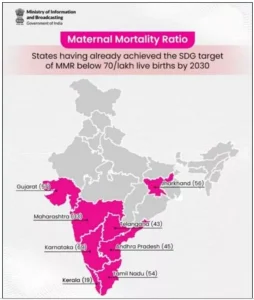
  • Maternal Mortality RatioMaternal Mortality Ratio Figures: India accounted for one-tenth of all maternal mortality numbers in 2023, putting the total deaths globally at 2.4 lakh
  • Countries Achieving SDG Target: The study also shows that 100 of the 204 countries and territories covered had reached the 2030 SDG target of below-70 MMR by 2023. 
    • Countries Yet to Achieve Target: Of the 104 not yet meeting the target, 15 had MMR in the range of 70 to 100, 16 between 100 and 140 (including India), and 73 MMR greater than 140.
  • Progress Towards SDGs: Apart from India, the countries struggling to meet the SDG 2030 target include the Democratic Republic of the Congo, Ethiopia, Nigeria and Pakistan.
    • India, however, remains among countries to have seen the most substantial improvement in MMR since 1990, along with Bangladesh, Ethiopia, Morocco, Nepal and Rwanda.
  • Regional Disparity: Within India, while the South and some states are on course to achieving the SDG target by 2030, the overall MMR is being pulled down by states such as Assam and Uttar Pradesh.
  • Preventable Medical Causes: Haemorrhage and Hypertensive disorders  easily preventable accounted for nearly half (above 40%) of the maternal deaths in 2023.
    • Impact of COVID-19: Setbacks to general healthcare during Covid are believed to have played a role in the slide seen in 2020-21.

Government Schemes Impacting MMR

Scheme Objective Impact
Janani Suraksha Yojana (JSY) Provides financial assistance for institutional deliveries, especially for low-income and rural women. Increased access to skilled birth attendants and institutional care, leading to reduced maternal deaths.
Pradhan Mantri Surakshit Matritva Abhiyan (PMSMA) Offers free, comprehensive antenatal care to pregnant women on the 9th of every month. Enables early identification and management of high-risk pregnancies, improving maternal health outcomes.
LaQshya Scheme Focuses on improving quality of care during delivery in labour rooms and maternity OTs. Implemented in high-delivery load public facilities to reduce preventable maternal and newborn deaths.
POSHAN Abhiyaan Aims to enhance nutritional outcomes for pregnant and lactating women. Addresses indirect causes of maternal mortality by improving maternal nutrition and health status.

Click to Explore UPSC Offline Coaching

Suggestions

  • Strengthening Primary Healthcare Systems: Strengthening primary healthcare systems with a focused approach on maternal and child health (MCH) can significantly reduce maternal mortality.
    • Improved access to antenatal care (ANC), skilled birth attendance, and postnatal care (PNC) ensures early detection and management of complications.
  • Link Between Child Mortality, Fertility, and MMR: A decline in child mortality rates leads to reduced uncertainty among families, thereby lowering the need for higher fertility.
    • Lower fertility results in fewer pregnancies per woman, which directly reduces the lifetime risk of maternal death.
    • This highlights the importance of an integrated life-cycle approach in public health policy.
  • Integrated Healthcare Approach: An integrated strategy combining maternal health, child health, nutrition, and family planning services can create synergistic outcomes.
    • Convergence of schemes like:
      • Janani Suraksha Yojana
      • Pradhan Mantri Matru Vandana Yojana
      • POSHAN Abhiyaan
        can enhance overall maternal health outcomes.

Check Out UPSC CSE Books

Visit PW Store

online store 1

Explore SRIJAN Prelims Crash Course

Need help preparing for UPSC or State PSCs?

Connect with our experts to get free counselling & start preparing

Aiming for UPSC?

Download Our App

      
Quick Revise Now !
AVAILABLE FOR DOWNLOAD SOON
UDAAN PRELIMS WALLAH
Comprehensive coverage with a concise format
Integration of PYQ within the booklet
Designed as per recent trends of Prelims questions
हिंदी में भी उपलब्ध
Quick Revise Now !
UDAAN PRELIMS WALLAH
Comprehensive coverage with a concise format
Integration of PYQ within the booklet
Designed as per recent trends of Prelims questions
हिंदी में भी उपलब्ध

<div class="new-fform">


    </div>

    Subscribe our Newsletter
    Sign up now for our exclusive newsletter and be the first to know about our latest Initiatives, Quality Content, and much more.
    *Promise! We won't spam you.
    Yes! I want to Subscribe.