Recently, the Supreme Court of India in the case Hamsaanandini Nanduri vs Union of India extended 12 weeks’ maternity leave to adoptive mothers regardless of the child’s age, reading down Section 60(4) of the Code on Social Security, 2020.
Original Section 60(4) of the Code on Social Security, 2020:
- Section 60(4) of the Code on Social Security, 2020 deals with maternity benefits for adoptive and commissioning mothers.
- It provided that:
- Adoptive mothers are entitled to 12 weeks of maternity benefit, only if the adopted child is below 3 months of age.
- Commissioning mothers (in surrogacy arrangements) are also entitled to 12 weeks of maternity benefit from the date the child is handed over.
|
Key Highlights of the Supreme Court Judgment
- “Family is not defined exclusively by biological factors. The protection of maternity leave is a basic human right, ensuring that motherhood does not become a factor for exclusion at the workplace.” — Supreme Court of India (2026)
|
- Striking Down Arbitrary Classification Based on Age: The Court held that restricting maternity benefits based on the age of the adopted child is manifestly arbitrary and constitutionally unsustainable, as it fails to satisfy the test of reasonable classification under Articles 14 and 21.
- It observed that such a distinction does not bear any rational nexus with the objective of maternity protection.
- Recognition of Motherhood Beyond Biological Processes: The judgment clearly articulates that motherhood is not confined to childbirth, but is fundamentally rooted in caregiving, emotional bonding, and nurturing responsibilities.
- Therefore, adoptive mothers are similarly situated to biological mothers in terms of parental obligations.
- Reading Down of Section 60(4): The Court reinterpreted the provision to ensure constitutional compliance, stating that:
- Any woman who legally adopts a child or is a commissioning mother shall be entitled to 12 weeks of maternity leave from the date of handover of the child, irrespective of the child’s age.
- This interpretation ensures that the law is aligned with constitutional morality and social realities.
- Maternity Leave as a Human Right and Social Protection: The Court emphasized that maternity benefits are not merely statutory entitlements but constitute a basic human right linked to dignity, health, and economic security.
- Such protection ensures that women are not forced to choose between employment and motherhood.
- Expansion of Reproductive Autonomy under Article 21: By recognising adoption as a legitimate mode of family formation, the Court expanded the scope of reproductive and decisional autonomy, holding that the right to parenthood includes the choice to adopt, and must be protected under Article 21.
- Importance of Early Parental Bonding: The Court observed that the need for parental care, bonding, and emotional integration does not diminish with the age of the child.
- Adopted children, irrespective of age, require time, stability, and nurturing support to adjust within the family.
- Strong Advocacy for Paternity Leave: The Court made a significant observation that the absence of paternity leave reinforces entrenched gender roles, where caregiving is disproportionately assigned to women.
- It urged the government to recognise paternity leave as a social security entitlement, highlighting that fatherly involvement in early childcare is indispensable and cannot be deferred.
Significance of the Supreme Court Judgment
- “Motherhood is Not Just Biology”: The Court held that the 3-month age limit was unconstitutional and violated Article 14 (Right to Equality) and Article 21 (Right to Life).
- It shifted the legal focus from the act of giving birth to the act of parenting. The Court famously stated that “the object of maternity benefit is not associated with the process of childbirth, but with the process of motherhood.”
- Removing “Illusory” Benefits: The Court noted that under India’s adoption laws (Central Adoption Resource Authority- CARA), it is largely illusory in practice to complete the legal process for a child under 3 months.
- Therefore, the old law provided a benefit that existed on paper but could rarely be used in reality.
- New Mandate: All adoptive mothers are now entitled to 12 weeks of leave, regardless of the child’s age, starting from the day the child is handed over.
About CARA
- It is a statutory body under the Ministry of Women and Child Development.
- Functions as the nodal agency for adoption of orphaned, abandoned, and surrendered children in India.
- Regulates both in-country and inter-country adoptions.
|
- Reproductive Autonomy & Equality: The judgment recognized adoption as an equal exercise of reproductive autonomy. By treating adoptive and biological mothers differently, the law was creating an “arbitrary classification” that served no rational purpose.
- It emphasized that older adopted children often need even more time for emotional bonding and adjustment into a new family environment.
- Strategic Significance:
- Constitutional Morality: This judgment is a prime example of the Judiciary using “Constitutional Morality” to overrule narrow statutory rules.
- It ensures that the law evolves with changing social definitions of “family.”
- Expanding Social Security: The Court also used this opportunity to urge the Centre to legislate Paternity Leave, noting that the absence of a father’s involvement in the “nascent days” of a child’s life reinforces harmful gender roles.
About the Maternity Leave Policy in India
- Refers: Maternity leave is a type of mandatory long-term paid leave granted to an employee before or after their delivery or the legal adoption of a child.
- Constitutional Status: Maternity leave is anchored in the Directive Principles of State Policy (DPSP) through Article 42 of the Constitution of India, which directs the State to secure just and humane conditions of work and for maternity relief.
- Legal Provision: The policy is primarily defined under the Maternity Benefit Act, 1961 (revised significantly in 2017) and is now integrated into the Code on Social Security, 2020.
 Objective: To provide job security to female employees while they are taking care of themselves and their children, ensuring they are not forced to choose between a career and motherhood.
- Eligibility & Scope: Applicable to women in both public and private sector organisations.
- It does not currently apply to self-employed women or firms with fewer than 10 employees.
- Key Provisions:
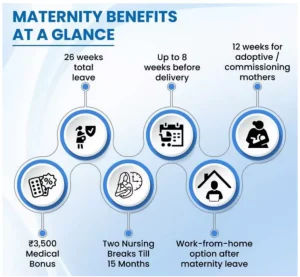
- Duration: 26 weeks for the first and second child (up to 8 weeks can be taken pre-delivery).
- Subsequent Children: 12 weeks of leave for the third or subsequent pregnancy.
- Adoption/Commissioning: 12 weeks of leave (the March 2026 Supreme Court ruling removed the requirement that the child be below 3 months of age).
- Medical Exigencies: 12 weeks of leave in cases of medical termination or accidental miscarriage.
- Work-from-Home (WFH): Encouraged if the nature of work allows; can be extended post-leave via mutual contract.
- Access to Crèche Facilities: Mandatory for organisations with 50 or more employees; mothers are allowed four visits a day to the facility.
- Job Security: Employers are prohibited from terminating an employee during leave and must reinstate them to an equivalent position.
About Reproductive Rights
- Reproductive rights refer to a composite of human rights guaranteed to women to protect against ill health and promote sexual and reproductive well-being.
- Recognised Human Rights: These rights intersect with international human rights law, including the Right to Health, Right to Privacy, Right to Equality, and the Right to Dignity.
- Classification of Rights:
-
- Reproductive Self-Determination: The right to decide the number, spacing, and timing of children.
- Health Services & Information: Access to contraception, fertility treatment, and reproductive health education.
- Equality and Non-discrimination: Ensuring reproductive choices do not lead to social or economic exclusion.
- Judicial View: The Supreme Court affirmed that adoption is an equal exercise of reproductive and decisional autonomy under Article 21.
- The “First 1000 Days” & SDG 2: Medical research confirms that parental presence during the first 1000 days is the most cost-effective intervention to prevent stunting and wasting.
- This directly links Maternity Leave to Sustainable Development Goal 2 (Zero Hunger) and the health of the future workforce.
- Article 15(3) – Protective Discrimination: This judgment is a classic application of Article 15(3), which allows the State to make “special provisions for women and children.”
- It ensures that biological or social choices (like adoption) do not lead to economic disadvantages.
|
Why is Maternity Leave Essential?
- Health and Recovery:
- Physiological Restoration: Beyond basic healing, the World Bank (2025) notes that paid leave is the single most effective tool for reducing infant mortality and maternal depression.
- The “Fourth Trimester”: The first 1000 days of a child’s life are critical. Leave allows for exclusive breastfeeding, which the NFHS-5 and recent NITI Aayog papers link to long-term national productivity.
- Economic Growth & Retention:
- Rising Participation: India’s Female Labour Force Participation Rate (LFPR) has seen a significant jump, reaching 41.7% in 2023-24 (PIB Data) and continuing an upward trend into 2025.
- Stopping the “Leaky Pipeline”: According to NITI Aayog (2025), millions of women still leave the workforce due to “care burden.” Statutory leave transforms a permanent exit into a temporary pause, saving the economy billions in lost human capital.
Critical Challenges & Gaps
- The “Motherhood Penalty”: A 2025 cross-sectional study showed that while 92% of government employees avail leave, only 75% of private-sector women do, often due to fear of job loss or employer denial.
- The Informal Sector Divide: 90% of India’s female workforce remains in the unorganized sector. While the Social Security Code 2020 aims to help, implementation gaps leave domestic and farm workers without actual cash benefits.
- Skewed Caregiving (The Paternity Gap): Only about 14% of Indian companies have formal paternity leave policies (2025 Data). This cements the idea that “childcare is a woman’s job,” leading to hiring bias.
- The “10-Employee” Threshold: A major limitation of the Code on Social Security (2020) is that it primarily applies to establishments with 10 or more employees. This excludes millions of women working in MSMEs, startups, and small shops, who remain outside the safety net.
- Ambiguity for Gig Workers: While the 2020 Code mentions “Gig and Platform workers,” it lacks an explicit mechanism for delivery partners or cab drivers to claim paid maternity benefits, creating a “protection vacuum” in the modern economy.
- The “Motherhood Penalty” vs. “Fatherhood Bonus”: Data from 2025 suggests that while women face a pay cut or career stagnation after children (Motherhood Penalty), men often see a rise in perceived reliability and pay (Fatherhood Bonus). Mandatory paternity leave is the only way to neutralize this bias.
Way Forward
- The Social Insurance Model: Moving from “employer-pays” to a Government-led Social Security Fund. The World Bank (2026) suggests this removes the “financial burden” from companies, making them more willing to hire women.
- Digital Inclusion (e-Shram & PMMVY): Using the e-Shram portal to identify unorganized workers and Direct Benefit Transfer (DBT) via schemes like Pradhan Mantri Matru Vandana Yojana to provide instant financial aid.
- Legal Inclusivity (Landmark SC Rulings):
-
- Adoptive Mothers: In Hamsaanandini Nanduri v. Union of India, the Supreme Court struck down the “3-month age limit,” ruling that all adoptive mothers are entitled to 12 weeks of leave regardless of the child’s age.
- Paternity Leave: The Court recently urged the Centre to recognize paternity leave as a social security benefit, stating that “parenthood is not a solitary function.”
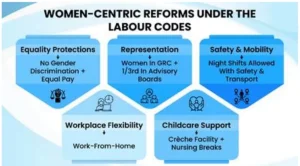
- Flexible Work (Labour Codes): The New Labour Codes encourage “Work from Home” post-maternity leave and mandate crèche facilities for offices with 50+ employees to support the transition back to work.
- The Nordic Model (Sweden/Norway): India should look toward “Parental Leave” models, where a pool of leave is shared between both parents. This prevents employers from viewing only female candidates as a “financial risk.”
- ILO Convention No. 183: India should align its funding with this convention by transitioning fully to the “Social Insurance Model.” If the government/state fund pays the salary during leave, private-sector discrimination against women during hiring will drastically decrease.
- Crèche-as-a-Service (CaaS): Instead of forcing every small office to build a crèche, the government should promote community-based crèche hubs in commercial clusters, funded through a Social Security Cess.
- Gender-Neutral Policy Language: Gradually shifting terminology from “Maternity Leave” to “Caregiver Leave” in official documents to decouple “childcare” from “gender” in the national psyche.
Conclusion
The Supreme Court has declared maternity protection a “Basic Human Right” under Article 21 (Right to Life). For India to become a Viksit Bharat by 2047, caregiving must be seen as a shared social responsibility. By supporting mothers and involving fathers, we create a workplace built on equity, dignity, and economic common sense.


 19 Mar 2026






.png)






 Current Affairs




 GS Foundation
 Optional Course
 Combo Courses
 Degree Program