The US-led initiative to link a two-week ceasefire with the reopening of the Strait of Hormuz marks a pivotal attempt to de-escalate the Israel-Iran standoff.
- By introducing this conditional window, the administration has shifted the focus from military posturing to diplomatic mediation.
UPSC Online Courses
About Mediation in International Conflicts
- Nature & Conceptual Basis: Mediation represents a voluntary, non-coercive, and non-binding mechanism of peaceful conflict resolution, wherein a mutually acceptable third party facilitates dialogue, reduces hostility, and enables disputing actors to arrive at a negotiated settlement.
- It operates as a middle ground between informal diplomacy and formal adjudication, relying more on persuasion than legal authority.
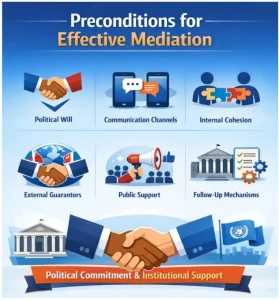
- Core Characteristics: The effectiveness of mediation is rooted in its consensual foundation, as parties must acknowledge the limitations of coercive strategies and demonstrate willingness to engage constructively.
- Its non-binding character ensures that agreements derive legitimacy from political acceptance rather than enforcement.
- The credibility and neutrality of the mediator—whether a state, organisation, or individual—remain central, while the process itself is gradual and iterative, focusing on confidence-building and convergence of interests rather than immediate resolution.
- Theoretical Underpinnings: The Contingency Model (Jacob Bercovitch) underscores that mediation outcomes are shaped by context, conflict intensity, disputant behaviour, and mediator capacity.
- Complementing this, the Theory of Ripeness (I. William Zartman) highlights that mediation becomes effective only when parties reach a “Mutually Hurting Stalemate,” where the costs of continued conflict outweigh perceived gains, creating incentives for compromise.
Legal Position on Mediation
- Evolution of Normative Legitimacy: The Hague Conventions (1899 and 1907 ) marked the first formal attempt to institutionalise peaceful dispute resolution by recognising mediation, conciliation, and arbitration as legitimate alternatives to war.
- This process was further strengthened through the establishment of the Permanent Court of Arbitration, which provided an institutional platform for third-party intervention.
- United Nations Framework: The UN Charter, particularly Article 33 under Chapter VI, mandates states to resolve disputes through peaceful means, explicitly including mediation.
- This legal mandate is reinforced by UNGA Resolution 65/283, which recognises mediation as a critical instrument for conflict prevention.
- Additionally, the UN Guidance for Effective Mediation (2012) lays down essential principles such as inclusivity, impartiality, national ownership, and sustainability, thereby providing a normative framework for effective mediation practice.
- Thus, mediation is not merely a diplomatic choice but a normatively sanctioned instrument within international law.
| Mediation vs Other Dispute Resolution Mechanisms |
| Aspect |
Mediation |
Negotiation |
Arbitration / Adjudication |
Conciliation |
Good Offices |
| Nature of Process |
Third-party facilitated |
Direct interaction between parties |
Formal legal/judicial process |
Third-party assisted |
Third-party facilitative |
| Role of Third Party |
Active facilitator; may suggest solutions |
No third party |
Decides outcome |
Limited role; suggests terms |
Minimal role; only brings parties together |
| Binding Nature |
Non-binding |
Non-binding |
Binding and enforceable |
Non-binding |
Non-binding |
| Level of Formality |
Semi-formal, structured |
Informal to formal |
Highly formal and rule-based |
Less structured than mediation |
Informal |
| Degree of Intervention |
Moderate to high |
None |
High (decision-imposing) |
Low to moderate |
Minimal |
| Objective |
Facilitate mutually acceptable solution |
Direct settlement |
Legal resolution based on law |
Suggest compromise |
Initiate dialogue |
| Suitability |
Complex, sensitive conflicts |
When communication exists |
Legal disputes requiring finality |
Early-stage disputes |
Pre-negotiation stage |
Historical Instances of Mediation
- Transformative Case Studies: The Camp David Accords demonstrated how sustained third-party engagement can overcome entrenched hostility, while the Oslo Accords highlighted the significance of backchannel diplomacy in initiating dialogue.
- The Dayton Agreement showcased the effectiveness of structured and directive mediation, whereas the Good Friday Agreement underscored the importance of inclusivity and trust-building.
- Contemporary Relevance: The role of Kofi Annan in Kenya (2008) illustrates how timely mediation can prevent large-scale violence, while the Saudi–Iran rapprochement (2023) reflects the emergence of multipolar mediation, with non-Western actors like China playing decisive roles.
- Inference: Successful mediation is contingent upon timing, mediator credibility, and process design.
Best Online Coaching for UPSC
| Illustrative Cases of Successful Mediation |
| Agreement |
Parties Involved |
Mediator |
Key Insight |
| Camp David Accords |
Egypt – Israel |
USA (Jimmy Carter) |
Sustained high-level mediation |
| Oslo Accords |
Israel – Palestine Liberation Organization (PLO) |
Norway |
Backchannel diplomacy |
| Dayton Agreement |
Bosnia – Croatia – Serbia |
USA |
Directive & structured mediation |
| Good Friday Agreement |
UK – Ireland – N. Ireland groups |
USA (George Mitchell) |
Inclusivity & trust-building |
| Kenya Mediation (2008) |
Kibaki vs Odinga |
Kofi Annan |
Timely conflict prevention |
| Saudi–Iran Rapprochement (2023) |
Saudi Arabia – Iran |
China |
Rise of multipolar mediation |
Typology of Mediation
Mediation in international conflicts is not a uniform process; rather, it varies according to the degree of involvement and intervention exercised by the mediator. Based on this, mediation can be classified into distinct types.
- Facilitative Mediation (Communication-Oriented Approach): Facilitative mediation represents the least intrusive form of mediation, where the mediator primarily focuses on:
- Establishing contact between disputing parties
- Reducing hostility and misperceptions
- Encouraging constructive communication and dialogue
- In this approach, the mediator does not influence the substance of negotiations, but instead creates an environment conducive to voluntary agreement.
- It is most suitable in the early stages of conflict, where trust deficits are high but parties are open to engagement.
- Formulative / Procedural Mediation (Process-Oriented Approach): In this form, the mediator assumes a more structured and managerial role by:
- Designing the framework of negotiations
- Setting agendas and sequencing discussions
- Identifying areas of convergence and divergence
- The mediator may also suggest procedural pathways to overcome deadlocks, while still refraining from imposing substantive solutions.
- This approach is effective when parties are willing to negotiate but lack clarity or organisation in the process.
- Directive / Manipulative Mediation (Outcome-Oriented Approach): Directive mediation represents the highest level of mediator involvement, where the mediator actively:
- Proposes concrete solutions and settlement frameworks
- Uses leverage, incentives, or pressure to influence outcomes
- Highlights costs of non-agreement and benefits of compromise
- Here, the mediator plays a decisive role in shaping the final agreement, often going beyond facilitation to active intervention.
- It is most relevant in high-intensity or protracted conflicts, where parties are unable to reach agreement independently.
International Organisation for Mediation (IOMed)
- Institutionalised Mediation Platform: The International Organisation for Mediation (IOMed) aims to create a permanent, structured global mechanism for mediation, moving beyond ad hoc diplomatic efforts toward rules-based conflict resolution.
- China-Led Initiative: Spearheaded by China, it reflects the emergence of multipolar global governance, with non-Western actors shaping international dispute-resolution norms.
- Voluntary & Non-Binding Framework: Participation remains consensual, and outcomes are non-binding unless accepted, preserving sovereignty while encouraging cooperative settlement.
- Wide Dispute Coverage: Envisaged to handle inter-state conflicts, investor–state disputes, and commercial disagreements, thereby bridging political and economic dimensions of disputes.
- Complementary to Existing Institutions: Designed to supplement—not replace— mechanisms like the International Court of Justice, offering a flexible and less adversarial alternative.
- Challenges of Credibility & Acceptance: Concerns persist regarding neutrality, geopolitical influence, and overlap with existing bodies, which may affect its global legitimacy and effectiveness.
|
Significance of Mediator Behaviour
- Communication–Facilitation Approach: At the initial stage, mediators often adopt a low-intervention role, focusing on establishing communication channels, reducing hostility, and clarifying perceptions, thereby creating a conducive environment for dialogue.
- Procedural–Formulative Strategy: As negotiations progress, mediators assume a more active role by structuring agendas, determining venues, and sequencing discussions, which helps reduce uncertainty and foster convergence.
- Directive Strategy: In advanced stages, mediators may employ high-intensity strategies, including proposing solutions, offering incentives, or exerting diplomatic pressure, thereby shaping the contours of the final agreement.
- Key Insight: The effectiveness of these strategies depends on conflict stage and ripeness, rather than any fixed hierarchy.
Click to Know UPSC Coaching Centres in India
Mediation in the West Asian Crisis
- Pre-Mediation Dynamics: The current situation reflects a transitional phase between conflict and structured mediation, rather than a fully institutionalised process.
- The ceasefire remains temporary, conditional, and reversible, indicating a tactical pause rather than a strategic settlement.
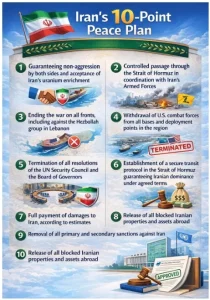
- Emerging Diplomatic Architecture: Proposed negotiations in Islamabad signal movement towards procedural engagement, while Iran’s 10-point framework attempts to expand the agenda to include sanctions relief, nuclear assurances, and regional de-escalation.
- Parallel initiatives, including a China–Pakistan peace proposal, reflect the emergence of a multi-layered mediation ecosystem, with Pakistan acting as a “tactical bridge.”
- Ground Realities & Constraints: Despite diplomatic overtures, continued missile and drone activity, ongoing Israeli operations, and ambiguity over nuclear “enrichment” provisions indicate that core disputes remain unresolved and trust deficits persist, limiting immediate prospects for effective mediation.
Need for Mediation
- Preventing Regional Escalation: Mediation is essential to prevent spillover across interconnected conflict zones such as Iraq, Lebanon, and Yemen, thereby containing a wider regional war.
- Ensuring Global Economic Stability: The strategic importance of the Strait of Hormuz, through which a significant share of global oil flows, makes uninterrupted functioning critical for global energy markets.
- Addressing Structural Drivers: Mediation provides a framework to address underlying issues such as nuclear ambitions, sanctions regimes, and geopolitical rivalries, which cannot be resolved through military means alone.
- Humanitarian Imperatives: It also plays a crucial role in protecting civilian populations and infrastructure, thereby mitigating humanitarian crises.
Actions Taken (Pre-Mediation Phase)
- Diplomatic Initiatives: The United States’ conditional ceasefire announcement reflects a calibrated strategy combining diplomacy with deterrence, while Iran’s reciprocal response indicates cautious engagement without abandoning core demands.
- Multilateral Engagement: The planned Islamabad dialogue, alongside initiatives involving China and Pakistan, demonstrates movement towards structured negotiations, with regional actors also playing a role in managing spillover risks.
- Overall Assessment: These steps represent confidence-building and agenda-setting, not full-fledged mediation.
India’s Perspective on Mediation
India’s approach to mediation in international conflicts is shaped by a careful balance between its commitment to peaceful dispute resolution and its long-standing emphasis on strategic autonomy and non-interference.
- Preference for Bilateralism over Third-Party Mediation: India has consistently maintained that disputes, particularly with neighbours like Pakistan, should be resolved bilaterally without external mediation. This position is rooted in:
- The Shimla Agreement (1972)
- The Lahore Declaration (1999)
- India views third-party mediation as potentially internationalising sensitive issues such as Kashmir.
- Support for Peaceful Settlement under International Law: India strongly supports the principles of peaceful dispute resolution enshrined in the UN Charter, including mediation, negotiation, and arbitration.
- However, this support is context-specific, and India distinguishes between:
- General international conflicts (where mediation may be useful)
- Core national issues (where mediation is resisted)
- Strategic Autonomy and Non-Alignment Legacy: India’s historical commitment to non-alignment shapes its cautious stance on mediation:
- Avoids alignment with power blocs
- Prefers independent diplomatic engagement
- This approach ensures that India retains policy flexibility while engaging in global conflict resolution efforts.
- Selective Acceptance of Mediation in Global Conflicts: While opposing mediation in its bilateral disputes, India does not reject mediation as a concept. It:
- Supports UN-led or multilateral mediation in international conflicts
- Advocates dialogue and diplomacy in crises such as those in West Asia
- India’s stance is thus principled yet pragmatic.
- India as a Potential Mediator: India has increasingly positioned itself as a credible and neutral interlocutor, especially among developing countries:
- Strong ties with both Iran and Israel
- Growing global stature and diplomatic credibility
- However, India prefers a role as a facilitator of dialogue rather than an assertive mediator, in line with its cautious diplomatic tradition.
- Example: During the Korean War, India acted as a neutral mediator, advocating ceasefire at the United Nations, chairing the Neutral Nations Repatriation Commission (NNRC) for voluntary Prisoners of War (POW) repatriation, and deploying the Custodian Force of India (CFI)—thereby establishing its credibility as an effective global mediator.
- Emphasis on Dialogue over Coercion: India consistently advocates:
- Diplomatic engagement over military escalation
- Respect for sovereignty and territorial integrity
- This aligns with mediation principles but avoids direct involvement unless conditions are favourable.
- Practical Constraints in Active Mediation: India’s limited involvement in active mediation stems from:
- Risk of strategic entanglement
- Lack of coercive leverage compared to major powers
- Sensitivity of conflicts involving major geopolitical actors like the United States
|
Click to Know UPSC Offline Courses
Challenges & Concerns that need to be Tackled
- Trust Deficit and Strategic Ambiguity: Mediation presupposes a minimum level of trust, which is often absent in protracted conflicts.
- In the ongoing tensions between the United States and Iran, conditional ceasefire commitments—where each side links restraint to the other’s actions—reflect a deterrence-based engagement rather than genuine confidence-building, making negotiations fragile and reversible.
- Timing Problem: Mediation succeeds only when conflicts reach a “Mutually Hurting Stalemate”.
- However, when parties believe they can still secure strategic or military gains, they are reluctant to compromise. For instance, continued hostilities in West Asia despite ceasefire announcements indicate that the conflict has not yet fully ripened for resolution.
- Non-Binding Nature and Lack of Enforcement: Mediation outcomes are inherently non-binding, lacking formal enforcement mechanisms.
- This makes agreements vulnerable to violations, as seen in several fragile ceasefires across conflict zones. Without credible monitoring or punitive measures, mediation may result in temporary pauses rather than durable peace settlements.
- Risk of Tactical Use and Conflict Freezing: Parties may engage in mediation not to resolve conflict but to buy time, regroup militarily, or reduce international pressure.
- This can lead to situations where mediation merely freezes the conflict without addressing its root causes.
- For example, temporary ceasefires in West Asia have often coexisted with continued proxy or indirect hostilities.
- Power Asymmetry and Coercive Outcomes: In conflicts marked by unequal power relations, mediation may not produce equitable outcomes.
- Stronger parties can exert implicit pressure or leverage, compelling weaker actors to accept suboptimal agreements.
- This undermines the fairness and long-term sustainability of settlements, particularly in geopolitically asymmetric conflicts.
- Credibility and Neutrality of Mediators: The effectiveness of mediation depends heavily on the acceptability and perceived impartiality of the mediator.
- In the current scenario, actors like China or Pakistan may face credibility constraints due to perceived geopolitical alignments, limiting their ability to build trust among all parties.
- Implementation and Compliance Challenges: Even when agreements are reached, their success depends on effective implementation mechanisms, including monitoring, verification, and confidence-building measures.
- Weak institutional follow-up or fragmented command structures—as seen in conflicts involving multiple actors—can lead to delays, violations, and eventual relapse into conflict, undermining the entire mediation effort.
- Spoiler Dynamics: Mediation efforts are often undermined by actors who benefit from continued conflict, including proxy groups, ideological factions, and hardline domestic constituencies.
- Their capacity to provoke violence or resist compromise can derail even well-designed peace processes.
Existing International Dispute Settlement Organisations:
- Judicial Settlement (Binding Adjudication): The International Court of Justice (ICJ) serves as the primary judicial body for inter-state disputes, delivering legally binding judgments based on international law, though its jurisdiction depends on state consent.
- Law of the Sea Mechanism: The International Tribunal for the Law of the Sea (ITLOS) adjudicates disputes related to maritime boundaries, navigation rights, and ocean resources under UNCLOS, playing a crucial role in resolving ocean-related conflicts.
- Trade Dispute Resolution: The World Trade Organization (WTO) Dispute Settlement Body (DSB) provides a quasi-judicial mechanism to resolve trade disputes between member states, ensuring compliance with global trade rules.
- Arbitration-Based Mechanisms: The Permanent Court of Arbitration (PCA) facilitates arbitration and conciliation in disputes involving states, state entities, and private parties, offering flexible and party-driven procedures.
- Investor–State Dispute Settlement (ISDS): The International Centre for Settlement of Investment Disputes (ICSID) provides a platform for resolving disputes between foreign investors and states, ensuring protection of investment treaties.
- Regional & Hybrid Mechanisms: Bodies like the European Court of Justice (ECJ) and International Criminal Court (ICC) address regional legal disputes and international crimes, reflecting the diversification of dispute-resolution frameworks.
|
Way Forward
- Transition from Tactical to Structural Mediation: The current Islamabad Dialogue must move beyond an emergency “pause” to establish a structured mediation framework.
- This involves setting a clear diplomatic roadmap with predefined negotiation phases, moving from military de-escalation to the resolution of underlying geopolitical grievances.
- Establishment of a Joint Verification Mechanism (JVM): Given the trust deficit and the risk posed by decentralized military commands, a neutral monitoring body potentially involving UN observers or a joint commission of mediator states (China and Pakistan) is essential to verify ceasefire compliance and prevent accidental escalations.
- Synchronized Reciprocity (The “More-for-More” Approach): To address the economic-security nexus, mediators should facilitate a synchronized de-escalation.
- For instance, the verified reopening of the Strait of Hormuz should be met with incremental sanctions relief or the phased release of frozen Iranian assets, creating a tangible incentive-based path toward peace.
- Harmonizing Technical and Political Language: A critical immediate step is the technical reconciliation of peace proposals. Mediators must employ directive strategies to bridge the linguistic gap on sensitive issues like “nuclear enrichment,” ensuring that the Farsi and English versions of any agreement are legally and politically identical to avoid future claims of “fraudulent” diplomacy.
- Inclusive Regional Architecture: A durable resolution cannot be strictly bilateral. The process must eventually transition into a multi-layered diplomatic forum that includes regional stakeholders such as Israel and the Gulf Arab states.
- This ensures that the concerns of all security-affected parties are addressed, preventing “spoiler” interventions that could derail the US-Iran settlement.
- Leveraging “Ripeness” for Nuclear Diplomacy: Mediators must capitalize on the current Mutually Hurting Stalemate to secure long-term Confidence Building Measures (CBMs).
- This includes turning the temporary nuclear freeze into a permanent verification regime, effectively trading sovereign security guarantees for the termination of high-level enrichment.
- Establishing a “Hormuz Transit Protocol”: Move beyond a simple reopening by proposing a Multilateral Transit Management Framework overseen by the International Maritime Organization (IMO).
- This would effectively de-politicize the waterway, transitioning it from a strategic bargaining chip to a neutral, rule-based global energy corridor.
- Institutionalizing a “Cyber-De-escalation Pact”: Addressing the drone and missile nature of the 2026 war requires a specific Cyber-De-escalation Pact.
- This would set “red-lines” for AI-led targeting and autonomous systems, preventing accidental escalations caused by algorithmic miscalculations or digital provocations.
Conclusion
Mediation remains an indispensable instrument for transforming conflict into cooperation in a complex multipolar order. However, its success depends on ripeness, trust, and institutional design. The current West Asian ceasefire offers an opportunity, but without sustained commitment, it risks remaining a temporary pause rather than evolving into durable peace.


 8 Apr 2026




.png)






 Current Affairs




 GS Foundation
 Optional Course
 Combo Courses
 Degree Program