Millions of naturally occurring Micrometeoroids and Orbital Debris (MMOD) orbit the earth, posing a constant threat to all spacecraft and space stations.
What is Space Debris?
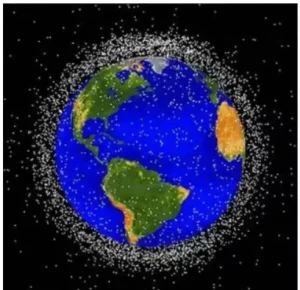
- Space debris, also known as orbital debris, space junk, or space trash, consists of human-made objects in Earth’s orbit that no longer serve any useful purpose.
- Most debris is concentrated in Low Earth Orbit (LEO), below 2,000 km altitude.
- These include defunct satellites, spent rocket stages, fragments from explosions or collisions, and even tiny flecks of paint.
- Sources of Space Debris: Exploded rocket stages and satellites: Due to leftover fuel or battery issues.
- Accidental collisions: Like the 2009 Iridium-Cosmos satellite crash.
- Intentional destructions: Anti-satellite (ASAT) weapon tests (e.g., China’s 2007 test created thousands of fragments).
- Mission-related objects: Tools lost by astronauts, lens caps, etc.
- Current Scale: Approximately 40,000–40,230 artificial objects in orbit, regularly monitored by surveillance networks.
- Of these, about 11,000 are active satellites; the rest are mostly debris.
- Most debris is concentrated in Low Earth Orbit (LEO), below 2,000 km altitude.
What Are Micrometeoroids?
- Micrometeoroids are tiny natural particles of rock, metal, or dust floating in space.
- They are extremely small meteoroids, often the size of dust grains.
- Size: Typically from a few micrometers (millionths of a meter) up to about 2 millimeters.
- Speed: Extremely high, ranging from 11 to 72 km/s (average around 20 km/s relative to Earth or spacecraft).
- Distribution: Found throughout interplanetary space, with slightly higher density near planets due to gravity.
- Unlike human-made debris, they are not confined to Earth’s orbit.
- Despite their small size, their hypervelocity turns them into high-energy projectiles. Kinetic energy (½ mv²) makes even a dust-sized particle capable of:
- Puncturing spacecraft hulls or suits.
- Cratering surfaces (like sandblasting over time).
The Threat of Micrometeoroid and Orbital Debris
- Hypervelocity impacts: MMOD particles travel at average speeds of 10 km/s for debris in low Earth orbit (LEO), up to 20 km/s or more for micrometeoroids.
- Untrackable small particles: Over 34,000 objects larger than 10 cm are tracked, but hundreds of millions of smaller ones (1 mm to 1 cm) cannot be monitored or avoided in real-time.
- Risk is assessed probabilistically using models like NASA’s Orbital Debris Engineering Model (ORDEM).
- Primary risk in LEO: NASA has identified MMOD as the top threat to crewed vehicles like commercial crew spacecraft and the International Space Station (ISS).
- Kessler Syndrome potential: Collisions can generate more debris, leading to a cascading effect that could make certain orbits unusable.
- A recent incident involved orbital debris chipping a window on China’s Shenzhou-20 spacecraft, highlighting ongoing risks.
Kessler syndrome
- Kessler syndrome is an idea proposed by NASA scientist Donald Kessler in 1978.
- He said that if there was too much space junk in orbit, it could result in a chain reaction where more and more objects collide and create new space junk in the process, to the point where Earth’s orbit becomes unusable.
Global Efforts to Manage Space Debris
- Inter-Agency Space Debris Coordination Committee (IADC): Founded in 1993, includes 13 major space agencies (e.g., NASA, ESA, ISRO, JAXA, Roscosmos).
- Develops technical standards; issued original Space Debris Mitigation Guidelines in 2002,
- United Nations Committee on the Peaceful Uses of Outer Space (UNCOPUOS): Adopted voluntary Space Debris Mitigation Guidelines in 2007, based on IADC standards.
- Promotes long-term sustainability guidelines, including data sharing and collision avoidance.
- ESA’s Zero Debris Approach (2030 Goal): Launched under European Space Agency Agenda 2025: Aims for near-zero debris production from ESA missions in Earth and lunar orbits by 2030.
- Facilitated the Zero Debris Charter(2023): Co-developed by over 40 global actors; open for signatures to commit to ambitious 2030 targets.
- Limitation: Guidelines are voluntary “soft law” with no legally binding enforcement.
How Spacecraft Are Protected from MMOD
- Risk Analysis & Modeling: Space agencies use Tracking data and statistical models to predict MMOD flux (expected impacts over a mission).
- Software tools to calculate failure probabilities and design protective measures.
- Whipple Shields: It is a common physical shield design containing:
- Outer bumper: Shatters incoming debris into a cloud.
- Stand-off gap: Lets the cloud expand and disperse energy.
- Inner rear wall: Absorbs the remaining impact energy.
- Debris Avoidance Maneuvers: For larger, trackable debris (>10 cm), agencies monitor collision risks. If a threat is detected, thrusters adjust the spacecraft’s orbit to avoid impact.


 24 Dec 2025





.png)






 Current Affairs




 GS Foundation
 Optional Course
 Combo Courses
 Degree Program