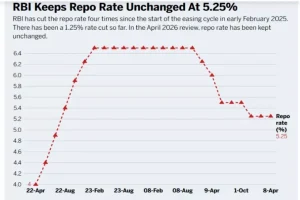
Announcing the first bi-monthly monetary policy for the current fiscal, the Reserve Bank of India has kept interest rates unchanged at 5.25 percent maintaining Policy stance as “Neutral”
- The monetary policy committee, chaired by the RBI Governor, meets every two months to review key economic indicators and determine the policy stance.
UPSC Online Preparation

MPC Review: Key Highlights
- Policy Corridor Rates Maintained: The standing deposit facility rate remains at 5 per cent and the marginal standing facility rate and the Bank Rate remains at 5.50 per cent.
- GDP Growth Projections: The Monetary policy Committee has also expected that the GDP for the last financial year will be at 7.6 percent while for the current fiscal year, it will be at 6.9 per cent.
- Inflation Outlook: RBI has projected that CPI inflation for the current financial year will be at 4.6 percent.
- Ease of Doing Business for MSMEs: RBI suspended due-diligence requirement for MSMEs for inclusion in various trade platforms to promote ease of doing business,
Why has the RBI maintained an Unchanged Interest Rate?
- Inflation Risk: Persistently elevated energy prices due to the West Asia conflict and possible El Niño conditions pose upside risks to inflation.’
- Headline inflation remains contained and below the central bank’s target of 4 per cent, but there’s upside risk.
- Risks of food prices rising due to weather disturbances.
- External Sector Pressures: High crude oil prices may widen the Current Account Deficit (CAD).
- Increased import costs could exert pressure on the rupee.
- External vulnerabilities necessitate a cautious monetary stance.
- Wait and Watch Approach: On the West Asia conflict, RBI has taken a wait-and-watch approach, citing the changing circumstances and the evolving growth-inflation outlook.
- Rising Input Costs: Higher input costs associated with an increase in energy prices and international freight and insurance costs, along with supply-chain disruptions, could constrain the availability of key inputs for downstream sectors, thus impairing growth.
Click to Know UPSC Coaching Centres in India
About Monetary Policy Committee (MPC)
- Statutory Establishment: The Monetary Policy Committee (MPC) was constituted in 2016 as a statutory body under the RBI Act, 1934.
- Role of MPC: The MPC is responsible for deciding the policy interest rate to maintain inflation within the prescribed target while supporting economic growth.
- Composition of MPC: The MPC has six members, including the RBI Governor as Chairperson, the Deputy Governor as In Charge , one RBI-nominated official, and three external members nominated by the Government of India.
- The external members of the MPC hold office for a fixed term of four years.
- Quorum Requirement: The quorum for an MPC meeting is four members, and it must include the Governor or, in his absence, the Deputy Governor.
- Decision-Making Process: MPC decisions are made through majority voting, and in case of a tie, the RBI Governor exercises a casting vote.
- Nature of Decisions: The decisions taken by the MPC are binding on the RBI, ensuring uniform implementation of monetary policy outcomes.
Monetary Policy Stances
| Policy Stance |
Meaning |
Repo Rate Bias |
Impact on Economy |
| Accommodative |
RBI signals a willingness to support economic activity by increasing money supply |
Tends to lower repo rates |
Encourages borrowing and lowers EMIs |
| Neutral |
RBI keeps flexibility to adjust rates based on evolving conditions. |
No strong direction |
Keeps policy options open |
| Tightening |
RBI focuses on controlling inflation while remaining cautious. |
Policy rates remain unchanged or increase; rate cuts are ruled out |
Makes loans costlier and slows demand |