The rapid military rise of China and its integrated strategy through the People’s Liberation Army has expanded warfare into cyber, space, and maritime domains, making multi-domain deterrence (MDD) essential for India’s security and strategic stability.
About Multi-Domain Deterrence (MDD)
- Refers: MDD is a comprehensive strategic framework wherein a nation integrates its military and non-military capabilities across land, air, maritime, cyber, space, and information domains to deter adversaries by shaping their decision-making environment and raising the costs, risks, and uncertainty of aggression.
Conceptual Evolution and Strategic Shift
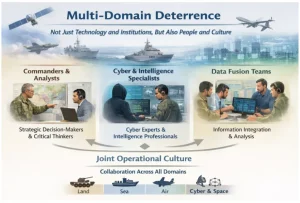
- From Platform-Centric to System-of-Systems Approach: Traditional deterrence focused on individual platforms (tanks, fighter jets, naval fleets) operating in silos.
- In contrast, MDD emphasises a networked “system-of-systems” architecture, where sensors, shooters, and decision-makers are digitally interconnected.
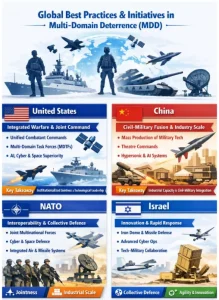
- For instance, the United States’ Multi-Domain Task Forces (MDTFs) integrate long-range fires, cyber units, and space-based intelligence, enabling coordinated cross-domain operations rather than isolated responses.
- From War-Fighting to Decision-Centric Deterrence: MDD aims not merely to defeat the adversary in battle but to influence adversarial calculus before conflict begins, thereby preventing escalation itself.
-
- This is evident in China’s grey-zone strategy, where cyber intrusions, economic coercion, and information warfare are used to achieve strategic objectives without triggering conventional war.
- Grey-zone strategy refers to the use of coercive, competitive actions below the threshold of full-scale war, aimed at achieving strategic objectives without triggering a conventional military response.
- From Military-Centric to Whole-of-Nation Deterrence: Deterrence today extends beyond armed forces to include economic resilience, technological dominance, supply-chain security, and diplomatic leverage, making MDD a whole-of-government and whole-of-society approach.
Core Pillars of Multi-Domain Deterrence
- Integrated Multi-Domain Operations: MDD ensures that military operations are no longer confined to a single domain, but are simultaneously executed across multiple domains, creating overwhelming and unpredictable effects.
- This integration enables cross-domain force multiplication, where actions in one domain amplify effects in another.
- For example, recent Indian military exercises like Exercise Trishul (2025) demonstrated jointness among land forces, air power, maritime assets, and drone-based Intelligence, Surveillance, and Reconnaissance (ISR), reflecting a shift toward integrated operations.
- Information Dominance and Decision Superiority: At the heart of MDD lies the ability to collect, process, and act upon real-time information faster than the adversary, thereby compressing the Observe–Orient–Decide–Act (OODA) loop.
- Advanced C4ISR systems ensure that data from satellites, UAVs, and ground sensors is fused into actionable intelligence, enabling rapid and precise responses.
- India’s evolving “sensor-to-shooter” networks aim to connect space-based surveillance with ground-based strike systems, significantly reducing decision latency.
About C4ISR Systems (Command, Control, Communications, Computers, Intelligence, Surveillance & Reconnaissance)
- C4ISR refers to an integrated military framework that enables real-time situational awareness, decision-making, and coordinated operations by linking sensors, command centres, and combat units across domains.
|
- Cross-Domain Synergy and Denial of Vulnerabilities: MDD ensures that no single domain remains a point of exploitation, as capabilities in one domain compensate for vulnerabilities in another.
- This creates a deterrence-by-denial mechanism, where adversaries are unable to achieve quick or decisive gains.
- For instance, even if communication networks are disrupted through cyberattacks, satellite-based backup systems and redundant communication grids ensure operational continuity.
- Integration of Emerging Technologies: Modern deterrence is increasingly driven by cutting-edge technologies such as Artificial Intelligence (AI), machine learning, quantum communication, hypersonic weapons, and autonomous systems.
- These technologies enhance predictive capabilities, precision targeting, and autonomous decision-support systems, fundamentally transforming warfare.
- India’s initiatives such as AI-enabled defence systems and integrated air defence networks (e.g., Mission Sudarshan Chakra) reflect this technological shift.
- Expansion into Non-Kinetic Domains (Cyber, Space, Information): MDD recognises that future conflicts will be fought as much in non-kinetic domains as in physical battlefields.
- Cyber warfare can disrupt critical infrastructure,
- Space capabilities enable surveillance and navigation,
- Information warfare shapes public perception and legitimacy.
- For example, State-sponsored cyberattacks on critical infrastructure globally demonstrate how disruption can occur without physical confrontation.
- The growing race for anti-satellite (ASAT) capabilities highlights the strategic importance of space as a deterrence domain.
- Flexible and Calibrated Response Spectrum: MDD provides a wide spectrum of response options, ranging from covert cyber operations and economic sanctions to conventional military strikes.
- This ensures proportionality, escalation control, and strategic signalling, reducing the likelihood of full-scale war.
- India’s evolving doctrine post-border tensions reflects a move toward calibrated, multi-domain responses rather than purely kinetic retaliation.
Enroll now for UPSC Online Course
Need for Multi-Domain Deterrence (MDD) for India
India’s evolving security environment—marked by geopolitical rivalry, technological disruption, and hybrid warfare threats—necessitates a transition from traditional single-domain military preparedness to an integrated Multi-Domain Deterrence (MDD) framework.
- Evolving Security Environment: India’s security landscape is shaped by geopolitical rivalry, technological disruption, and hybrid threats. Traditional single-domain preparedness is inadequate, necessitating a shift to an integrated Multi-Domain Deterrence (MDD) framework.
- Rising Strategic Challenge from China: China’s rapid military modernisation, higher defence spending (three times that of India), and advances in cyber, space, Artificial Intelligence (AI), and missile systems have created significant asymmetry.
- Its assertiveness along the Line of Actual Control (LAC) and expanding footprint in the Indian Ocean Region (IOR) require a holistic, cross-domain deterrence posture.
- Rise of Grey-Zone and Hybrid Warfare: Increasing use of cyberattacks, disinformation, economic coercion, and psychological operations operates below the war threshold.
- MDD enables India to detect, deter, and respond across kinetic and non-kinetic domains, ensuring covert aggression is not cost-free.
- Persistent Two-Front Security Threat: Simultaneous threats from China and Pakistan, including potential collusion, complicate defence planning.
- MDD ensures optimal resource allocation and cross-domain force multiplication under multi-front pressure.
- Changing Nature of Warfare: Emerging technologies like drones, loitering munitions, hypersonic missiles, cyber tools, and space-based Intelligence, Surveillance and Reconnaissance (ISR) are transforming warfare.
- Conflicts like Russia–Ukraine highlight the shift toward precision, speed, and real-time integration.
- Protection of Economic and Maritime Interests: Over 90% of India’s trade (by volume) passes through vulnerable Sea Lines of Communication (SLOCs) in the IOR.
- MDD enables layered maritime security through integration of naval, air, cyber, and space capabilities.
- Long-War Preparedness and Strategic Resilience: Modern conflicts are prolonged and resource-intensive, requiring strong industrial capacity, logistics, and economic endurance.
- MDD integrates military capability with industrial and supply-chain resilience.
Challenges that Need to be Tackled for Effective Multi-Domain Deterrence (MDD) in India
While India is gradually moving towards a multi-domain military framework, several structural, technological, and institutional constraints continue to limit its full operationalisation.
- Weak Defence Industrial Base and Import Dependence: Continued reliance on imports for fighter aircraft, submarines, and advanced electronics creates strategic vulnerabilities.
- It limits rapid replenishment and self-reliance during high-intensity conflicts.
- Budgetary Imbalance and Fiscal Constraints: High revenue expenditure (salaries and pensions) reduces funds for capital acquisition and modernisation.
- This constrains investment in emerging domains like Artificial Intelligence (AI), cyber, and space.
- Procurement Delays and Institutional Inefficiency: Bureaucratic complexity and procedural delays lead to time and cost overruns.
- This affects operational readiness and technological relevance, weakening deterrence.
- Gaps in Ammunition Stockpiles and War Reserves: Shortfalls in critical ammunition and spares and limited surge production capacity hinder preparedness for long-duration conflicts.
- Technological Dependence and Low Research & Development (R&D) Investment: Low allocation (around 3–4% of defence budget) limits indigenous innovation in critical technologies.
- This increases dependence, vulnerability to supply disruptions, and lack of customization.
- Lack of Jointness and Integrated Command Structures: Incomplete integration among the Indian Army, Indian Navy, and Indian Air Force leads to duplication, inefficiency, and weak cross-domain synergy.
- Theatre command reforms remain work in progress.
- Underdeveloped Maritime Capabilities: Gaps in naval assets, surveillance systems, and anti-submarine warfare capabilities constrain India’s role in the IOR.
- China’s expanding presence challenges maritime dominance and SLOC security.
India’s Initiatives & Actions towards Multi-Domain Deterrence (MDD)
- Institutional Reforms for Jointness and Integration: The creation of the Chief of Defence Staff (CDS) marks a paradigm shift towards joint military planning and integration of the three services.
- The push for Integrated Theatre Commands aims to bring all military assets in a geographical theatre under a unified command, enabling seamless multi-domain operations.
- These reforms seek to break service-specific silos, enhance inter-operability, and ensure faster, coordinated decision-making, which is critical for MDD.
- Over time, this will enable India to move towards a “joint-by-design” rather than “joint-by-coordination” military structure.
- Strengthening Defence Indigenisation and Industrial Base: Initiatives like Atmanirbhar Bharat in Defence focus on reducing import dependence and building a robust domestic defence manufacturing ecosystem.
- The introduction of Positive Indigenisation Lists restricts imports of several defence items, encouraging domestic production and innovation.
- Establishment of Defence Industrial Corridors (in Uttar Pradesh and Tamil Nadu) aims to create integrated manufacturing ecosystems with private sector participation.
- Promotion of startups and MSMEs through innovations like iDEX (Innovations for Defence Excellence) is fostering cutting-edge solutions in AI, drones, and robotics.
- This strengthens strategic autonomy and supply-chain resilience, essential for sustained multi-domain deterrence.
- Technological Modernisation and Emerging Domains Focus: India is investing in Artificial Intelligence (AI), cyber warfare capabilities, space-based assets, and unmanned systems, recognising their central role in future warfare.
- Establishment of the Defence Cyber Agency, Defence Space Agency, and Armed Forces Special Operations Division reflects a structural shift towards new domains of warfare.
- Development of Integrated Air Defence Systems (e.g., Mission Sudarshan Chakra) enhances network-centric warfare capabilities, linking sensors and shooters across domains.
- Increased focus on drone warfare and counter-drone systems reflects lessons from recent global conflicts.
- These initiatives aim to build information dominance, real-time situational awareness, and precision strike capability, key pillars of MDD.
- Enhancement of Maritime Capabilities and Indo-Pacific Strategy: India is strengthening its presence in the Indian Ocean Region through naval modernisation, mission-based deployments, and maritime partnerships.
- Initiatives like SAGAR (Security and Growth for All in the Region) reflect India’s vision of being a net security provider in the Indo-Pacific.
- Expansion of maritime domain awareness (MDA) through satellite surveillance, coastal radar chains, and information fusion centres enhances real-time monitoring of sea lanes.
- Growing engagement in frameworks like the Quadrilateral Security Dialogue strengthens collective maritime deterrence.
- This ensures protection of Sea Lines of Communication (SLOCs) and counters expanding influence of China in the region.
- Doctrinal Evolution and Strategic Reorientation: India is gradually shifting from a reactive, platform-based military doctrine to a proactive, integrated deterrence framework.
- Emphasis is being placed on network-centric warfare, joint operations, and cross-domain synergy.
- Military exercises increasingly reflect multi-domain integration, involving cyber, space, and electronic warfare elements alongside conventional forces.
- The focus is on creating a credible deterrence posture that operates both below and above the threshold of war.
- Strengthening Logistics, Infrastructure, and War Preparedness: India has accelerated development of border infrastructure, advanced landing grounds, and logistics networks, particularly along the northern borders.
- Reforms in logistics management and creation of integrated logistics nodes aim to ensure rapid mobilisation and sustainment of forces.
- Efforts are underway to enhance ammunition stockpiles and improve supply-chain resilience, addressing gaps exposed in prolonged conflicts globally.
- Initiatives such as corporatisation of Ordnance Factory Board aim to improve efficiency and production capacity.
- This strengthens India’s ability to sustain long-duration, multi-domain operations.
- International Defence Partnerships and Strategic Collaborations: India is deepening defence cooperation with key partners such as the United States, France, and Israel to access advanced technologies and best practices.
- Agreements like LEMOA, COMCASA, and BECA enhance interoperability, logistics support, and geospatial intelligence sharing.
- Joint military exercises (e.g., Malabar Naval Exercise) strengthen multi-domain coordination and operational readiness.
- These partnerships also facilitate technology transfer and co-development, critical for bridging capability gaps.
Check Out UPSC CSE Books From PW Store
Way Forward
- Strengthening Domestic Defence Manufacturing Ecosystem: India must accelerate defence indigenisation by enhancing private sector participation, Micro, Small and Medium Enterprises (MSMEs) integration, and startup-led innovation, moving beyond Public Sector Undertaking (PSU) dominance.
- Building a robust end-to-end defence industrial base—from design to production—is essential for strategic autonomy and supply-chain resilience.
- Greater focus on co-development, technology transfer, and export-oriented manufacturing will position India as a global hub and ensure rapid replenishment during conflicts.
- Rebalancing Defence Expenditure towards Modernisation: India needs to shift from revenue-heavy expenditure (salaries and pensions) towards capital expenditure and modernisation.
- Adoption of outcome-based budgeting and prioritisation of critical capability gaps can enhance efficiency.
- Increased investment in Artificial Intelligence (AI), cyber warfare, space assets, and unmanned systems is crucial for transitioning to a technology-driven deterrence model.
- Building War Sustainability and Ammunition Resilience: India must ensure adequate ammunition stockpiles and surge production capacity for long-duration conflicts.
- Strengthening logistics networks, supply chains, and industrial mobilisation mechanisms is critical.
- Lessons from recent conflicts highlight that endurance and industrial depth are key to credible deterrence.
- Accelerating Jointness through Theatre Command Reforms: Fast-tracking Integrated Theatre Commands is essential for seamless coordination among the Indian Army, Indian Navy, and Indian Air Force.
- Strengthening the role of the Chief of Defence Staff (CDS) and ensuring unified planning and integrated logistics will improve operational efficiency.
- This is vital for achieving true cross-domain synergy under Multi-Domain Deterrence (MDD).
- Enhancing Capabilities in Cyber, Space, and Maritime Domains: India must strengthen cyber security, offensive cyber capabilities, and space-based Intelligence, Surveillance and Reconnaissance (ISR) systems.
- Expansion of satellite constellations, secure communication networks, and anti-satellite resilience is essential.
- Simultaneously, enhancing naval capabilities and maritime domain awareness in the Indian Ocean Region (IOR) will secure Sea Lines of Communication (SLOCs).
- Promoting Defence Research & Development (R&D) and Innovation Ecosystem: Increasing investment in Research & Development (R&D) to global standards is crucial for technological self-reliance.
- Strengthening collaboration between Defence Research and Development Organisation (DRDO), private industry, academia, and startups will accelerate innovation.
- Focus areas should include Artificial Intelligence (AI), quantum technologies, hypersonic systems, and advanced sensors.
- Developing Asymmetric and Cost-Effective Capabilities: India should prioritise asymmetric capabilities such as drones, loitering munitions, electronic warfare systems, and cyber tools, which offer high impact at lower cost.
- These capabilities help offset adversaries’ advantages and enhance deterrence through unpredictability and scalability.
- Strengthening Strategic Partnerships and Alliances: India must deepen cooperation with partners through technology sharing, joint exercises, intelligence exchange, and interoperability frameworks.
- Engagement in platforms like the Quadrilateral Security Dialogue (Quad) strengthens collective deterrence in the Indo-Pacific.
- Strategic partnerships act as force multipliers, helping bridge capability gaps and enhance India’s global security role.
Conclusion
India’s future security hinges on integrating military capability, industrial strength, and economic resilience. While multi-domain deterrence offers a holistic framework, its effectiveness will depend on timely reforms, sustained investments, and seamless coordination across domains in both peace and conflict.


 28 Mar 2026




.png)






 Current Affairs




 GS Foundation
 Optional Course
 Combo Courses
 Degree Program