Recently, the National Blood Transfusion Bill, 2025, was introduced in Parliament, and thalassaemia patients and advocacy groups have welcomed it.
About Blood Transfusion
- Blood transfusion is a medical procedure in which whole blood or specific blood components (such as red blood cells, plasma, platelets, or clotting factors) are transferred intravenously from a donor to a recipient’s circulation.
- Before a blood transfusion is given, many steps are taken to ensure the quality of the blood products, their compatibility, and the recipient’s safety.
Need For the National Blood Transfusion Bill
- Fragmented System: Blood transfusion services are run through a mix of public and private blood banks under non-uniform guidelines.
- Uneven Performance: While some states have efficient networks and traceability systems, others face shortages, expired stock, and weak monitoring.
- Weak Legal Mandate: The Directorate General of Health Services (DGHS) and State Blood Transfusion Councils operate primarily through policies and guidelines rather than binding law.
- High Human Costs: Thalassaemia patients, emergency cases, and recipients of poorly screened blood face avoidable shortages and infections.
Key Provisions of the Bill
- National Blood Transfusion Authority: The Bill proposes establishing a National Blood Transfusion Authority to provide centralised oversight and governance of blood transfusion services.
- A national authority is meant to reduce state-to-state variation and provide technical oversight.
- Standardisation of Services: It seeks to lay down uniform national standards for the collection, testing, processing, storage, distribution, issuance, and transfusion of blood and blood components.
- Regulatory Oversight: The legislation mandates compulsory registration of all blood centres to eliminate unregulated operators and illegal or unsafe collection points.
 Supply Augmentation: The Bill promotes voluntary and non-remunerated blood donation to ensure a safe, sufficient, and ethical blood supply.
- Enforcement Mechanism: It introduces strict penal provisions to deter unsafe, unethical, or non-compliant practices in blood transfusion services.
Advantages of the Bill
- Legally Enforceable Patient Safety: The Bill makes testing and quality standards statutory obligations and provides legal recourse when safety norms are violated.
- Uniform National Standards: The Bill seeks to ensure uniform rules across states, reducing regulatory differences that affect referrals and the interstate transfer of blood units.
- Safer Emergency Transfusions: The Bill strengthens safety protocols to reduce the risk of transfusion-transmitted infections.
- Clarity and Accountability for Institutions: The Bill establishes clear registration, reporting, audit, and compliance requirements for hospitals and blood banks, creating uniform, transparent rules and clarity for Institutions.
Challenges in Implementation of the Bill
- Centre–State Coordination Issues: Since health is a state subject, uniform national standards may conflict with local realities and will require flexible implementation and strong Centre–state coordination.
- Inspection and Enforcement Capacity: Effective implementation will depend on adequate staffing, laboratories, funding, trained personnel, and real-time data systems for the National Authority.
- Financial Stress on Smaller Blood Banks: The cost of upgrading infrastructure, training staff, and maintaining cold-chain logistics may strain smaller blood banks and risk closures in underserved areas if financial support is insufficient.
- Digital Traceability Requirements: The success of traceability provisions will depend on interoperable digital systems across public and private blood banks without disrupting blood supply or access.
About Thalassaemia
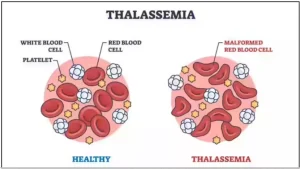
- Nature of the Disease: Thalassaemia is a hereditary blood disorder caused by a genetic defect that leads to reduced or absent production of haemoglobin.
- Impact on Blood and Oxygen Transport: Due to defective haemoglobin synthesis, red blood cells are fragile and short-lived, resulting in chronic anaemia and reduced oxygen delivery to tissues.
- Types of Thalassaemia: Thalassaemia is broadly classified into alpha and beta thalassaemia, with thalassaemia major being the most severe form requiring lifelong care.
- Symptoms: Include tiredness, pallor, bone problems, an enlarged spleen, jaundice, pulmonary hypertension, and dark urine.
- Treatment Requirements: Patients with severe thalassaemia require regular blood transfusions, often every 2–4 weeks, to survive.
- Steps taken by the Government for the prevention and management of Thalassemia:
- Thalassemia Bal Sewa Yojana (TBSY): The Union Health Ministry has implemented the Thalassemia Bal Sewa Yojana in association with Coal India Limited, providing financial assistance of up to ₹10 lakh for bone marrow transplantation in 17 empanelled hospitals across the country.
- Screening and Carrier Identification: As of 26 March 2025, a total of 15,87,903 individuals have been screened for thalassaemia, and 50,462 individuals have been identified as carriers.
|


 16 Dec 2025





.png)






 Current Affairs




 GS Foundation
 Optional Course
 Combo Courses
 Degree Program