Recent attempts by the United States to exert strategic, economic, and diplomatic pressure on NATO allies over Greenland signal deep stress within alliance-based security and the post-World War II multilateral order.
Key Development
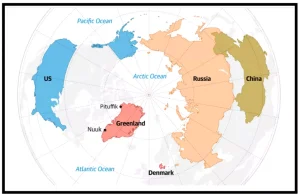
- U.S. Acquisition of Greenland: The issue centres on President Donald Trump’s renewed interest in acquiring Greenland, an autonomous territory of Denmark, a NATO member.
- Tariffs as Pressure: Recently, the US imposed 10% U.S. tariffs on 8 NATO allies from Feb 1, 2026, over Greenland opposition.
- Deal or Duties: Tariffs to jump to 25% by June unless the U.S. acquires Greenland.
- Security Cover: U.S. cites Russian–Chinese encroachment and proposes an Arctic missile shield (“Golden Dome”).
Why Does the US Want Greenland?
- Strategic Arctic Location: Greenland’s position between North America and Europe makes it crucial for controlling the Arctic and North Atlantic region, especially for monitoring movement across the Atlantic and emerging Arctic sea routes.
- Natural Resources and Critical Minerals: Greenland has potential reserves of rare earth elements, uranium, iron, oil, and gas.
- The United States currently lacks a reliable domestic supply chain for REEs. China dominates the sector, accounting for around 60% of global REE mining and over 90% of processing.
- Military and Early-Warning Importance: The US operates the Pituffik Space Base (earlier Thule Air Base), which is vital for missile early-warning systems, space surveillance, and homeland security, forming a key part of US and NATO defence architecture.
- Arctic Geopolitics and Climate Change: Melting ice due to climate change is opening new shipping routes and strategic spaces, increasing Greenland’s importance in Arctic geopolitics.
- Great Power Rivalry (US–Russia–China): The US views Russia’s Arctic militarisation and China’s growing commercial and strategic presence as threats to NATO’s northern flank, making Greenland central to power competition.
- Long-standing US Defence Presence: Under the 1951 US–Denmark Defence Agreement, the US enjoys extensive defence rights in Greenland and has earlier operated up to 17 military bases, showing deep historical involvement.
- Continuity of US Strategic Interest: Past US administrations also attempted to acquire Greenland, indicating that current moves reflect a long-term strategic outlook, not a sudden policy shift.
U.S. Past Attempts to Acquire Greenland
- 1867–1868: Post–Alaska Purchase
- After buying Alaska from Russia, Secretary of State William H. Seward explored acquiring Greenland.
- 1910: Land-Swap Proposal
- Under President William Howard Taft, U.S. diplomats floated a land-exchange plan.
- Greenland would be transferred to the U.S. in return for concessions elsewhere.
- 1946: Truman’s $100 Million Offer
- At the dawn of the Cold War, President Harry Truman’s administration formally offered Denmark $100 million in gold for Greenland.
|
Impact of the US Move on NATO
- Intra-Alliance Coercion: The use of tariffs, political pressure, and strategic threats against NATO allies challenges the alliance’s core principle of mutual trust and voluntary cooperation, creating internal friction.
- Collective Defence Paradox (Article 5): NATO’s Article 5 was designed to address attacks by external adversaries, not internal disputes.
- Denmark has indicated it could invoke Article 5 if Greenland were threatened, creating legal and political uncertainty within the alliance.
- Prior to any Article 5 invocation, Denmark could invoke Article 4, which mandates consultations when a member’s territorial integrity or security is threatened.
- Breach of Political and Moral Expectations: Denmark has been a reliable NATO ally, contributing troops and sacrifices (e.g., 43 soldiers lost in Afghanistan post-9/11).
- Any US move against Greenland would contradict moral and political expectations of alliance solidarity.
- Threat to NATO Credibility and Deterrence: Actions that undermine alliance norms could weaken NATO’s deterrence posture, making it appear less credible to external adversaries.
About North Atlantic Treaty Organization (NATO)
- Historical Background: NATO was established on 4 April 1949 in the aftermath of World War II to counter the Soviet security threat and prevent further instability in Europe.
- Purpose: It aimed to institutionalise collective defence and transatlantic political-military cooperation between North America and Europe.
- Membership: The alliance began with 12 founding members and has gradually expanded to 32 members (as of March 2024), reflecting its continued strategic relevance.
- Albania, Belgium, Bulgaria, Canada, Croatia, Czechia, Denmark, Estonia, Finland, France, Germany, Greece, Hungary, Iceland, Italy, Latvia, Lithuania, Luxembourg, Montenegro, North Macedonia, Norway, Poland, Portugal, Romania, Slovakia, Slovenia, Spain, Sweden, The Netherlands, Türkiye, United Kingdom, & United States.
- Headquarters: NATO’s headquarters in Brussels, Belgium
- Core Role and Objectives of NATO:
- Collective Defence (Article 5): The cornerstone of NATO is Article 5, which states that an attack on one ally is considered an attack on all, forming the alliance’s primary deterrent.
- Security Consultations (Article 4): Article 4 enables members to consult on matters of common security concern, extending NATO’s role beyond territorial defence.
- Expanded Security Mandate: NATO’s mission has evolved to include counter-terrorism, cyber security, piracy, peacekeeping, and crisis management beyond Europe.
- Operational Role and Missions:
- Out-of-Area Operations: NATO led the UN-mandated International Security Assistance Force (ISAF) in Afghanistan and has conducted missions in Kosovo, the Balkans, and the Mediterranean.
- Training and Capacity Building: The alliance conducts joint military exercises, strengthens interoperability, and supports partner organisations such as the UN, EU, and African Union.
- North Atlantic Council (NAC): The NAC is NATO’s principal political decision-making body, where all members are represented and decisions are taken by consensus, reinforcing NATO’s role as a political forum for conflict management.
- Funding Mechanism:
- Shared Financial Responsibility: Members contribute based on Gross National Income (GNI) to fund NATO’s headquarters, command structures, missions, and joint equipment.
- Military Contributions: Each country also contributes troops, capabilities, and defence spending, rather than relying solely on financial payments.
- Joint Innovation Initiatives: NATO supports multinational funds for research and emerging defence technologies.
Contemporary Relevance of NATO
- Pillar of Transatlantic Security: Ensures Euro‑Atlantic stability through coordinated defence planning and joint preparedness.
- Collective Defence (Article 5): Strengthens deterrence, reassuring smaller states.
- Deterrence against Russia: Post‑Ukraine war, NATO has intensified deployments and signalling in Eastern Europe.
- New Security Domains: Expanding focus to cyber, space, and hybrid threats, adapting to modern conflict.
Key Challenges Facing NATO
- Trump Tariffs and Greenland Linkage:
- Economic Pressure on Allies: US-imposed tariffs on European NATO members have raised concerns of direct confrontation within the alliance.
- Greenland Linkage: Tariffs were reportedly linked to US pressure over Greenland, despite European claims that Greenland already falls under NATO’s collective security umbrella.
- Unilateralism by Powerful Members: Actions taken unilaterally by dominant members risk undermining consensus-based decision-making, which is central to NATO’s functioning and legitimacy.
- Internal Political Divisions and Trust Deficit: Differences in threat perceptions and domestic politics among members have created a trust deficit, affecting unity and coordinated responses.
- Managing Intra-Alliance Disputes: NATO lacks clear institutional mechanisms to resolve disputes between its own members, making internal crises harder to manage.
- Over-Reliance on US Leadership: Heavy dependence on the US for military capabilities and leadership raises concerns about burden-sharing and strategic autonomy within the alliance.
- Emerging Strategic Frontiers like the Arctic: NATO’s growing involvement in the Arctic region has outpaced the development of a clear governance and security framework, increasing strategic ambiguity.
Reform Priorities for NATO
- Reaffirming Sovereignty and Non-Coercion: NATO must clearly reaffirm its commitment to respect for sovereignty and non-coercive behaviour among members to preserve mutual trust.
- Institutionalising Dispute-Resolution Mechanisms: Developing formal internal mechanisms for dispute resolution would help manage conflicts within the alliance without escalation.
- Strengthening European Defence Capacity: Enhancing European military capabilities within NATO structures can reduce over-reliance on the US while maintaining alliance unity.
- Developing a Coherent Arctic Security Doctrine: A clear and shared Arctic strategy is necessary to manage competition, avoid misunderstandings, and safeguard regional stability.
|
Crisis of Multilateralism and the Rules-Based Global Order
- Erosion of the Alliance-Based and Multilateral Order: The Greenland crisis signals a weakening of the post-war alliance and multilateral system.
- It reflects a shift from rules-based, institution-led cooperation to unilateral and power-driven arrangements.
- Strategic Advantage to Rival Powers: Russia benefits from visible NATO divisions, aligning with its objective of weakening Western unity.
- China exploits internal fractures to expand its strategic and economic influence, especially in contested regions like the Arctic.
- Acceleration of Arctic Militarisation: Increased tensions hasten military build-up in the Arctic, raising risks of miscalculation, accidents, and escalation in a previously low-conflict zone.
- Rising Nuclear Proliferation Risks: A weakened NATO could trigger security anxieties among allies, pushing countries like Germany, Poland, Canada, Japan, and South Korea to reconsider nuclear deterrence, fuelling a new arms race.
India’s Strategic Dilemma in a Fragmenting Global Order
- Balancing Engagement and Multilateral Legitimacy:
- Strategic Concerns: India faces the challenge of engaging with major powers while preserving the credibility of multilateral institutions such as the United Nations, where it seeks long-term reform and leadership.
- Reassessment of Multilateral Strategy: Growing bypassing of global institutions by powerful states forces India to adapt its diplomacy to a more power-driven international system.
- Regional and Bilateral Considerations:
- The Pakistan Factor: Shifting geopolitical alignments in West Asia and the Arctic could alter regional influence balances, affecting India’s strategic interests.
- Tariff Exposure: India faces up to 50% US tariffs in certain sectors, making trade relations an important factor in its foreign policy calculus.
- The “Veto” Rivalry: Weakening of multilateral institutions indirectly affects India’s long-standing campaign for a permanent seat in the UN Security Council.
- Global Security Spillovers:
- NATO Weakening: Instability within NATO and Western alliances indirectly affects India’s strategic environment, given interconnected global security threats.
- Arctic and Resource Implications: Rising Arctic competition influences future trade routes, energy security, and critical mineral geopolitics, areas of growing Indian interest.
- Normative and Strategic Positioning:
- Strategic Autonomy: India’s emphasis on sovereignty, multilateralism, and rule-based order contrasts with coercive alliance politics, reinforcing its preference for flexible, issue-based partnerships.
- Strategic Opportunity: Western instability highlights India’s diplomatic flexibility and the relevance of non-alliance-based, targeted partnerships in global affairs.
Way Forward
- For NATO and the Western Alliance:
- Re-centre Alliance on Shared Principles: NATO must clearly reaffirm its commitment to sovereignty, non-coercion, and consensus-based decision-making, which form the moral and political foundation of the alliance.
- De-escalate Through Institutional Diplomacy: Internal disagreements should be addressed through formal political consultations and mediation mechanisms, avoiding unilateral pressure or strategic intimidation.
- Depoliticise Trade and Security Instruments: Economic tools such as tariffs and sanctions should not be weaponised against allies, as this erodes trust and weakens alliance cohesion.
- Clarify Legal and Strategic Red Lines: NATO should evolve clear norms on intra-alliance conduct, including how Article 5 applies in internal crises, to prevent ambiguity and escalation.
- Develop a Cooperative Arctic Security Framework: A shared Arctic doctrine focusing on transparency, confidence-building, and restraint is essential to prevent militarisation and miscalculation.
- For the International Community:
- Reinforce the Primacy of International Law: States must uphold territorial sovereignty and peaceful dispute resolution, especially in regions of emerging strategic competition.
- Strengthen Multilateral Conflict-Management Mechanisms: Global and regional institutions should be empowered to manage great-power rivalry, reducing the risk of alliance breakdowns.
- For India:
- Sustain Strategic Autonomy with Issue-Based Partnerships: India should continue balancing relations through flexible, non-alliance-based cooperation, preserving diplomatic space and strategic independence.
- Expand Constructive Engagement in the Arctic: Active participation in Arctic governance forums will help India protect long-term interests in trade routes, energy, and critical minerals.
- Champion Reform of Global Governance: India can use its diplomatic voice to support inclusive, rules-based institutional reforms that reduce coercion and enhance collective security.
Conclusion
The Greenland crisis and the proposed Board of Peace highlight a shift toward power-driven global politics, testing NATO’s cohesion and the post-1945 rules-based order. Long-term credibility now depends on unity, trust, and respect for sovereignty, underscoring Hedley Bull’s insight that power must be balanced by shared rules and institutions.


 21 Jan 2026






.png)






 Current Affairs




 GS Foundation
 Optional Course
 Combo Courses
 Degree Program