Bulgaria Joins Eurozone
Context: Bulgaria joined the eurozone and adopted the euro as its official currency, becoming the 21st member of the euro area.
About the Eurozone
- Monetary Union: The eurozone (also known as the euro area) is a monetary union of some European Union (EU) member states that have adopted the euro (€) as their official currency.
- History: The euro was first introduced as an electronic currency in 1999 for 11 countries, with physical notes and coins following in 2002.
- Members: 21 countries, not all EU states are part of the Eurozone.
- Central Bank: Monetary policy is set by the European Central Bank (ECB), headquartered in Frankfurt.
- Single Monetary Policy: Interest rates, money supply, and asset purchases are uniform across members.
About Bulgaria
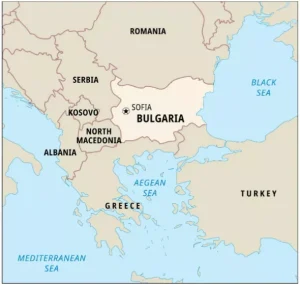
- Location: Located in Southeastern Europe on the Balkan Peninsula.
- It is bordered by Romania to the north, Serbia and North Macedonia to the west, Greece and Turkey to the south, and the Black Sea to the east.
- Capital: Sofia
- Key Features: Danube River forms the northern border; Balkan Mountains (Stara Planina) run east-west; highest peak is Musala (2,925 m) in the Rila Mountains.
India and Pakistan Exchange Lists of Nuclear Installations
Context: India and Pakistan exchanged lists of their nuclear installations and prisoners on January 1, 2026, under the “Agreement on Prohibition of Attacks against Nuclear Installations and Facilities” (1988).
About Agreement
- Core Objective: It is a bilateral pact designed to prevent attacks on each other’s atomic facilities and facilities to reduce escalation risks and avoid catastrophic radiological consequences.
- Signatories: Bilateral agreement between India and Pakistan, signed in 1988 amid regional security tensions.
- Scope of Protection: Covers nuclear power plants, research reactors, fuel fabrication, reprocessing, enrichment facilities, and related sites.
- Annual Exchange of Lists: Mandates yearly exchange (1st January) of lists of covered nuclear facilities to ensure transparency and confidence-building.
Amazon’s Stingless Bees
Context: Two municipalities (Satipo and Nauta) in Peru have granted legal rights to Amazonian stingless bees the first time an insect has received such recognition globally.
- The ordinance recognizes specific inherent rights of stingless bees, including their:
- Right to exist.
- Right to maintain healthy populations.
- Right to have their habitats restored.
- Right to live in a pollution-free environment.
About the Stingless Bees
- The world’s oldest bee lineage, existing for nearly 80 million years.
- They lack stingers or have ineffective ones and functionally useless for defense.
- Found in tropical regions worldwide, with about half of the 500 known species living in the Amazon.
- Peru alone is home to more than 170 species.
- Amazon’s Key Pollinator: They pollinate over 80% of Amazonian flora, including vital crops like Cacao, Coffee and Avocados.
- Indigenous Heritage: They are central to the culture and knowledge of the Asháninka and Kukama-Kukamiria peoples.
- Medicinal Role: Their honey is used as traditional medicine, with modern studies confirming its anti-inflammatory, antibacterial, and antiviral properties.
Desert Cyclone II Exercise
The India-UAE Desert Cyclone II exercise recently concluded in Abu Dhabi, marking a significant milestone in the growing defense cooperation between India and the UAE.
Key highlights of the exercise include
- The exercise, which took place from December 18 to 30, 2025, involved nearly two weeks of rigorous joint military training.
- Location: It took place at the Al-Hamra Training City, located in Abu Dhabi.
- Objective: The main goal was to enhance interoperability and strengthen defense cooperation between the two nations, focusing on sub-conventional operations and joint peacekeeping activities under a United Nations mandate.
- Training Program: The exercise included a mix of classroom learning and field activities, such as urban combat fundamentals, building clearance techniques, IED awareness, and casualty evacuation.
- Troops also practiced heliborne operations and air assault drills, with an emphasis on coordinated offensive and defensive urban operations.
- Final Operations: The final phase of the exercise showcased high-level combined operational readiness, with both forces working seamlessly together to execute integrated urban operations.
First Phase of All India Tiger Estimation (AITE) 2026
Context: The All India Tiger Estimation (AITE) 2026 exercise will begin its first phase in Tamil Nadu on January 5, 2026.
- The All India Tiger Estimation (AITE) 2022, India’s 5th tiger census, recorded an estimated 3,682 tigers and India is estimated to host nearly 75% of the world’s tiger population.
Key Details
- About: This national exercise is part of a global initiative aimed at monitoring tiger populations, co-predators (like leopards, wild dogs, and hyenas), and their prey, including gaur, sambar deer, spotted deer, and barking deer.
- The exercise will cover all tiger reserves, other habitats, and private estates with notable carnivore presence.
- Conducted by: National Tiger Conservation Authority (NTCA) and Wildlife Institute of India (WII) every four years.
- Purpose: To assess tiger populations, monitor co-predators, estimate herbivore prey-base, and conduct detailed habitat assessments through sign surveys, camera trapping, line transects, and genetic sampling.
Tiger Population Growth in Tamilnadu
- Tamil Nadu’s tiger population has risen from 264 in 2018 to 306 in 2022, highlighting the success of conservation efforts in the state.
- Tiger Reserves in Tamil Nadu: The state, home to five major tiger reserves (Kalakad Mundanthurai, Anamalai, Mudumalai, Sathyamangalam, and Srivilliputhur-Megamalai), will play a key role in the nationwide effort.


 2 Jan 2026


.png)




 Current Affairs




 GS Foundation
 Optional Course
 Combo Courses
 Degree Program