Reynisfjara Beach
Context: Reynisfjara Beach in Iceland has undergone rapid and unprecedented changes due to severe coastal erosion during the winter of 2025–2026.
About Reynisfjara Beach
- Location: Situated on the south coast of Iceland, below Mount Reynisfjall, facing the North Atlantic Ocean.
- Origin:
- Black Volcanic Sand: Formed from eroded basaltic lava, giving it its iconic black colour.
- Key Features:
- Reynisdrangar Sea Stacks: Famous offshore basalt pillars known as Reynisdrangar are found here.
- Basalt Columns & Caves: Hexagonal basalt formations and caves shaped by volcanic activity and wave erosion.
- Tourism: One of Iceland’s most visited natural attractions; popular for photography and geology.
- Part of Katla UNESCO Global Geopark: Recognized for its geological significance tied to volcanic activity.
- Recent Severe Erosion (2025–26): Persistent easterly winds and high waves caused rapid shoreline shrinkage and landslides.
- Safety Risk: Known for dangerous “sneaker waves” that can unexpectedly sweep visitors into the sea.
Mt Reynisfjall
- Reynisfjall is a volcanic mountain located on Iceland’s southern coast.
- Location and Altitude: Reynisfjall rises 340 meters (1,115 feet) above sea level on the Reynisfjara black sand beach.
- Geological Formation: The mountain is composed of volcanic rock and basalt, formed during volcanic eruptions.
INDO-PACOM
Context: The Chief of the U.S. Indo-Pacific Command (INDO-PACOM) praised Operation Sindoor and called for deeper India–U.S. defence cooperation amid evolving Indo-Pacific security challenges.
About INDO-PACOM
- The United States Indo-Pacific Command (INDO-PACOM) is the U.S. unified combatant command responsible for military operations across the Indo-Pacific region, covering vast maritime and strategic theatres.
- The United States Indo-Pacific Command (INDOPACOM), originally established as the U.S. Pacific Command (PACOM), was established on January 1, 1947
- Participants: INDO-PACOM works closely with regional allies and partners, including India, Japan, Australia, South Korea, and ASEAN countries.
- India–U.S. defence cooperation has expanded through joint exercises such as Tiger Triumph, Malabar, Cope India, and RIMPAC, along with defence acquisitions including Apache helicopters and maritime platforms.
- Focus Areas: The command emphasises deterrence, maritime security, and maintaining a free and open Indo-Pacific.
- Key domains include maritime domain awareness, undersea surveillance, space and counterspace operations, electronic warfare, artificial intelligence, and integrated long-range strike capabilities.
Significance
- INDO-PACOM plays a critical role in balancing strategic competition in the Indo-Pacific, particularly amid China’s growing military presence.
AI Impact Summit 2026
Context: India hosts the fourth AI Impact Summit 2026 in New Delhi, marking the first such global AI gathering in the Global South.
About AI Summit
- The AI Impact Summit is a multilateral platform bringing together governments, global technology leaders, industry, and civil society to deliberate on the transformative potential and governance challenges of artificial intelligence.
- AI Summit Origin:
- AI Safety Summit at Bletchley Park in the UK in November 2023, the landmark Bletchley Declaration focusing on identifying AI safety risks was adopted.
- India was one of the 28 original signatory nations and the European Union
- The Seoul Summit in May 2024 expanded discussions to include innovation and inclusivity alongside safety.
- Paris AI Action Summit in February 2025 emphasised practical implementation and economic opportunities.
- AI Impact Summit 2026: The 2026 edition is being held at Bharat Mandapam, New Delhi, from February 16–20.
- It is the fourth summit in the series of AI Summits
- Three main goals of the AI Impact Summit 2026
- Leveraging AI to empower people and promote innovation.
- Projecting India as the service provider for AI for the whole world, and
- Democratising access to compute, datasets, and algorithms.
- The summit aims to:
- Unlock AI’s potential for economic growth and job creation.
- Promote inclusive and responsible AI deployment.
- Strengthen global cooperation on AI safety standards and governance frameworks.
- Enhance AI applications in public services such as healthcare, education, and urban governance.
- Theme: Sarvajana hitaya, sarvajana sukhaya (Welfare for all, Happiness for all)
- Sutras: Enchored around India’s three Sutras — People, Planet, and Progress.
- The summit emphasises equitable access, sustainable development, and innovation-driven growth, particularly for developing nations.
- Previous Summits: The summit represents the latest chapter in an evolving international conversation on AI governance.
- Earlier AI Summits were held in the United Kingdom, South Korea, and Paris, France, focusing on AI safety, ethics, and regulatory cooperation.
Kerala Vision 2031
Context: Kerala inaugurated the three-day ‘Vision 2031: International Conference on Development and Democracy’.
- Kerala’s human development achievements are a foundation for a new phase of economic and social transformation rather than an endpoint.
- The vision aims to prepare Kerala for its 75th year in 2031.
Key Visions
- Knowledge-Based Productive Economy: To transition towards a high-value, innovation-driven economy leveraging technology, research, and skilled human capital.
- Inclusive and Just Society: To combine growth with social justice, ensuring equity, welfare protection, and participatory democracy.
- Climate Resilience and Sustainability: It emphasises environmental sustainability and climate adaptation, recognising Kerala’s vulnerability to extreme weather events.
- Democratic and Consultative Governance: Promotes deliberative democracy, decentralised planning, and citizen participation in policymaking.
Challenges to the Vision
- Fiscal constraints and borrowing limitations while reinforcing Kerala’s model of human development as a globally referenced framework.
Significance
- As Kerala approaches its 75th year in 2031, Vision 2031 represents a roadmap to balance modernisation with humanity and technology with social justice.
Magh Mela
Context: Over 40 lakh devotees took a holy dip at the Sangam on Maha Shivratri, marking the conclusion of Magh Mela 2026 in Prayagraj.
About Magh Mela
- Introduction: Magh Mela is an annual Hindu religious congregation held in Prayagraj at the sacred Triveni Sangam, the confluence of the Ganga, Yamuna and the mythical Saraswati rivers, during the Hindu month of Magha (January–February).
- Frequency: It is a 45-day-long annual pilgrimage held in Magh Mela every year.
- It becomes the Kumbh Mela every four years.
- It becomes the Maha Kumbh Mela every twelve years.
- Magh Mela 2026 Celebrations: The 2026 Mela witnessed massive participation, with over 22 crore devotees attending throughout the festival and 40 lakh taking the holy dip on its concluding day, coinciding with Maha Shivratri.
- Cultural Significance: Magh Mela symbolises spiritual purification, penance and faith in Sanatan traditions. Ritual bathing at the Sangam is believed to cleanse sins and promote moksha.
Magh Mela India’s intangible cultural heritage, pilgrimage economy, and large-scale crowd management capabilities, often serving as a precursor to the larger Kumbh Mela gatherings.
LHS 1903 System
Context: Scientists using ESA’s Cheops satellite discovered an unusual planetary arrangement around LHS 1903 that challenges conventional planet-formation theories.
About LHS 1903 System
- LHS 1903 is a distant planetary system orbiting a cool M-dwarf (red dwarf) star. It was studied using the European Space Agency’s CHEOPS (CHaracterising ExOPlanet Satellite), designed to analyse known exoplanets.
- Unusual Planetary Arrangement: Traditional planetary models suggest rocky planets form close to stars, while gas-rich planets form farther away.
- However, LHS 1903 exhibits an “inside-out” configuration:
- Rocky – Gaseous – Gaseous – Rocky.
- The outermost planet appears rocky despite being located far from its host star, contradicting established formation patterns.
- Possible Explanation: Scientists ruled out atmospheric stripping due to collision and planetary migration.
- Instead, they propose a sequential or “inside-out” formation model, where planets formed one after another.
- By the time the outermost planet formed, the protoplanetary gas may have dissipated, leaving only solid material to create a rocky body.
- Scientific Significance: The discovery challenges long-standing planetary formation theories and suggests greater diversity in solar system architectures.
- It raises questions about whether our Solar System’s structure is typical or just one among many possible cosmic configurations.
Sangtam Community
Context: The apex body of Nagaland’s Sangtam community has passed a resolution to protect pangolins, the world’s most trafficked wild mammal, within its jurisdiction.
About the Sangtam Community
- The Sangtam are one of the 16 major recognized Naga tribes in Nagaland.
- Location: They are a significant ethnic group among the Nagas, primarily inhabiting Kiphire and Tuensang districts in eastern Nagaland.
- The region is part of the Indo-Myanmar Biodiversity Hotspot, making it both ecologically significant and vulnerable to wildlife exploitation.
- Language: They speak Sangtam, a Sino-Tibetan language belonging to the Tibeto-Burman family.
- Society: Sangtam society is egalitarian, with villages organized around clans and intermarried households emphasizing kinship and mutual support.
- They follow a patriarchal system of lineage and inheritance as well.
- Governance: Governance is through village councils and apex bodies like the United Sangtam Likhum Pumji (USLP), which handle disputes, conservation, and community decisions.
- Economy: The traditional economy was based on jhum cultivation (shifting agriculture), growing rice, millet, and vegetables. Hunting and gathering supplemented agriculture.
About the Pangolins
- Pangolins, often called scaly anteaters, are unique nocturnal mammals in the order Pholidota.
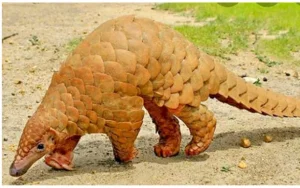 They are the world’s most trafficked wild mammal, facing severe threats from illegal trade and habitat loss. All eight recognized species are threatened with extinction.
- Species and Distribution: There are eight species of Pangolins:
- Asian species (4): Indian pangolin (Manis crassicaudata), Chinese pangolin (Manis pentadactyla), Sunda pangolin (Manis javanica), Philippine pangolin (Manis culionensis).
- African species (4): Giant ground pangolin (Smutsia gigantea), Temminck’s ground pangolin (Smutsia temminckii), White-bellied pangolin (Phataginus tricuspis), Black-bellied pangolin (Phataginus tetradactyla).
- Habitats: Forests, savannas, grasslands; some arboreal (tree-climbing), others ground-dwelling with burrows.
- Diet: Strictly insectivorous. Mainly ants and termites; use smell and tongue to forage. They play a key ecological role in controlling insect populations.
- Conservation Status: All eight species are threatened as per IUCN Red List.
- Indian pangolin is Endangered on the IUCN Red List.
- The Chinese pangolin is listed as Critically Endangered.
- Both are protected under Schedule I of India’s Wildlife (Protection) Act, 1972.
- All 8 species are listed in CITES Appendix I.
Brahmaputra Road-Cum-Rail Tunnel Project
Context: The Union Government approved India’s first underwater twin tube road-cum-rail tunnel under the Brahmaputra River in Assam.
About Brahmaputra Road-Cum-Rail Tunnel Project
- The Road-Cum-Rail Tunnel Project involves construction of a 33.7-km four-lane access-controlled Greenfield corridor, including a 15.79-km twin tube underwater tunnel beneath the Brahmaputra River.
- Location: It will connect Gohpur (NH-15) and Numaligarh (NH-715) in Assam.
- It will reduce distance from 240 km to 34 km and travel time from six hours to 20 minutes.
- Cost and Execution: The project will be developed at a cost of ₹18,662 crore in Engineering, Procurement and Construction (EPC) mode.
- Significance: The project will boost regional connectivity, strengthen strategic infrastructure, generate employment, and accelerate socio-economic growth across Northeast India.
- It will be India’s first underwater road-cum-rail tunnel and the second such project globally.
About Cabinet Committee on Economic Affairs (CCEA)
- The CCEA is a key decision-making body of the Union Government that oversees economic policies and major infrastructure approvals.
- Composition: It is chaired by the Prime Minister and includes senior Union Ministers.
- Home Affairs (Amit Shah), Finance (Nirmala Sitharaman), Defence (Rajnath Singh), Road Transport, Agriculture, External Affairs, Commerce, and Education
- Role and Functions: The CCEA approves major investment proposals, infrastructure projects, pricing policies, and matters related to economic growth and public expenditure.


 16 Feb 2026




.png)






 Current Affairs




 GS Foundation
 Optional Course
 Combo Courses
 Degree Program