A six-member special bench of the National Green Tribunal (NGT) upheld the environmental clearance for the Great Nicobar mega project, finding no valid ground to interfere.
- Strategic Importance: The tribunal acknowledged that the project’s strategic significance cannot be denied.
- Concerns addressed: The tribunal was satisfied that concerns previously raised were addressed by the High-Powered Committee (HPC) formed in 2023.
NGT’s View
- Balanced Approach: It emphasized that Island Coastal Regulation Zone (ICRZ) conditions must also be respected, calling for a balanced approach.
- CRZ Compliance for Port Areas: The tribunal noted the Centre’s submission that parts of the ports falling in CRZ 1A and 1B zones will be excluded from the revised master plan.
- Species Protection Conditions: It noted that specific safeguards were mandated to protect the leatherback sea turtle, Nicobar megapode, saltwater crocodile, robber crab, Nicobar macaque and other endemic bird species of Great Nicobar Island.
- Compliance with Environmental Clearance: The conditions in the environmental clearance and must ensure these are not violated.
- Coastal Protection: To prevent coastal erosion and protect sandy beaches, which are vital nesting sites and natural barriers for the island.
- Coral Reef Protection: Citing the Zoological Survey of India, the tribunal stated that no coral reef exists in the project area.
- Scattered corals will be translocated, and the Ministry must ensure protection and scientific regeneration of coastal reefs.
About Great Nicobar Island Project
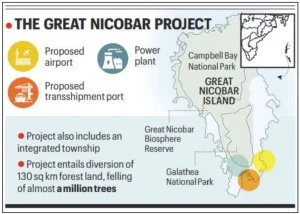
- Vision: A multi-component mega development project to transform Great Nicobar into a logistics, trade, and defence hub, improving India’s presence in the Indian Ocean.
About Andaman and Nicobar Islands Integrated Development Corporation Ltd (ANIIDCO)
- About: Quasi-government agency, incorporated in 1988 under the Companies Act.
- Objective: To develop and commercially exploit natural resources for the balanced and environment friendly development of the territory.
- Appointment as Project Proponent: Appointed by A&N administration in July 2020 for the Great Nicobar Project.
|
- Planned with environmental safeguards and tribal welfare compliance under EIA Notification 2006 and Shompen Policy 2015 to ensure sustainability
- Shompen Policy 2015: It is a regulatory framework established by the Andaman and Nicobar Administration to prioritize the welfare and rights of the indigenous Shompen tribe during large-scale development projects on Great Nicobar Island.
- Implementing authority: Andaman and Nicobar Islands Integrated Development Corporation Ltd (ANIIDCO).
- Phased Timeline: Construction from 2024 onwards; partial operationalization by 2028, with full-scale development spread till 2050.
- High-Powered Committee (HPC) Review:
- Following challenges to environmental clearance, the National Green Tribunal constituted a High-Powered Committee (HPC) to revisit the project’s environmental clearance, as per a 2023 order of the NGT.
Key Components
- International Container Transhipment Terminal (ICTT): With a capacity of 14.2 million TEU, it will reduce India’s reliance on Colombo/Singapore and position the island as a global shipping hub.
- It is part of Maritime India Vision 2030 and Amrit Kaal Vision 2047, supporting India’s long-term economic strategy.
- Greenfield International Airport: Will improve air connectivity, promote tourism, and enable rapid deployment of troops and supplies in emergencies.
- 450 MVA Gas + Solar Power Plant: Ensures uninterrupted energy supply with a mix of conventional and renewable sources for sustainable growth.
- Integrated Township: A planned township over 16,610 hectares to provide housing, infrastructure, and modern amenities to residents and workers.
- Phased Development: Divided into three phases (2025–47) to spread investment, minimise ecological stress, and allow adaptive planning over two decades.
Location – Great Nicobar Island (GNI)
- Southernmost island of the Nicobar group of islands in the Bay of Bengal.
- Protected Sites:
- Great Nicobar Biosphere Reserve
- Campbell Bay National Park
- Galathea National Park
|
Significance of the Project
- Strategic Location: Great Nicobar lies near the Malacca Strait, through which nearly 30%-40% of global trade, including a large share of China’s oil and gas imports, passes through this chokepoint.
- Economic Potential: It supports Sagarmala initiative and aims to make India a regional transshipment hub like Singapore/Hong Kong.
- Infrastructure Development: Improves connectivity and infrastructure in a remote region.
- Defence Importance: Enhances naval and air operational capacity in the eastern Indo-Pacific.
- Regional Diplomacy: Positions India as a trade and logistics leader in Bay of Bengal and BIMSTEC region. It helps in reducing dependency on foreign ports for transshipment.
Concerns Associated with the Project
- Ecological Concerns: Great Nicobar is a biodiversity hotspot (200 bird species, endemic flora, coral reefs).
- Galathea Bay: Critical nesting site for giant leatherback sea turtle and Ramsar wetland with protective mangroves.
- UNESCO World Heritage Site candidature could be jeopardized.
- Governance and Institutional Concerns: ANIIDCO appointed as project proponent despite limited experience (previously handled liquor, milk, tourism resorts).
- Lack of environmental policy & expertise until 2022 → questions of credibility.
- Conflict of Interest: Same officials heading ANIIDCO also in charge of environmental oversight and clearances.
- Raises doubts about independent monitoring and transparency.
- Legal and Regulatory Concerns: Project area includes Coastal Regulation Zone (CRZ-1A) → normally prohibits large-scale construction.
- Environmental clearance by MoEFCC despite lack of preparedness flagged as irregular.
- Ongoing petitions before NGT & Calcutta High Court challenge forest clearances.
Way Forward
- Earth Jurisprudence: Countries like Bolivia, Colombia, Ecuador, and New Zealand follow ‘earth jurisprudence’ granting legal rights to nature—an approach India should adopt to strengthen ecological protection.
- Ensure Forest Rights Act Compliance: Conduct fresh Gram Sabha consultations with genuine participation of Nicobarese and Shompen tribes.
- Properly recognise and settle individual and community forest rights before proceeding.
- Independent Environmental Oversight: Establish an independent monitoring body (outside ANIIDCO and A&N administration) for environmental safeguards.
- Involve credible external experts in biodiversity and disaster management.


 17 Feb 2026







.png)






 Current Affairs




 GS Foundation
 Optional Course
 Combo Courses
 Degree Program