Recently, NITI Aayog unveiled a report titled “Empowering Farmers: Natural Farming Training Toolkit & Best Practices Guide.”
Key Highlights of the Report
- Concept and Agroecological Framework of Natural Farming: The report presents Natural Farming as a science-based, agroecology-driven agricultural system that is chemical-free, biodiversity-oriented, and livestock-based.
 It emphasises on-farm biomass recycling, mulching, soil aeration, and elimination of synthetic fertilisers and pesticides, shifting the focus from “feeding crops” to “nurturing living soil ecosystems.”
- Knowledge Foundations- Traditional Wisdom and Modern Ecological Thought: Natural Farming draws inspiration from ancient Indian agricultural knowledge found in texts such as Krishi-Parashar, Arthashastra, and Vrikshayurveda.
- It also incorporates modern ecological farming ideas influenced by Masanobu Fukuoka and Subhash Palekar, reflecting a synthesis of traditional practices and contemporary agroecology.
- Core Principles and Key Practices (“Four Pillars”): The report outlines the foundational practices of Natural Farming:
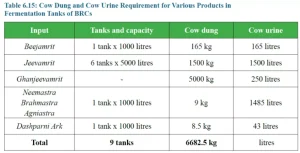 Beejamrit: Microbial seed treatment using cow dung and urine to protect seedlings.
- Jeevamrit and Ghanjeevamrit: Microbial soil inoculants that enhance soil fertility and microbial activity.
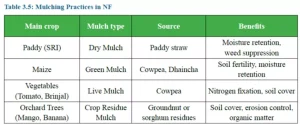
- Acchadana (Mulching): Continuous soil cover using crop residues to conserve moisture and suppress weeds.
- Whapasa: Maintaining optimal soil aeration and moisture balance for nutrient uptake.
These practices are complemented by mixed cropping, cover cropping, indigenous seed use, minimal tillage, and plant-based pest management.
 Environmental Sustainability and Climate Resilience: Natural Farming strengthens soil organic carbon, microbial biodiversity, and ecosystem balance, improving water retention and soil structure.
- The report notes reduced greenhouse-gas emissions, lower irrigation demand, and improved crop resilience to climate shocks, including examples from the impact of Cyclone Michaung.
- Farmer Economics and Self-Reliance (Atma-Nirbharta): By relying on locally available and farm-derived inputs, Natural Farming reduces dependence on costly external inputs.
 Field evidence suggests 5–10% reduction in cultivation costs (up to 20–55% in some cases) and higher Benefit–Cost ratios, improving farm profitability, income stability, and financial resilience.
- Institutional Support and Government Policy Framework: Scaling of Natural Farming is supported by the National Mission on Natural Farming, which has an outlay of ₹2,481 crore and aims to bring 1 crore farmers under Natural Farming.
- The mission proposes 10,000 Bio-Input Resource Centres (BRCs) and convergence with schemes such as the Mahatma Gandhi National Rural Employment Guarantee Act and the Formation and Promotion of 10,000 Farmer Producer Organizations Scheme.
- Implementation Toolkit, Market Linkages, and State-Level Models: The report functions as a practice-oriented training manual, covering seed selection, soil health management, pest control, bio-input production, certification, and marketing strategies.
- It promotes Participatory Guarantee System (PGS-India) certification, direct farmer-consumer markets, and digital marketing platforms. Successful implementation models are highlighted in Andhra Pradesh, Himachal Pradesh, and Gujarat, which demonstrate scalable institutional frameworks for Natural Farming.
About Natural Farming
- Definition: According to NITI Aayog, Natural farming is an agricultural production system that eliminates the use of synthetic chemicals and fertilizers, centred around integrating livestock into the crop production system.
- Key Features:
- Integrated Farming: Combines crops, trees, and livestock to enhance biodiversity.
- Ecological Balance: Works in harmony with natural processes within the farm ecosystem.
- Self-Reliant System: Relies on farm-derived inputs, eliminating dependence on synthetic fertilisers and chemicals.
- Aim: It does not merely replace chemical inputs with organic alternatives; rather, it aims to redesign the farm as a self-sustaining biological system in which soil, crops, livestock, trees, microorganisms, moisture, and biomass function in an integrated, mutually reinforcing manner.
Components of Natural Farming
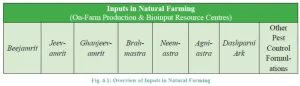
The manual identifies several core components that form the operational basis of this ecological system:
- Beejamrit: A microbial seed treatment formulation made from cow dung, urine, lime, and water.
- It is used for coating seeds to provide beneficial microbes, improve germination, and protect seedlings against seed-borne and soil-borne diseases.
- Jeevamrit: A fermented microbial solution prepared using cow dung, urine, jaggery, pulse flour, and soil.
- It acts as a biological stimulant that enriches microbial life and activates the soil food web to support long-term fertility.
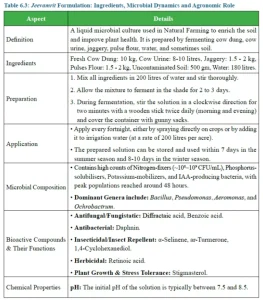
- Ghanjeevamrit: The solid form of Jeevamrit, used as a stable amendment to improve soil microbial activity and nutrient availability over a longer period, especially in rainfed areas.
- Mulching (Acchadana): The practice of keeping the soil covered with crop residues or live mulch. This reduces evaporation, moderates soil temperature, suppresses weeds, and gradually enriches soil organic matter.
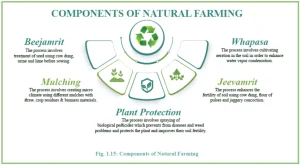
- Whapasa: The maintenance of an ideal balance of soil air and moisture. Natural farming discourages over-irrigation, seeking instead to promote biologically active, well-aerated soils that enhance nutrient uptake.
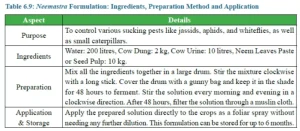
- Plant Protection (Botanical Preparations): Utilizing natural formulations such as Neemastra, Brahmastra, and Agniastra for pest management, which are based on locally available biological materials and eliminate the need for synthetic toxins.
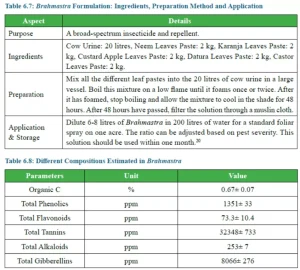
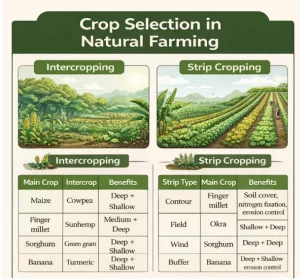
- Crop Diversity and Integration: Relying on intercropping, mixed cropping, and livestock integration to enhance farm resilience, diversify output, and reduce ecological risks.
Principles of Natural Farming
The training manual presents natural farming as an agroecology-based system governed by several ecological principles:
- Minimal Soil Disturbance: Advocates for reduced tillage because excessive ploughing disrupts soil aggregates, destroys microbial habitats, and accelerates moisture loss.
- Complete Exclusion of Synthetics: Insists on the total removal of synthetic fertilizers and pesticides, which may provide short-term gains but weaken long-term ecological stability.
- On-Farm Resource Use: Prioritizes biomass recycling, making the farm an autonomous unit less dependent on volatile external markets.
- Biodiversity and Polyculture: Recognizes that ecological diversity is the foundation of resilience against pests, nutrient stress, and climate shocks.
- Polyculture refers to growing multiple crops together in the same field rather than a single crop.
- Indigenous Seeds: Encourages the use of locally adapted seeds, which are often better suited to local agro-climatic conditions and require fewer external resources.
- Integration of Life-forms: Underlines the importance of integrating livestock, agroforestry, and pollinators (like bees) into the farm economy to create a holistic ecosystem.
Evolution of Natural Farming in India
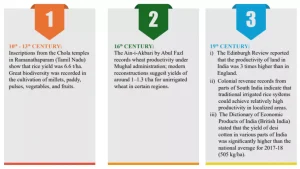
- The Foundation- Ancient Historical Texts: India possesses the world’s oldest systematic agricultural records. These texts prove that “Natural Farming” is not a new concept but a revival of traditional science.
 Krishi-Parashar (circa 400 BC): Authored by Maharishi Parashar, it is considered the world’s first systematic agricultural textbook.
- It covers everything from predicting rainfall based on planetary movements to the design of the plough and nutrient management.
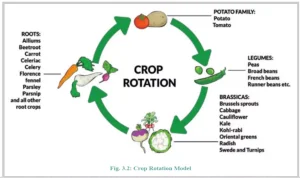
- Kautilya’s Arthashastra (circa 321 BC): Features a chapter titled ‘Sitadhyaksha’ which outlines the importance of cattle rearing, seed treatment, and crop rotation.
- Vrikshayurveda (circa 1000 AD): Written by Surapala, this text is revolutionary for describing ‘Kunapala’, the world’s first-known fermented natural liquid manure.
- Upavanavinoda (circa 1283-1301 AD): A specialized text on arboriculture and horticulture, detailing soil selection, seed sowing, and the use of natural indicators for crop growth.
- Vishvavallabha (circa 1577 AD): A manual tailored for the Mewar region, focusing on groundwater detection and agriculture in arid and hilly terrains.
- The Traditional Socio-Economic Context: Historically, Indian agriculture was a community-driven tradition where wealth was measured by natural resources rather than currency.
- Forms of Wealth: Society valued ‘Gau-dhan’ (cows), ‘Ashva-dhan’ (horses), and ‘Gaj-dhan’ (elephants).
- The Supremacy of ‘Dhanya’: Among all forms of wealth, Dhanya (crops/rice) was considered the most important, serving as the primary medium for social and economic transactions.
- Cultural Status: As noted in the Thirukkural (70 BC), farming was considered the noblest profession, held in such high regard that even royalty bowed to the farmer.
- The Contemporary Movement: The modern revival of natural farming is a response to the chemical-intensive practices of the Green Revolution.
- Zero-Budget Natural Farming (ZBNF): Developed in the 1980s by Shri Subhash Palekar, this system focuses on eliminating cultivation costs by utilizing on-farm resources derived from the study of Vedas and traditional science.
- The Role of Acharya Devvrat: As Governor of Himachal Pradesh and later Gujarat, his efforts transformed natural farming into a state-wide movement, reaching thousands of panchayats in just three years.
- Bhartiya Prakritik Krishi Paddhati (BPKP): The Government of India formally recognized and branded natural farming under this name, grounding its roots in the ancient knowledge of Vrikshayurveda.
- The National Call to Action: On December 16, 2021, Prime Minister Narendra Modi urged the nation to take agriculture “out of the chemistry lab and connect it to the laboratory of nature,” aiming to connect at least one village in every panchayat to natural farming during the Azadi Ka Amrit Mahotsav.
Benefits of Natural Farming
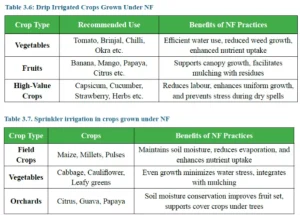
- Drastic Reduction in the Cost of Cultivation: Natural farming is designed to break the cycle of farmer debt by removing the need for expensive commercial products.
- Avoiding Purchased Inputs: By replacing chemical fertilizers (like Urea or DAP) and synthetic pesticides with on-farm preparations like Jeevamrit and Neemastra, farmers significantly lower their daily expenses.
- Proven Savings: Field evidence in the manual confirms a 5–10% reduction in paid-out costs across major crops.
- Example: The report highlights that in states like Andhra Pradesh and Gujarat, farmers transitioning to natural farming have successfully eliminated the high costs of chemical sprays, which previously accounted for nearly 25% of their total investment.
- Significant Improvement in Farmer Income: When the cost to grow food drops while yields remain stable, the farmer’s take-home pay increases.
 Optimized Benefit-Cost (B:C) Ratio: The manual notes that natural farming leads to a much better return on investment.
- Even if the harvest volume is similar to conventional farming, the “net income” is higher because the input costs were nearly zero.
- Premium Market Access: Farmers using the Participatory Guarantee System (PGS-India) can certify their produce as “natural,” allowing them to sell at higher prices in urban markets.
- Example: Field studies in Himachal Pradesh showed that apple orchardists practicing natural farming reported higher net profits compared to their neighbors using chemicals, primarily due to the elimination of expensive imported fertilizers.
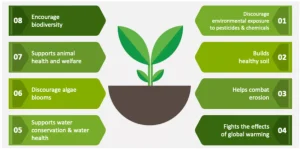
- Environmental Restoration & Resource Saving: Natural farming acts as a “healing” process for the land, reversing the damage caused by decades of chemical use.
 Soil Organic Carbon (SOC) Enhancement: By using microbial inoculants and avoiding tillage, the system strengthens the SOC, which is the primary indicator of fertile, living soil.
- Massive Resource Savings: The practice of Mulching (covering soil with crop residue) improves moisture retention so effectively that it leads to 50–60% savings in water and electricity.
- Example: In the Mewar region of Rajasthan, the use of Whapasa (soil aeration) and mulching has allowed farmers to grow crops with significantly fewer irrigation cycles, proving vital in water-scarce zones.
- Enhanced Climate Resilience: In an era of unpredictable weather, natural farming provides a biological insurance policy for the crop.
- Biological Resilience & Root Strength: Crops grown naturally develop deeper, more robust root systems and natural immunity against pests.
- Extreme Weather Survival: Comparative field observations show that natural farming crops sustain far less damage during disasters like cyclones, heatwaves, or unseasonal rains.
- Example: The manual cites observations from Odisha, where natural farming paddy crops remained standing after heavy cyclonic winds, while neighboring chemical-heavy crops suffered from “lodging” (falling over) because their roots were too shallow and weak.
- Health and Social Benefits:
- Chemical-Free Nutrition: The produce is free from toxic residues, making it safer for the farmer’s family and more nutritious for consumers.
- Atma Nirbharta (Self-Reliance): By producing all inputs on-site, the community becomes self-sufficient, reducing the social stress caused by rising fertilizer prices and supply chain disruptions.
Comparison- Conventional vs. Organic vs. Natural Farming
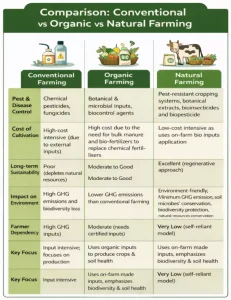
- Conventional Farming: An input-intensive system that depends heavily on synthetic chemicals and often promotes monoculture, frequently resulting in high ecological costs.
- Organic Farming: Avoids synthetic chemicals but still permits the use of externally purchased organic manures and certified inputs, which can remain relatively expensive and market-dependent.
- Natural Farming: Relies largely on farm-derived biological inputs and biomass recycling. It seeks not just input substitution, but ecological regeneration and farmer self-reliance, making it the most self-sustaining among the three.
Challenges of Natural Farming
- The Transition Problem (Healing the Soil): The shift from chemical-based farming to natural methods is not instantaneous; it requires a period of ecological “detox.”
- Initial Adjustment Period: Farmers moving away from synthetic fertilizers may face a stage where yields or confidence fluctuate. This happens because the soil takes time to “re-learn” how to function without chemical stimulants.
- Soil Recovery Time: The manual notes that it can take a few seasons for Soil Organic Carbon (SOC) and beneficial earthworm populations to return to healthy levels.
- Example: In regions of Punjab and Haryana, the manual notes that some farmers initially feared a drop in wheat production; however, those who persisted found that the soil’s water-holding capacity improved by the third year, stabilizing the yields.
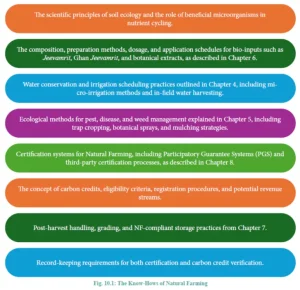
- Knowledge Intensity (Brainpower over Chemical Power): Unlike conventional farming, which is “input-heavy” (buying pre-made solutions), Natural Farming is knowledge-heavy.
 Skill Requirement: Farmers must understand complex biological processes, such as the exact timing for applying Jeevamrit or how to balance Whapasa (soil aeration).
- Extension Support: There is a massive need for demonstration plots where farmers can see “proof of concept.” Without constant technical guidance, farmers may return to chemicals if they face a minor pest issue they don’t know how to handle naturally.
- Example: The National Mission on Natural Farming (NMNF) is addressing this by deploying Krutisheel Kisans (active expert farmers) to act as local mentors for other villagers, turning the farm itself into a classroom.
- Market Differentiation & Certification: Producing healthy, chemical-free food is only profitable if the customer knows it is different.
- Lack of Price Premium: Currently, natural produce often sells at the same price as chemical produce because certification and branding are not yet available everywhere.
- Consumer Awareness: In many regions, there isn’t enough consumer demand for natural products because people aren’t yet aware of the health benefits.
- Example: The manual highlights that the Participatory Guarantee System (PGS-India) is being scaled up to provide low-cost certification, helping small farmers in states like Gujarat get their produce into dedicated “Natural Organic” sections in city supermarkets.
- Labor and Input Management:
- Preparation Time: Making natural inputs like Ghanjeevamrit or Dashparni Arka (pest repellent) requires more manual labor and time compared to simply buying a bag of fertilizer.
- Livestock Dependency: Natural farming relies heavily on indigenous cow dung and urine. A major challenge in some areas is the declining population of local cattle, making it harder for some farmers to source the raw materials they need.
- Example: To solve this, the government is encouraging the creation of 10,000 Bio-input Resource Centres (BRCs). These centres act as local hubs where farmers can buy ready-made natural inputs, saving them the labor of making it themselves.
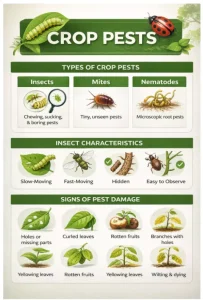 Weeds and Pest Management:
-
- Manual Weeding: Without chemical weed-killers, farmers must rely on mulching (Acchadana) and manual removal, which can be difficult during peak seasons.
- Natural Pest Cycles: Farmers have to learn to tolerate a small number of pests to keep beneficial insects (like ladybugs) alive on the farm, which requires a change in the mindset of “zero-tolerance” for bugs.
Government Initiatives to Promote Natural Farming in India
- National Mission on Natural Farming (NMNF): This is the primary flagship mission dedicated to the large-scale adoption of chemical-free farming across the country.
- Massive Scaling: The mission aims to bring 1 Crore (10 Million) Farmers into the natural farming fold over the next few years to ensure food security without chemicals.
- Financial Outlay: The government has allocated a significant budget of ₹2,481 Crore to support training, infrastructure, and financial incentives for farmers.
- National Corridors: A major focus of the National Mission on Natural Farming is creating a “Natural Farming Corridor” along the Ganga River to prevent chemical runoff into the holy river.
 Bhartiya Prakritik Krishi Paddhati (BPKP): This is a dedicated sub-scheme launched under the Paramparagat Krishi Vikas Yojana (Traditional Agriculture Development Scheme) to promote traditional indigenous practices.
- On-Farm Inputs: It strongly encourages the use of on-farm biomass, cow dung-urine formulations like Jeevamrit and Beejamrit, and strictly excludes all synthetic chemicals.
- Cluster-Based Approach: Farming is promoted in Clusters of 500 Hectares, making it easier for groups of farmers to access collective training and shared marketing tools.
- Bio-Input Resource Centres (BRCs): To solve the challenge of input availability for farmers who may not have livestock, the government is building a localized supply chain.
- 10,000 Centres: The government is establishing 10,000 Bio-Input Resource Centres across India.
- Localized Supply Hubs: These centres act as specialized hubs where farmers can easily access raw materials or pre-prepared natural formulations such as Neemastra (neem-based pesticide) or Dashparni Arka (ten-leaf extract).
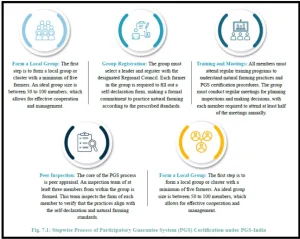
- Certification through Participatory Guarantee System (PGS-India): One of the biggest hurdles for farmers is proving their produce is “natural.” The government provides a farmer-friendly, cost-effective solution for this.
- Participatory Guarantee System: This is a low-cost, decentralized certification process where farmers in a group monitor and verify each other’s practices, eliminating the need for expensive third-party inspectors.
- Market Access: Once certified under Participatory Guarantee System-India, farmers can use official logos on their packaging, which helps build trust with consumers and secure a Price Premium.
- Extension and Training Framework: The government is utilizing a “train-the-trainer” model to ensure scientific knowledge reaches every village.
- Krutisheel Kisans (Master Trainers): The report highlights the role of expert farmers who act as mentors and peer-educators for their fellow villagers.
- Krishi Vigyan Kendras (Agricultural Science Centres): Over 700 Krishi Vigyan Kendras have been tasked with setting up Demonstration Plots. These plots serve as live laboratories where farmers can witness the success of natural farming first-hand.
- Advisory and Market Support Tools:
- mKisan Portal: This portal provides Personalized Short Message Service (SMS) and Voice Advisories to farmers.
- It sends alerts on crop management, weather updates, and specific Natural Farming Best Practices directly to the farmer’s mobile phone.
- National Agriculture Market (e-NAM): This digital platform is being leveraged to help farmers find buyers nationwide.
- It facilitates Price Discovery and Transparent Trading, specifically helping those practicing natural farming to sell their produce at Competitive Prices.
Way Forward
- Institutional Strengthening and Scaling:
- National Mission on Natural Farming (NMNF): Scaling the mission to bring 1 crore (10 million) farmers under natural farming in the next two years.
- Cluster Development: Establishing 15,000 clusters across gram panchayats to create a planned transition towards a mass movement.
- Bio-Input Resource Centres (BRCs): Establishing 10,000 localized centres to ensure farmers have easy, local access to the raw materials and pre-prepared natural formulations they need.
- Knowledge and Capability Building:
 Extension Ecosystem: Building a robust knowledge network involving Self-Help Groups (SHGs), Farmer Producer Organisations (FPOs), and Primary Agricultural Credit Societies (PACS).
- “Train-the-Trainer” Model: Utilizing Master Trainers and Krutisheel Kisans (progressive expert farmers) as local mentors to provide hands-on, peer-to-peer learning in every village.
- Education and Research: Integrating natural farming into the curriculums of Agricultural Universities to train future agricultural scientists and extension officers in agroecological principles.
- Market Development and Financial Sustainability:
- Certification and Branding: Promoting the Participatory Guarantee System (PGS-India) to provide smallholders with a cost-effective, credible way to certify their produce as “natural”.
 Value Chain Integration: Strengthening market linkages through digital platforms like e-NAM (National Agriculture Market) to ensure farmers receive a price premium for their chemical-free produce.
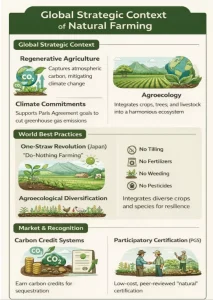
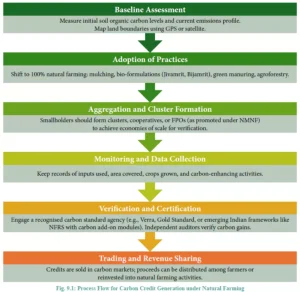
- Carbon Credit Mechanisms: Developing frameworks to reward farmers for soil carbon sequestration, creating an additional “green” income stream for healing the planet.
- Policy and Social Shift:
- Self-Reliance (Atma Nirbharta): Reducing national and farm-level dependence on imported synthetic inputs, thereby improving India’s fertilizer security and reducing farmer debt.
- Climate Action: Positioning natural farming as a cornerstone of India’s Nationally Determined Contributions (NDCs) under the Paris Agreement to reduce greenhouse gas emissions.
- Collective Effort: Moving from individual adoption to a collaborative model where policymakers, researchers, and civil society work together to build a productive and resilient agricultural ecosystem.
Conclusion
Natural Farming represents a shift from input-intensive to ecology-intensive agriculture. It is not a nostalgic return to the past, but a scientific attempt to combine traditional wisdom with modern agroecological thinking. If supported by training and institutional innovation, it will become the bedrock of a Viksit Bharat 2047, ensuring a productive and sustainable future in harmony with nature.


 11 Mar 2026








.png)






 Current Affairs




 GS Foundation
 Optional Course
 Combo Courses
 Degree Program