Oil Economy

12 Jan 2026

Oil Economy

Recent U.S. sanctions on Russian energy and renewed engagement with Venezuelan oil reflect growing concerns over de-dollarisation and shifts in global oil-financial power from the Petrodollar System.

About the Petrodollar System

  • The petrodollar system refers to the global practice of pricing and settling international oil trade primarily in U.S. dollars.

PW OnlyIAS ExtraEdge

  • De-dollarisation refers to the process by which countries reduce dependence on the United States dollar (USD) in trade, reserves, and finance.
  • It involves using alternative currencies, bilateral settlements, and regional financial mechanisms to enhance monetary sovereignty and reduce exposure to US-led sanctions.

  • This system has linked energy markets with global finance, making oil not just a commodity but a pillar of international monetary power.
  • Origin: The system emerged in the early 1970s after the collapse of the Bretton Woods system.
    • Following negotiations between the United States and Saudi Arabia, oil-exporting countries agreed to price crude oil exclusively in U.S. dollars in exchange for American security guarantees and financial access.
    • This arrangement soon became the global norm through the Organization of the Petroleum Exporting Countries (OPEC).
  • Current Use: Even today, a large share of global oil trade is settled in dollars, sustaining constant international demand for the U.S. currency. 
    • Globally, around 80% of oil trade remains in dollars  allowing  the United States to finance large fiscal and current account deficits and exercise geopolitical influence through sanctions and financial controls.

About Crude Oil

  • Crude oil is a naturally occurring, non-renewable fossil fuel composed mainly of hydrocarbons, formed over millions of years from buried organic matter under heat and pressure.
    • Oil provides approximately 30% of the world’s total energy supply.
  • Crude Oil  is refined into essential fuels such as petrol, diesel, aviation turbine fuel, liquefied petroleum gas (LPG), and petrochemical feedstocks, making it a cornerstone of modern economies.
  • Process of Crude Oil Extraction: Crude oil is extracted primarily through drilling into underground reservoirs located on land or beneath the seabed.
    • It is often found along with natural gas and saline water. 
    • After extraction, crude oil is transported to refineries, where it undergoes distillation and further processing to produce usable petroleum products.

Types of Crude Oil

  • Light Crude Oil: Light crude oil has low density and flows easily. 
    • It yields a higher proportion of high-value refined products such as petrol, diesel, and aviation fuel. 
    • It is cheaper to refine and preferred by most modern refineries.
    • It is commonly found in the United States (shale oil fields), North Sea (Brent crude), parts of West Africa (Nigeria), and Azerbaijan.
  • Heavy Crude Oil: Heavy crude oil has high density and viscosity. It produces more residual products and requires complex refining techniques such as coking and hydrocracking, increasing processing costs.
    • Heavy crude oil is mainly found in Venezuela (Orinoco Belt), Canada (oil sands), Mexico, and parts of the Middle East.
  • Sweet Crude Oil: Sweet crude oil contains low sulphur content (generally less than 0.5%). 
    • It produces fewer pollutants, causes less corrosion in refinery equipment, and meets environmental standards more easily.
      It is produced in the United States (WTI crude), North Sea (Brent), Libya, Nigeria, and parts of Indonesia.
  • Sour Crude Oil: Sour crude oil has high sulphur content (more than 0.5%), making it more polluting and technically challenging to refine. 
    • It requires desulphurisation and advanced refining infrastructure.
    • It is predominantly found in the Middle East (Saudi Arabia, Iraq), Canada, Venezuela, and Russia.

Oil Trade Benchmark

  • Brent Crude: The most widely used global benchmark, derived from North Sea fields, pricing most waterborne crude, known for being light and sweet.
  • West Texas Intermediate (WTI): A key US benchmark, also light and sweet, heavily traded in North America.
  • Dubai/Oman: Used to price Middle Eastern oil, especially for Asian markets, often linked to Brent. 
  • OPEC Reference Basket: Used by OPEC for pricing decisions. 
  • Western Canadian Select (WCS): A heavy, sour benchmark for Canadian oil. Bonny Light (Nigeria) & Urals (Russia): Regional benchmarks. 

Organisations Related to Crude Oil

  • Organization of the Petroleum Exporting Countries (OPEC): It is an intergovernmental organisation founded in 1960 to coordinate petroleum policies among member countries, stabilise oil markets, and ensure fair prices for producers.
    • Members (12 as of 2024): Includes Saudi Arabia, Iran, Iraq, UAE, Kuwait, Venezuela, Nigeria, Algeria, Libya, Congo, Equatorial Guinea, and Gabon.
      • Angola (withdrew in January 2024)
  • OPEC+: It is a broader coalition formed in 2016, comprising the 12 OPEC members and 10 additional non-OPEC oil-exporting nations, including Russia, Mexico, Kazakhstan, and Oman, that coordinate on production levels to influence the global market. 

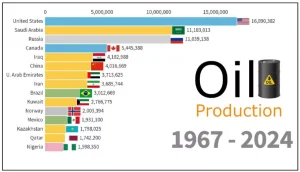
Current Crude Oil Production

Oil Economy

Top Producers

  1. United States
  2. Saudi Arabia
  3. Russia
  4. Canada
  5. Iraq

Top  Crude Oil Reserves:

  1. Venezuela
  2. Saudi Arabia
  3. Canada
  4. Iran
  5. Iraq

Current Scenario in the Global Oil Market

The global oil market is undergoing significant structural changes driven by geopolitics, technology, and energy transition.
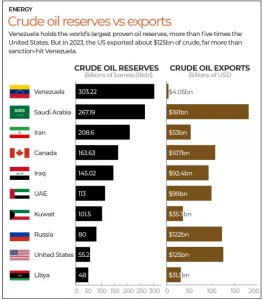
  • Geopolitical Fragmentation: Fragmentation has intensified after the Russia–Ukraine conflict.
    • Western sanctions on Russian oil disrupted traditional supply chains, forcing buyers such as India and China to seek discounted crude through alternative settlement mechanisms.
  • Changes in Oil Quality :  The oil quality is reshaping trade flows. 
    • The United States produces mainly light sweet shale oil, while many of its refineries are designed for heavy sour crude
    • This explains continued U.S. interest in Venezuelan and Canadian oil despite energy abundance.
  • Market Volatility: Supply uncertainty has increased due to conflicts in West Asia, OPEC+ production decisions, and climate-related disruptions.
    • These factors have made oil markets more politically sensitive.
  • Energy Transition: Recent focus on non-fossils energy sources is altering long-term demand expectations.
    • Rapid growth in electric vehicles, especially in China, is gradually weakening future oil demand growth while simultaneously shifting industrial and technological leadership.
  • Greater State Intervention: With governments using strategic reserves, export controls, and sanctions to influence markets, reducing the role of purely market-driven price discovery.

Oil Economy

De-dollarisation of Oil Economy 

The dominance of the petrodollar is increasingly being questioned due to multiple coordinated and uncoordinated global developments.

  • Non-dollar Oil Trade by Major Economies:  Russia has increasingly accepted payments in rubles and yuan for its oil exports following Western sanctions.
    • China has expanded yuan-denominated oil contracts, particularly with Russia and some Gulf suppliers.
  • BRICS-led Financial Initiatives: BRICS nations have discussed alternative payment systems, local currency trade, and even a potential common settlement mechanism to reduce dependence on the U.S. dollar.
  • Bilateral Currency Arrangements: India has experimented with non-dollar mechanisms for settling oil imports, including rupee-based trade frameworks and third-currency settlements, particularly for discounted Russian crude.
    • The Reserve Bank of India (RBI) established a formal framework for international trade settlement in INR in July 2022.
    • This is also a step towards Internationalisation of Indian Rupee.
  • Weaponisation of the Dollar through Sanctions: Extensive U.S. use of financial sanctions against Iran, Russia, and Venezuela has incentivised countries to build parallel payment systems such as China’s Cross-Border Interbank Payment System (CIPS).
  • Rise of Multipolar Energy Markets: The diversification of oil suppliers, growth of spot markets, and regional energy hubs are weakening the monopoly of any single currency in oil trade.

Check Out UPSC CSE Books

Visit PW Store

online store 1

Status of India in the Current Oil Economy

  • High Import Dependence: More than 85% dependence on imported crude oil exposes India to external supply disruptions and global price shocks.
  • Geopolitical Risks: Potential disruption of the Strait of Hormuz, sanctions on the Russian Federation, and tariff threats by the United States increase supply-side uncertainty.
  • Macroeconomic Vulnerability: A $10 per barrel rise in crude oil prices can raise Consumer Price Index (CPI) inflation by 25–35 basis points and reduce Gross Domestic Product (GDP) growth by 20–30 basis points.
  • Sanctions and Compliance Pressures: Restrictions on discounted Russian crude could significantly increase India’s annual crude oil import bill.
  • Inadequate Strategic Buffer: Strategic storage capacity remains below international benchmarks. Organisation for Economic Co-operation and Development (OECD) countries maintain an emergency oil cover of 90 days
    • India’s Strategic Petroleum Reserves (SPR) currently provide around 9–10 days of crude oil cover. 
    • When combined with inventories held by Oil Marketing Companies (OMCs) such as Indian Oil Corporation Limited (IOCL) total emergency coverage rises to approximately 70–75 days.
    • India aims to significantly increase its SPR capacity, with plans to reach approximately 11.83 MMT (around 22 days of demand)

Alternatives to Reduce Oil related Crisis

  • Energy Source Diversification: Increased reliance on Liquefied Natural Gas (LNG), renewable energy, and nuclear power.
    • India has significantly advanced its non-fossil fuel energy capacity, reaching over 50% of its total installed electricity capacity from non-fossil sources (hydro, nuclear, renewables) by mid-2025
  • Source Country Diversification: India’s recent crude oil sourcing shows significant diversification, moving beyond traditional West Asian reliance to incorporate more Russian, American, and African supplies.
  • Biofuel Expansion: Promotion of ethanol blending, bio-Compressed Natural Gas (bio-CNG), and biodiesel to reduce petroleum demand.
  • Electric Mobility and Green Hydrogen: Long-term transition pathways to structurally reduce oil consumption.
    • India has set a target for 5 Million Metric Tonnes (MMT) of annual capacity by 2030 under the National Green Hydrogen Mission.
  • Efficiency Improvements: Enhanced refinery efficiency and demand-side energy management.

Conclusion

The petrodollar system is gradually weakening amid geopolitical fragmentation, de-dollarisation efforts, and energy transition, with oil increasingly shaped by currency politics as much as by market fundamentals.

Enroll in SRIJAN Prelims Crash Course

Need help preparing for UPSC or State PSCs?

Connect with our experts to get free counselling & start preparing

Aiming for UPSC?

Download Our App

      
Quick Revise Now !
AVAILABLE FOR DOWNLOAD SOON
UDAAN PRELIMS WALLAH
Comprehensive coverage with a concise format
Integration of PYQ within the booklet
Designed as per recent trends of Prelims questions
हिंदी में भी उपलब्ध
Quick Revise Now !
UDAAN PRELIMS WALLAH
Comprehensive coverage with a concise format
Integration of PYQ within the booklet
Designed as per recent trends of Prelims questions
हिंदी में भी उपलब्ध

<div class="new-fform">


    </div>

    Subscribe our Newsletter
    Sign up now for our exclusive newsletter and be the first to know about our latest Initiatives, Quality Content, and much more.
    *Promise! We won't spam you.
    Yes! I want to Subscribe.