The prolonged conflict in West Asia has transformed an external oil shock into a broader macroeconomic challenge for India.
- Rising crude oil prices, a weakening rupee, widening external imbalances, and inflationary pressures have together compelled policymakers to carefully balance price stability, economic growth, and fiscal prudence.
Impact on the Indian Economy
- The External Sector “Twin Pressure”: India is currently caught in a pincer movement.
- First, the Current Account Deficit (CAD) is increasing because India is spending much more on oil imports.
- Second, there are massive Foreign Portfolio Investment (FPI) outflows ( about $33 billion since late 2024) as global investors pull money out of “risky” emerging markets.
About Current Account Deficit (CAD)
- The Current Account Deficit (CAD) occurs when a country’s total imports of goods, services, and transfers exceed its total exports. It reflects that the country is spending more foreign exchange than it is earning.
- Implications: Leads to pressure on the rupee, increases external vulnerability, and requires financing through capital inflows, managed partly by the Reserve Bank of India.
About Foreign Portfolio Investment (FPI)
- FPI refers to investment by foreign investors in financial assets such as stocks and bonds in another country, without gaining control over businesses.
- Nature: It is short-term and volatile, as investors can quickly enter or exit markets based on global conditions and returns.
- Impact: Influences stock markets, exchange rate, and capital flows; large inflows strengthen the rupee, while sudden outflows can create financial instability, monitored by the Reserve Bank of India.
|
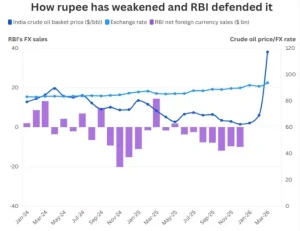
- Currency and Exchange Rate Volatility: The Rupee is acting as the primary shock absorber.
- With the rupee depreciating beyond ₹93 per US dollar, driven by a strong US dollar and a widening trade deficit, India’s currency has come under pressure.
- This depreciation has made imports such as electronics and raw materials more expensive, thereby increasing overall import costs and adding to inflationary pressures.
- Inflation Transmission and Second-Round Effects: The economy is witnessing cost-push inflation, driven by rising fuel prices.
- Higher diesel and petrol costs have increased transportation expenses, which are now feeding into the prices of food articles and essential manufactured goods.
- This may lead to persistently high inflation expectations.
- Logistics and Supply Chain Disruptions: The conflict has made critical maritime routes such as the Strait of Hormuz and the Red Sea vulnerable.
- This has resulted in higher freight charges and insurance premiums, thereby reducing the global competitiveness of Indian exports.
Enroll now for UPSC Online Course
Actions Taken by the Government & RBI
| Institution |
Measure |
Objective |
Implications |
| Reserve Bank of India (RBI) |
- Forex Intervention (selling dollars from reserves)
|
- To stabilise the rupee and curb excessive volatility
|
- Helps prevent sharp depreciation, but may reduce forex reserves over time
|
- Monetary Policy Pause (no rate cuts)
|
- To control inflation and maintain macroeconomic stability
|
- Limits growth stimulus, but avoids capital outflows and currency pressure
|
| Government |
- Fuel Price Cushioning (via OMCs)
|
- To protect consumers from rising global crude prices
|
- Reduces inflationary pressure, but impacts OMC profitability
|
- Fertiliser Subsidy Expansion
|
- To contain food inflation and support farmers
|
- Ensures agricultural stability, but increases fiscal burden (≈0.6% of GDP)
|
Actions Further Needed (Strategic Blueprint)
- Gradual Price Pass-Through: The government should allow a phased increase in domestic fuel prices in line with global crude trends.
- Artificially low prices lead to higher consumption and widen the trade deficit, while also increasing the fiscal burden.
- Strengthening Energy Security (SPR): India must accelerate the filling of its Strategic Petroleum Reserves (SPR) to full capacity.
- These reserves act as a critical buffer during supply disruptions, enhancing the country’s energy security in times of geopolitical crises.
- Diversification of Trade Routes: There is a need to fast-track alternative connectivity projects such as the International North-South Transport Corridor.
- This will help India bypass vulnerable maritime choke points like West Asia and ensure resilient supply chains.
- Energy Transition Push: The crisis should be used as an opportunity to scale up investments in Green Hydrogen and Electric Vehicles (EVs).
- Reducing the oil intensity of GDP is essential for achieving long-term economic stability, energy independence, and climate goals.
| Monetary vs Fiscal Policy (in the Context of Oil Shock) |
| Basis |
Monetary Policy |
Fiscal Policy |
| Authority |
- Reserve Bank of India (RBI)
|
|
| Tools / Instruments |
- Repo Rate, Cash Reserve Ratio (CRR), Statutory Liquidity Ratio (SLR), Open Market Operations, Liquidity Management
|
- Taxation, Public Expenditure, Subsidies, Government Borrowing
|
| Core Objective |
- Price Stability, Inflation Control, Financial Stability
|
- Economic Growth, Redistribution, Macroeconomic Stabilisation
|
| Nature |
- Manages Money Supply, Credit, Liquidity
|
- Manages Revenue, Expenditure, Public Debt
|
| Time Lag |
- Faster Transmission (via interest rates, liquidity)
|
- Slower but Wider Impact (structural and distributive)
|
| Focus Area |
- Inflation, Exchange Rate, Capital Flows, Financial Markets
|
- Growth, Welfare, Infrastructure, Demand Management
|
| Role in Oil Shock |
- Controls Imported Inflation, Stabilises Rupee, Manages Capital Outflows
|
- Absorbs Price Shock (Subsidies/Tax Cuts), Protects Vulnerable Sections, Maintains Demand
|
Conclusion
The 2026 West Asia war is a stark reminder that India’s Macro-Economic Stability is deeply linked to global energy geopolitics. While the Reserve Bank of India has managed the “currency shock” and the Government has provided “fiscal shields,” these are short-term fixes. The ultimate success of India’s economy hinges on transitioning from a crisis-management mode to a structural resilience mode, focusing on energy independence and robust domestic supply chains.


 27 Mar 2026





.png)






 Current Affairs




 GS Foundation
 Optional Course
 Combo Courses
 Degree Program