NASA’s OSIRIS-REx mission successfully returned samples from the near-Earth asteroid Bennu in 2023. Subsequent laboratory analysis revealed complex organic molecules and ancient stellar material, deepening understanding of solar system evolution and the origin of life.
About OSIRIS-REx Mission
- Origins, Spectral Interpretation, Resource Identification, and Security–Regolith Explorer (OSIRIS-REx).
- Collaboration: Analysis involves NASA and JAXA (Japan), leveraging prior expertise from the Itokawa and Ryugu missions.
- Aim: To study a near-Earth asteroid and return pristine regolith samples to Earth for detailed analysis.
- Mission Category: NASA’s third New Frontiers science mission, focusing on high-priority planetary science objectives.
- Sample Collection: Conducted through a Touch-and-Go (TAG) manoeuvre in October 2020.
- Sample Return: Capsule safely landed on Earth in September 2023 using parachutes.
About Bennu
- Nature: A carbon-rich near-Earth asteroid, ideal for studying primitive organic chemistry.
- Orbital Group: Member of the Apollo group of asteroids with Earth-crossing orbits, making it scientifically and strategically important.
- Migration and Early Formation: Content: Originally formed approximately 4.6 billion years ago in the cold regions beyond Saturn, the parent body was relocated to the inner asteroid belt by Jupiter’s orbital migration.
- Scientific Value: Considered a time capsule of the early solar system, preserving materials largely unchanged since formation.
Key Discoveries
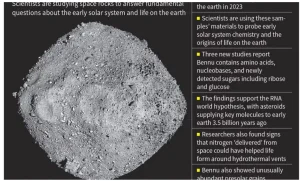
- Organic Building Blocks: Presence of amino acids and all five nucleobases required for DNA and RNA formation.
- Sugars Essential for Life: Discovery of ribose (a key component of RNA) and glucose (central to metabolism), marking the first detection of 6-carbon sugars on an asteroid.
- Optimal Formation Conditions: These 6-carbon molecules—the first of their kind found on an asteroid—formed in protected pockets of liquid brine (salty water) at extremely low temperatures, which shielded them from destructive solar radiation.
- Nitrogen-rich Polymers: Identification of carbamate polymers, providing a potential extraterrestrial source of nitrogen, crucial for life.
- Carbamates and Gummy Polymers: Specifically identified as carbamate, these nitrogen-rich materials were originally soft and “gummy” before hardening; they represent the longest polymer chains ever observed in an extraterrestrial sample.
- Presolar Grains: Exceptionally high concentration of dust from ancient stars and supernovae, predating the Sun itself.
- Supernova Concentration and Nebular Heating: The concentration of presolar grains is at least six times higher than in other studied meteorites.
- These grains show signs of “nebular heating,” having been singed by the intense energy released during the Sun’s birth.
Impact
- On Origin-of-Life Theories: Strengthens the RNA World Hypothesis by showing that RNA-related molecules formed in space and were delivered to Earth by asteroids.
- The discovery of nitrogen-rich polymers on Bennu helps resolve the “nitrogen gap” in the hydrothermal vent theory, providing the missing nitrogen source required for RNA formation.
- On Planetary Science: Reveals evidence of liquid water–driven chemical reactions on small bodies.
- Enhances understanding of asteroid evolution, collision history, and internal chemistry.
Significance
- Astrobiological Significance: Demonstrates that carbon-rich asteroids can host a complete molecular inventory required for life.
- Reinforces the possibility of life-seeding processes operating across the solar system.
- Cosmochemical and Astronomical Significance: Provides rare insight into presolar materials and supernova contributions to solar system formation.
- Helps reconstruct the chemical environment before and during the birth of the Sun.
Conclusion
The OSIRIS-REx mission establishes Bennu as a natural archive of the early solar system, offering compelling evidence that organic compounds and life-supporting chemistry originated in space and were later delivered to Earth, reshaping our understanding of planetary and biological origins.


 6 Jan 2026






.png)





 Current Affairs






 GS Foundation
 Optional Course
 Combo Courses
 Degree Program