India has marked a major milestone in its nuclear energy programme as the indigenously designed and built Prototype Fast Breeder Reactor (PFBR) at Kalpakkam in Tamil Nadu attained criticality.More on News:
- It is fully designed by BHAVINI and Indira Gandhi Centre for Atomic Research (IGCAR).
- BHAVINI (Bharatiya Nabhikiya Vidyut Nigam Limited) is a PSU under the Department of Atomic Energy responsible for building and operating fast breeder reactors in India.
UPSC Coaching Classes
India’s Nuclear Power Programme: Overview
- End-to-End Capability: India is among the few countries possessing complete nuclear fuel cycle capabilities, from fuel production to reprocessing.
- Installed Capacity: India’s total nuclear power capacity is approximately 8,180 MWe.
- Reactor Composition: The sector is dominated by Pressurised Heavy Water Reactors (PHWRs), along with a few Light Water Reactors (LWRs).
- Resource Strategy: The programme is designed to efficiently utilise limited uranium and abundant thorium reserves for long-term energy security.
|
About Prototype Fast Breeder Reactor
- The Prototype Fast Breeder Reactor (PFBR) is a 500 MWe nuclear reactor that uses fast neutrons for sustaining the nuclear chain reaction without the need for a moderator.
- Unlike Pressurised Heavy Water Reactors (PHWRs) that use heavy water to slow neutrons, PFBR directly uses fast neutrons to sustain the chain reaction, improving fuel efficiency.
 Breeder Reactor: It is designed as a breeder reactor, meaning it produces more fissile fuel (Plutonium-239) than it consumes, thereby enhancing fuel efficiency and sustainability.
-
- The reactor converts fertile isotopes into fissile fuel through neutron absorption:
- Uranium-238 → Plutonium-239 (in the core)
- Thorium-232 → Uranium-233 (in the blanket region)
- Fuel: Mixed Oxide (MOX) fuel, consisting of a uranium–plutonium blend, derived from reprocessed spent fuel of Pressurised Heavy Water Reactors (PHWRs).
- Coolant: Liquid sodium (over 1,750 tonnes) used as a coolant, ensuring high heat transfer efficiency while maintaining a fast neutron spectrum due to the absence of moderation.
- Closed Fuel Cycle: Involves reprocessing and recycling of spent nuclear fuel to recover usable fissile materials, thereby minimising radioactive waste and maximising resource efficiency.
Challenges
- High Cost: The PFBR involves high capital costs in terms of construction and requires significant expenditure on maintenance, making it economically demanding.
- Sodium Coolant Risks: The use of liquid sodium as a coolant poses risks as it is highly reactive, especially when it comes into contact with air or water, raising safety concerns.
- Safety and Design Complexity: The reactor has a complex design and operational mechanism, which increases safety challenges and demands advanced technological expertise.
- Long Gestation Period: The development and deployment of PFBRs involve a long gestation period, delaying returns on investment and large-scale implementation.
- Limited Global Experience: Only a few countries have successfully operated fast breeder reactors, limiting availability of proven models and expertise.
- Past challenges faced by countries like France and Japan in their breeder reactor programmes highlight operational difficulties.
Significance
- Strategic Importance: The PFBR advances the second stage of India’s three-stage nuclear programme, strengthening the country’s long-term nuclear roadmap.
- It brings India closer to the utilisation of its vast thorium reserves in the third stage
- Energy Security: It helps reduce dependence on imported uranium by efficiently using available nuclear fuel.
- Ensures a sustainable and closed nuclear fuel cycle for long-term energy needs.
- Aligned with Aatmanirbhar Bharat initiative: The project has been built indigenously with contributions from over 200 Indian industries, including several MSMEs, aligning with the government’s push for self-reliance under the Aatmanirbhar Bharat initiative.
- Clean Energy Transition: It supports low-carbon electricity generation, contributing to cleaner energy production.
- Aligns with India’s climate commitments and sustainable development goals.
- Technological Achievement: India becomes the second country after Russia to develop a commercial fast breeder reactor.
- It demonstrates strong indigenous capabilities in advanced nuclear reactor technology and engineering.
Click to Know UPSC Offline Courses
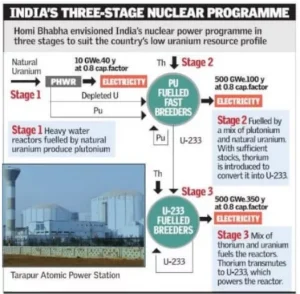
About India’s 3 Stage Nuclear Programme
- First Stage: PHWRs (Pressurised Heavy Water Reactors)
- Fuel Use: Natural uranium (U-238) is used as fuel.
Role of Fast Breeder Reactors (FBRs): Link Between Stages
- Bridge Between Stages: Fast Breeder Reactors (FBRs) act as a crucial link between the first (PHWRs) and third (thorium-based) stages of India’s nuclear power programme.
- Use of Plutonium: They utilise Plutonium-239 (Pu-239) generated from spent fuel of PHWRs as a primary input fuel.
- Breeding Capability: FBRs generate more fissile material than they consume, thereby increasing the overall fuel availability.
- Thorium Utilisation: They enable irradiation of Thorium-232, facilitating its conversion into Uranium-233 (U-233) for use in the third stage.
- Closed Fuel Cycle: FBRs are essential for achieving a closed nuclear fuel cycle, ensuring efficient recycling and optimal utilisation of nuclear resources.
|
-
- Moderator & Coolant: Heavy water (D₂O) is used as both moderator and coolant.
- Output: Produces Plutonium-239 (Pu-239) in spent fuel.
- Status: This stage is fully operational and forms the backbone of India’s nuclear power programme.
- Second Stage: Fast Breeder Reactors (FBRs)
- Key Feature: Designed to produce more fuel than they consume (breeding capability).
- Fuel Type: Uses Mixed Oxide (MOX) fuel (uranium + plutonium).
- Mechanism: Converts U-238 into Pu-239 through nuclear transmutation.
- Energy Efficiency: Enhances energy extraction from uranium by ~60 times.
- Strategic Role: Builds plutonium inventory required for the third stage.
- Third Stage: Thorium-Based Reactors
- Fuel Cycle: Converts Thorium-232 into Uranium-233 (fissile material).
- Objective: To utilise India’s vast thorium reserves available in coastal sands of states like Kerala, Tamil Nadu, Odisha, Andhra Pradesh, etc.
- Future Technology: Involves advanced systems such as Molten Salt Reactors (MSRs) (under development).
Criticality in Nuclear Reactors
- Criticality refers to the state of a nuclear reactor when the nuclear fission chain reaction is self-sustaining.
- It depends on the neutron population balance in the reactor core.
Key Concept: Multiplication Factor (k)
- Denoted as k (effective multiplication factor)
- It is the ratio of:
- Number of neutrons in one generation
to
- Number of neutrons in the previous generation
Types of Criticality
- Subcritical State (k < 1)
- Neutron population decreases over time
- Chain reaction dies out
- Used during:
- Reactor shutdown
- Safety conditions
- Critical State (k = 1)
- Neutron population remains constant
- Chain reaction is steady and self-sustaining
- This is the normal operating condition of a nuclear reactor
- Supercritical State (k > 1)
- Neutron population increases exponentially
- Power output rises rapidly
- Used during:
- Reactor startup
- If uncontrolled, it can lead to accidents
|


 7 Apr 2026




.png)






 Current Affairs




 GS Foundation
 Optional Course
 Combo Courses
 Degree Program