Recently, India achieved a critical milestone in its civil nuclear programme as the Prototype Fast Breeder Reactor (PFBR) at Kalpakkam attained criticality.
- This development marks not merely a technological success but the operational entry into the second stage of India’s long-conceived three-stage nuclear energy strategy.
UPSC Online Courses
Understanding ‘Criticality’
- Nature & Conceptual Basis: Criticality refers to the state in which a nuclear reactor achieves a self-sustaining chain reaction, wherein each fission event produces sufficient neutrons to sustain subsequent reactions in a controlled equilibrium.
- It represents the point at which the reactor’s neutron production balances neutron losses, ensuring stability in reactor physics.
- Core Characteristics: The condition of criticality is defined by a stable neutron economy, where the multiplication factor (k = 1) ensures that the reaction neither diminishes nor escalates uncontrollably.
- However, criticality is not synonymous with electricity generation or full operational capability, rather, it signifies the validation of reactor design, fuel configuration, and control systems.
- Post-criticality, reactors undergo prolonged low-power operations, safety testing, and calibration before gradual power escalation.
- Technical Significance: Criticality acts as a gateway stage in reactor commissioning, confirming that the core physics and engineering systems function as intended under controlled conditions.
- It lays the foundation for subsequent phases of operation, including power generation, safety validation, and grid integration.
- Thus, criticality represents a scientific threshold—marking the transition from design validation to operational realisation, rather than the culmination of reactor functionality.
About Prototype Fast Breeder Reactor (PFBR)
- The PFBR represents decades of indigenous research, design, and engineering. Its technology was developed by the Indira Gandhi Centre for Atomic Research (IGCAR), an R&D centre under the Department of Atomic Energy.
- Location: The PFBR is a 500 MWe sodium-cooled fast breeder reactor located at Kalpakkam, Tamil Nadu.
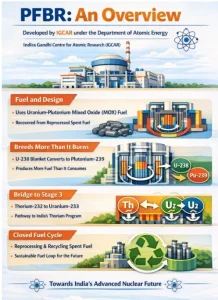 Fuel & Design Architecture: The reactor uses Mixed Oxide (MOX) fuel, comprising plutonium and uranium, enabling efficient utilisation of fissile material.
-
- It is surrounded by a fertile blanket of Uranium (U)-238, which facilitates the breeding of additional plutonium through neutron absorption.
- Technological Significance: PFBR represents India’s first large-scale breeder reactor, marking a transition from conventional thermal reactors to advanced fast reactor technology.
- It embodies the principles of closed fuel cycle and resource multiplication, which are central to long-term nuclear sustainability.
Working of Fast Breeder Reactors (FBRs)
- Nature & Operational Logic: Fast Breeder Reactors operate on the principle of fast neutron fission, unlike conventional reactors that rely on thermal (slow) neutrons.
- They eliminate the need for a moderator, thereby retaining neutron energy and enhancing breeding efficiency.
- Core Functional Mechanism: The reactor core generates high-energy neutrons, which not only sustain fission in plutonium fuel but also interact with the surrounding fertile blanket.
- Through nuclear transmutation, fertile isotopes are converted into fissile material:
- Uranium (U)-238 → Plutonium (Pu)-239
- Thorium (Th)-232 → Uranium (U)-233
- Key Outcomes: The defining feature of FBRs is the breeding ratio greater than one, enabling the production of more fuel than consumed.
- They ensure significantly higher fuel utilisation (~10%) compared to conventional reactors (~1%).
- Additionally, they enable a closed nuclear fuel cycle, reducing radioactive waste and enhancing sustainability.
- Thus, FBRs transform nuclear energy from a finite resource system into a regenerative and self-sustaining energy paradigm.
- Economic & Physical Trade-offs:
- Thermal vs. Fast Physics: Unlike Stage I reactors that require a moderator (Heavy Water) to slow neutrons, FBRs maintain a high-energy “fast” spectrum.
- This is a physical necessity; only high-energy neutrons possess the threshold energy required to efficiently transmute fertile Thorium and U-238 into fissile isotopes.
- The Sodium Choice: The use of liquid sodium as a coolant offers excellent thermal conductivity and a high boiling point (882.8 degrees Celsius), allowing the reactor to operate at high temperatures and atmospheric pressure, enhancing safety against pressure-vessel ruptures.
- However, this introduces a “Complexity Premium”—the high chemical reactivity of sodium with air and water necessitates an intermediate heat transport loop, increasing the initial capital expenditure (CAPEX) compared to thermal reactors.
UPSC Online Coaching
About India’s Three-Stage Nuclear Programme
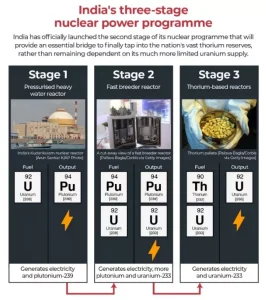
- Strategic Vision: Conceptualised by Homi Jehangir Bhabha, the programme embodies a long-term, strategic response to India’s unique resource profile—characterised by scarce uranium reserves and abundant thorium deposits.
- Principle Used: It is founded on the principle of a closed nuclear fuel cycle, wherein spent fuel is reprocessed to extract usable fissile material, thereby significantly enhancing fuel efficiency and sustainability.
- Focus On: The strategy seeks to progressively multiply fissile material, transitioning from uranium dependence to thorium self-reliance, ensuring energy security for several centuries.
- Thus, the programme represents a fusion of scientific foresight, strategic autonomy, and intergenerational energy planning.
Stage I – PHWRs- Building the Fissile Foundation
The first stage employs Pressurised Heavy Water Reactors (PHWRs) that utilise natural uranium, thereby avoiding the need for costly enrichment infrastructure.
- Heavy water (D₂O) acts as both moderator and coolant, enabling efficient neutron economy and sustained chain reactions even with low fissile content.
- During reactor operation, fertile U-238 captures neutrons to form Plutonium-239 (Pu-239), which accumulates in the spent fuel.
- Functional Outcome: Simultaneous generation of electricity and strategic plutonium reserves.
- Establishes the essential fissile base required to initiate Stage II.
- This stage is not merely power-generating but resource-creating, as it converts a limited uranium base into a gateway for advanced nuclear fuel cycles.
Stage II – FBRs- Transition to Fuel Multiplication
The second stage marks a paradigm shift from consumption to production of nuclear fuel through Fast Breeder Reactors (FBRs).
- These reactors utilise plutonium-based mixed oxide (MOX) fuel derived from reprocessed spent fuel of Stage I.
- Operating with fast neutrons (without moderation) and typically cooled by liquid sodium, FBRs achieve a high neutron flux, essential for breeding.
- Core Mechanism – Breeding Process:
- Fissile consumption: Pu-239 undergoes fission to release energy
- Fertile conversion: Surrounding blanket material (U-238 or Th-232) absorbs neutrons to form:
- More Pu-239 (from uranium)
- Uranium-233 (U-233) (from thorium)
- A defining feature is a breeding ratio greater than one, meaning net production of fissile material exceeds consumption.
- India’s Prototype Fast Breeder Reactor represents the operationalisation of this stage, marking a critical technological milestone.
- Functional Outcome: Exponential expansion of fissile inventory
- Bridging uranium and thorium fuel cycles
- Stage II serves as the “engine of fuel amplification”, transforming limited inputs into a self-reinforcing nuclear resource base, while simultaneously preparing the ground for thorium utilisation.
Stage III – Thorium-Based Reactors- Realising Long-Term Sustainability
- The third stage is designed to harness thorium (Th-232), a fertile but non-fissile material, which upon neutron absorption transforms into Uranium-233 (U-233)—a highly efficient fissile isotope.
- Advanced reactor designs, such as the Advanced Heavy Water Reactor (AHWR), are being developed to utilize U-233 as primary fuel, often in combination with thorium blankets.
- Key Technological Features:
- Sustained thorium utilisation cycle
- Improved safety characteristics due to advanced reactor design
- Reduced long-lived radioactive waste compared to conventional uranium cycles
- Functional Outcome: Establishes a self-sustaining thorium fuel cycle
- Enables large-scale, long-term nuclear power generation
- This stage represents the culmination of India’s nuclear vision, converting its geological advantage (thorium) into a strategic energy asset, thereby ensuring multi-century energy security.
| India’s Three-Stage Nuclear Programme: Comparative Features |
| Feature |
Stage I: PHWR |
Stage II: FBR |
Stage III: Thorium Cycle |
| Reactor Type |
Pressurised Heavy Water Reactor |
Fast Breeder Reactor (e.g., Prototype Fast Breeder Reactor) |
Advanced Heavy Water Reactor / Thorium-based advanced reactors |
| Primary Fuel |
Natural Uranium (U-238 with U-235 fissile content) |
MOX Fuel (Plutonium-239 + Uranium-238) derived from reprocessed spent fuel |
Thorium-232 + Uranium-233 (bred fissile material) |
| Neutron Spectrum |
Thermal neutron reactor |
Fast neutron reactor (no moderation) |
Thermal / epithermal spectrum (depending on design) |
| Moderator |
Heavy Water (D₂O) used for neutron moderation |
No moderator required (fast neutron regime) |
Light/Heavy water or advanced moderators depending on reactor design |
| Coolant |
Heavy Water (D₂O) |
Liquid Sodium (high heat transfer, no neutron moderation) |
Water / Molten Salt / Gas (advanced designs) |
| Fuel Cycle Type |
Open to partially closed cycle (limited reprocessing) |
Closed fuel cycle with reprocessing and recycling |
Fully closed thorium-based fuel cycle |
| Key Output / By-product |
Plutonium-239 (Pu-239) generated from U-238 |
Uranium-233 (U-233) bred from Thorium-232; additional plutonium breeding |
Sustained energy generation using U-233 (self-sustaining thorium cycle) |
| Core Objective |
Electricity generation + creation of plutonium inventory for next stage |
Fuel breeding and multiplication (producing more fissile material than consumed) |
Long-term energy security through thorium utilisation |
| Strategic Role |
Foundation stage utilising limited uranium resources |
Bridge stage enabling transition to thorium economy |
End stage ensuring near-inexhaustible, indigenous energy supply |
Best Online Coaching for UPSC
Integrated Fuel Cycle Logic- Sequential Interdependence
- The programme operates as a tightly integrated, sequential system, where each stage feeds into and strengthens the next:
- Stage I → Generates Pu-239
- Stage II → Multiplies Pu-239 and produces U-233
- Stage III → Utilises U-233 in a thorium-based cycle
- Outcome: Creation of a closed-loop, self-replenishing nuclear fuel ecosystem
- Progressive transition from scarce to abundant resources
- Analytical Insight: This interlinkage makes the programme a globally unique model of resource optimisation, ensuring minimal waste and maximum energy extraction.
Current Nuclear Power Landscape (2026)
As of April 2026, India has successfully integrated nuclear energy as a baseload pillar of its national grid.
- Installed Capacity: India’s current operational capacity is 8.78 GW, generated by 24 reactors. In the fiscal year 2024–25, nuclear power plants generated a record 56,681 Million Units, accounting for 3.1% of total electricity generation.
- Expansion Pipeline: A robust expansion plan is underway to nearly triple this capacity to 22.38 GW by 2031–32.
- The PFBR Milestone: The 500 MWe PFBR at Kalpakkam attained its first criticality on April 6, 2026. This sodium-cooled fast reactor uses Uranium-Plutonium Mixed Oxide (MOX) fuel and is designed to “breed” more fuel than it consumes.
- Global Standing: With the PFBR operational, India joins Russia as the only other nation to possess a commercially viable Fast Breeder Reactor technology.
India’s Initiatives and Actions regarding Nuclear Energy
- Strategic Mission and Financial Commitment:
- Nuclear Energy Mission (NEM): Launched in the 2025–26 Union Budget, this mission sets a strategic target of achieving 100 GW of nuclear capacity by 2047.
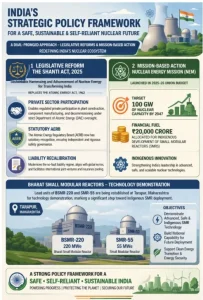 Dedicated Funding: The government has made a significant financial commitment by allocating ₹20,000 crore toward the design, development, and deployment of Small Modular Reactors (SMRs).
- SMR Operational Roadmap: India has established a clear timeline to have at least five indigenously designed SMRs operational by 2033 to strengthen the clean energy roadmap.
- Legislative and Regulatory Overhaul:
- The SHANTI Act, 2025: The Sustainable Harnessing and Advancement of Nuclear Energy for Transforming India Act was enacted to modernize the legal framework, replacing the legacy Atomic Energy Act of 1962.
- Private Sector Integration: For the first time, the law enables regulated private participation in plant construction, component manufacturing, and decommissioning under Department of Atomic Energy (DAE) oversight.
- Empowered Regulation: The Atomic Energy Regulatory Board (AERB) has been granted statutory recognition, ensuring more independent and rigorous safety governance.
- Liability Modernization: The Act recalibrated the no-fault liability regime to align with global norms, facilitating international joint ventures and insurance pooling.
- Indigenous Technological Advancements (BARC & IGCAR):
- Prototype Fast Breeder Reactor (PFBR): Developed by IGCAR, the 500 MWe PFBR at Kalpakkam attained criticality on April 6, 2026, marking India’s operational entry into Stage II of its nuclear programme.
- Next-Generation Reactor Designs: Led by the Bhabha Atomic Research Centre (BARC), India is developing a suite of advanced reactors:
- BSMR-220: A 220 MWe Bharat Small Modular Reactor.
- SMR-55: A compact 55 MWe reactor design.
- High-Temperature Gas-Cooled Reactor (HTGR): A reactor of up to 5 MWth designed specifically for hydrogen generation and high-temperature industrial applications.
- Scaling and Diversification Actions:
- Fleet Mode Construction: India is accelerating the deployment of its indigenous 700 MW PHWRs using “fleet mode” to standardize construction, reduce timelines, and achieve economies of scale.
- Closing the Fuel Cycle: Actions are being taken to expand reprocessing capabilities and fast reactor deployment, ensuring a transition from a uranium-constrained system to a thorium-based economy.
- Cross-Sectoral Synergy: Initiatives are underway to leverage nuclear expertise for “Dual-Use” applications, such as Radioisotope Thermoelectric Generators (RTGs) for deep-space missions and power modules for maritime strategic platforms.
Significance of the PFBR and Stage II of India’s Nuclear Programme
- Strategic Transition to Thorium Economy: The PFBR represents a decisive shift in India’s nuclear trajectory, enabling the transition from a uranium-constrained first stage to a thorium-based long-term energy framework under India’s Three-Stage Nuclear Programme.
- By unlocking access to India’s vast thorium reserves, it ensures long-term energy security, resource sustainability, and strategic autonomy.
- Fuel Multiplication and Efficiency Gains: The PFBR fundamentally alters the resource efficiency paradigm of nuclear energy.
- While conventional Pressurised Heavy Water Reactors utilise only about 1% of natural uranium, fast breeder reactors, through a fast neutron spectrum and closed fuel cycle, enhance utilisation to over 60–70%.
- By converting fertile Uranium-238 into fissile Plutonium-239, PFBRs ensure net fuel generation, transforming nuclear energy into a self-sustaining system.
- Gateway to Thorium Fuel Cycle: PFBR serves as the critical technological link to Stage III, where thorium becomes the primary fuel.
- Through the irradiation of Thorium-232 in the reactor blanket, it produces Uranium-233, thereby operationalising the thorium fuel cycle.
- This enables India to leverage its global leadership in thorium reserves, ensuring a long-term, indigenous and sustainable energy pathway.
- Closed Fuel Cycle and Waste Reduction: Fast breeder technology facilitates a closed nuclear fuel cycle, wherein spent fuel is reprocessed and reused.
- Additionally, PFBRs can consume long-lived actinides, significantly reducing the volume, toxicity, and longevity of nuclear waste.
- This advances a circular nuclear economy and reduces the burden on long-term waste disposal systems.
- Strategic Autonomy and Safeguard Flexibility: The PFBR remains a cornerstone of India’s “Strategic Autonomy.” Unlike imported Light Water Reactors (LWRs) which operate under permanent international safeguards, the indigenous PFBR allows India to manage its fissile inventory according to national priorities.
- It ensures that the plutonium “wealth” generated in Stage I is shielded from external supply-chain shocks, providing a sovereign bridge to the Thorium-led Stage III.
- Strategic and Climate Relevance: The successful deployment of PFBR positions India among advanced nuclear technology nations such as Russia and France, strengthening its technological sovereignty and global standing.
- Simultaneously, it contributes to reliable low-carbon baseload power, supporting India’s commitments under the Paris Agreement and complementing intermittent renewable energy sources.
Click to Know UPSC OnlyIAS Coaching Centres
Challenges to Nuclear Expansion
- Technological Complexity and Safety Risks: Fast breeder reactors involve high-end engineering complexity, particularly due to the use of liquid sodium coolant, which is highly reactive with air and water.
- This necessitates stringent safety systems, leak-proof designs, and advanced monitoring mechanisms, alongside the use of materials capable of withstanding intense neutron radiation.
- High Capital Costs and Long Gestation: Nuclear energy projects are characterised by high upfront investments and long construction timelines (8–15 years).
- Despite efforts such as fleet mode construction, nuclear power must compete with rapidly declining costs of renewable energy, raising concerns regarding its Levelized Cost of Energy (LCOE) and overall economic viability.
- Public Perception and Social Acceptance: Concerns related to radiation risks, nuclear accidents, and land acquisition continue to influence public acceptance.
- Global events such as the Fukushima Disaster have intensified risk perception, necessitating greater transparency, stakeholder engagement, and trust-building measures.
- Supply Chain and Fuel Constraints: Scaling nuclear capacity requires a robust domestic industrial ecosystem capable of producing nuclear-grade materials, heavy components, and advanced control systems.
- Dependence on fuels like High-Assay Low-Enriched Uranium (HALEU) introduces strategic vulnerabilities, highlighting the need for indigenisation across the nuclear value chain.
- The “Baseload” Integration Challenge: As India’s grid becomes increasingly dominated by intermittent Renewable Energy (RE), the role of nuclear energy must evolve.
- While PFBRs provide essential steady-state baseload power, their high capital cost requires them to operate at high Capacity Utilization Factors (CUFs) to remain economically viable.
- Balancing the “must-run” status of nuclear with the variability of solar and wind requires advanced grid-management and energy-storage solutions to avoid curtailment.
PWOnlyIAS Extra Edge:
About Pink Hydrogen
- Pink Hydrogen refers to hydrogen produced via electrolysis using nuclear-generated electricity and heat. Unlike green hydrogen (renewables-based) and grey hydrogen (fossil fuel-based), it offers a reliable, round-the-clock, carbon-free supply independent of weather variability.
- Technological Enabler: The High Temperature Gas Cooled Reactor developed by Bhabha Atomic Research Centre is central to this transition.
- High operating temperatures (~900–950°C) significantly enhance thermal efficiency
- Enables thermochemical water-splitting, which is more efficient than conventional electrolysis for large-scale hydrogen production
- Decarbonising Hard-to-Abate Sectors: Pink Hydrogen extends nuclear energy beyond electricity into industrial decarbonisation by providing a clean, high-energy feedstock for:
- Steel and cement (replacing coal/coke)
- Fertilisers (green ammonia production)
- Chemicals (low-carbon industrial inputs)
- Strategic Role in Net Zero: By integrating Pink Hydrogen with the National Hydrogen Mission, India adopts a dual-track decarbonisation strategy—renewables for distributed use and nuclear for stable, high-intensity industrial demand.
- This synergy is critical for achieving Net Zero 2070 and the Viksit Bharat 2047 vision.
|
Click to Know UPSC Offline Courses
Way Forward
- Fleet Mode for Scale and Efficiency: Accelerating the fleet mode deployment of 700 MW PHWRs can reduce construction timelines and costs through standardisation and economies of scale, enabling faster and more predictable capacity addition.
- SMRs for Diversification and Decarbonisation: The adoption of Small Modular Reactors (SMRs) can expand nuclear energy applications to hard-to-abate sectors such as steel and cement, while also supporting decentralised power generation.
- Advanced systems like the High Temperature Gas Cooled Reactor can facilitate pink hydrogen production and high-temperature industrial processes.
- Regulatory Strengthening and Reform: The Atomic Energy Regulatory Board must evolve into a modern, independent, and adaptive regulator, capable of supporting next-generation technologies and private participation while maintaining a strict “safety first” approach.
- Fuel Cycle Self-Reliance: Expanding reprocessing capabilities and fast reactor deployment is essential to achieving a closed fuel cycle, thereby ensuring long-term sustainability and reduced external dependence.
- Public Trust and Stakeholder Engagement: Building social legitimacy requires institutionalising transparent communication, community participation, and equitable benefit-sharing, ensuring that nuclear expansion is both technologically viable and socially acceptable.
- Cross-Sectoral Synergy (Nuclear-Space-Defense): The expertise in plutonium handling and compact fast-reactor physics cultivated through the PFBR should be leveraged for “Dual-Use” applications.
- This includes the development of Radioisotope Thermoelectric Generators (RTGs) for deep-space missions and the potential for high-density power modules for maritime strategic platforms, ensuring a unified national technological ecosystem.
Conclusion
The Prototype Fast Breeder Reactor at Kalpakkam attained criticality, marking a key milestone in India’s Three-Stage Nuclear Programme. This signals India’s transition to Stage II (fast breeder technology), strengthening its closed fuel cycle, energy security, and long-term thorium-based nuclear strategy.


 9 Apr 2026




.png)






 Current Affairs




 GS Foundation
 Optional Course
 Combo Courses
 Degree Program