A cold winter storm struck 17 US states in January, 2026, affecting millions of people due to the Polar Vortex expanding southward, bringing extreme cold and heavy snowfall.
About Polar Vortex
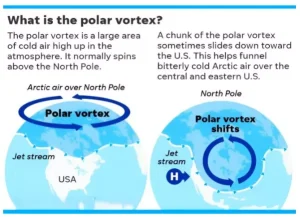
- Definition: The Polar Vortex is a large-scale low-pressure and cold air system that circulates counterclockwise around the North and South Poles.
- Vortex: The term “vortex” describes its rotating nature, similar to a whirlpool in the atmosphere.
- Key Characteristics: It extends from the troposphere (lower atmosphere) up to the stratosphere (about 50 km above the surface).
-
- The vortex strengthens in winter due to the absence of sunlight at the poles, leading to rapid cooling.
- Location: Primarily over the Arctic (Northern Polar Vortex) and Antarctic (Southern Polar Vortex).
Formation and Mechanism of Polar Vortex
- Cold Polar Regions: The poles receive almost no sunlight for months (polar night), so temperatures drop sharply compared to the temperate and tropical regions (which stays warm).
- Big Temperature Difference: Between the freezing cold poles and warmer mid-latitudes/equator.
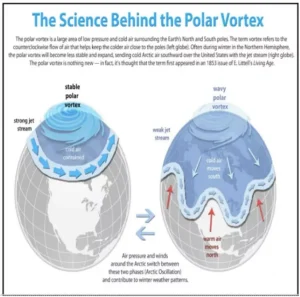
- Role of Jet Streams: Air wants to balance the temperature contrast causing fast west-to-east winds (jet stream) forming in the upper atmosphere (stratosphere) around the pole.
- Vortex: The fast-moving winds circle the pole like a whirlpool or vortex. This spinning ring traps the extremely cold air inside it.
- Strongest in Winter: Polar Vortex forms/strengthens in autumn-winter when the temperature gap is biggest. It weakens or almost disappears in summer when poles get sunlight again.
Types of Polar Vortex
There are two main types based on altitude
- Stratospheric Polar Vortex: Located in the stratosphere, this is the primary vortex.
- It is more stable in the Southern Hemisphere due to fewer landmasses disrupting airflow.
- Tropospheric Polar Vortex: An extension into the lower atmosphere.
- It is less defined but can cause surface-level cold outbreaks when the stratospheric vortex weakens.
Disruption and Sudden Stratospheric Warming (SSW)
- SSW: A rapid warming of the stratosphere (up to 50°C in days) caused by planetary waves from the troposphere. This weakens or splits the vortex.
- Consequences: When disrupted, the jet stream becomes wavy (meandering), allowing cold polar air to spill into mid-latitudes while warmer air moves northward.
- Frequency: SSW events occur about every other winter in the Northern Hemisphere, but are rarer in the South.
Impacts on Weather and Climate
- Extreme Cold Waves: Known as “polar vortex outbreaks,” these bring sub-zero temperatures, heavy snowfall, and blizzards to regions like Canada, the US and Europe.
- Broader Effects: Can lead to altered precipitation patterns, droughts in some areas, and even influence monsoon systems indirectly.
- Economic and Human Impact: Disruptions cause energy demand spikes, transportation halts, and health risks from hypothermia. For instance, they exacerbate winter mortality rates.
Polar Vortex and Climate Change
- Arctic Amplification: The Arctic warms faster than the global average, reducing the temperature gradient and potentially weakening the vortex, leading to more frequent disruptions.
- Some studies suggest increased SSW events due to global warming, causing more extreme winter weather paradoxes (cold snaps amid overall warming).
- Implications for India: Though India is not directly affected, indirect effects on global circulation could influence the Indian monsoon or Himalayan weather.


 28 Jan 2026






.png)






 Current Affairs




 GS Foundation
 Optional Course
 Combo Courses
 Degree Program